Fractals Everywhere (eBook)
548 Seiten
Elsevier Science (Verlag)
978-1-4832-5769-3 (ISBN)
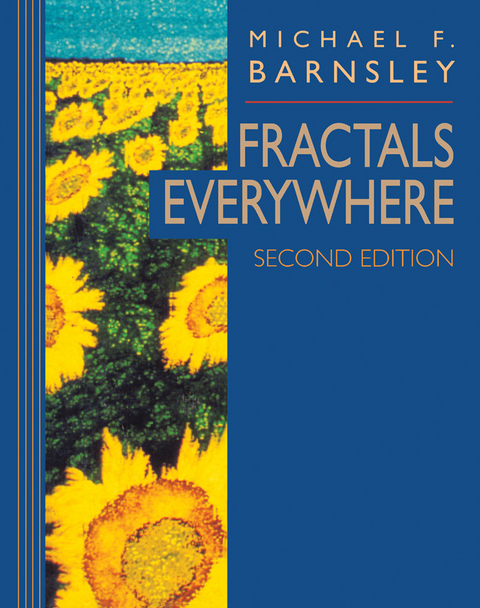
Fractals Everywhere, Second Edition covers the fundamental approach to fractal geometry through iterated function systems. This 10-chapter text is based on a course called "e;Fractal Geometry"e;, which has been taught in the School of Mathematics at the Georgia Institute of Technology. After a brief introduction to the subject, this book goes on dealing with the concepts and principles of spaces, contraction mappings, fractal construction, and the chaotic dynamics on fractals. Other chapters discuss fractal dimension and interpolation, the Julia sets, parameter spaces, and the Mandelbrot sets. The remaining chapters examine the measures on fractals and the practical application of recurrent iterated function systems. This book will prove useful to both undergraduate and graduate students from many disciplines, including mathematics, biology, chemistry, physics, psychology, mechanical, electrical, and aerospace engineering, computer science, and geophysical science.
Front Cover 1
Fractals Everywhere 4
Copyright Page 5
Table of Contents 8
Dedication 6
Foreword to the Second Edition 12
Acknowledgments 14
Chapter I. Introduction 16
Chapter II. Metric Spaces Equivalent Spaces
1 Spaces 20
2 Metric Spaces 25
3 Cauchy Sequences, Limit Points, Closed Sets, Perfect Sets, and Complete Metric Spaces 30
4 Compact Sets, Bounded Sets, Open Sets, and Boundaries 34
5 Connected Sets, Disconnected Sets, and Pathwise-Connected Sets 39
6 The Metric Space (H(X),h): The Space Where Fractals Live 42
7 The Completeness of the Space of Fractals 48
8 Additional Theorems about Metric Spaces 55
Chapter III. Transformations on Metric Spaces Contraction Mappings
1 Transformations on the Real Line 57
2 Affine Transformations in the Euclidean Plane 64
3 Möbius Transformations on the Riemann Sphere 73
4 Analytic Transformations 76
5 How to Change Coordinates 83
6 The Contraction Mapping Theorem 89
7 Contraction Mappings on the Space of Fractals 94
8 Two Algorithms for Computing Fractals from Iterated Function Systems 99
9 Condensation Sets 106
10 How to Make Fractal Models with the Help of the Collage Theorem 109
11 Blowing in the Wind: The Continuous Dependence of Fractals on Parameters 116
Chapter IV. Chaotic Dynamicson Fractals 138
1 The Addresses of Points on Fractals 138
2 Continuous Transformations from Code Space to Fractals 145
3 Introduction to Dynamical Systems 153
4 Dynamics on Fractals: Or How to Compute Orbits by Looking at Pictures 163
5 Equivalent Dynamical Systems 168
6 The Shadow of Deterministic Dynamics 172
7 The Meaningfulness of Inaccurately Computed Orbits Is Established by Means of a Shadowing Theorem 181
8 Chaotic Dynamics on Fractals 187
Chapter V. Fractal Dimension 194
1 Fractal Dimension 194
2 The Theoretical Determination of the Fractal Dimension 203
3 The Experimental Determination of the Fractal Dimension 211
4 The Hausdorff-Besicovitch Fractal Dimension 218
Chapter VI. Fractal Interpolation 228
1 Introduction: Applications for Fractal Functions 228
2 Fractal Interpolation Functions 231
3 The Fractal Dimension of Fractal Interpolation Functions 246
4 Hidden Variable Fractal Interpolation 252
5 Space-Filling Curves 261
Chapter VII. Julia Sets 269
1 The Escape Time Algorithm for Computing Pictures of IFS Attractors and Julia Sets 269
2 Iterated Function Systems Whose Attractors Are Julia Sets 289
3 The Application of Julia Set Theory to Newton's Method 299
4 A Rich Source for Fractals: Invariant Sets of Continuous Open Mappings 310
Chapter VIII. Parameter Spaces and Mandelbrot Sets 317
1 The Idea of a Parameter Space: A Map of Fractals 317
2 Mandelbrot Sets for Pairs of Transformations 322
3 The Mandelbrot Set for Julia Sets 332
4 How to Make Maps of Families of Fractals Using Escape Times 340
Chapter IX. Measures on Fractals 353
1 Introduction to Invariant Measures on Fractals 353
2 Fields and Sigma-Fields 360
3 Measures 372
4 Integration 375
5 The Compact Metric Space (P(X), d) 380
6 A Contraction Mapping on P(X) 381
7 Elton's Theorem 395
8 Application to Computer Graphics 401
Chapter X. Recurrent Iterated Function Systems 410
1 Fractal Systems 410
2 Recurrent Iterated Function Systems 414
3 Collage Theorem for Recurrent IFS 423
4 Fractal Systems with Vectors of Measures as Their Attractors 434
5 References 440
References 443
Selected Answers 447
Index 554
Credits for Figures and Color Plates 564
| Erscheint lt. Verlag | 10.5.2014 |
|---|---|
| Sprache | englisch |
| Themenwelt | Mathematik / Informatik ► Mathematik ► Geometrie / Topologie |
| Technik | |
| ISBN-10 | 1-4832-5769-X / 148325769X |
| ISBN-13 | 978-1-4832-5769-3 / 9781483257693 |
| Informationen gemäß Produktsicherheitsverordnung (GPSR) | |
| Haben Sie eine Frage zum Produkt? |
 PDF (Adobe DRM)
Kopierschutz: Adobe-DRM
Adobe-DRM ist ein Kopierschutz, der das eBook vor Mißbrauch schützen soll. Dabei wird das eBook bereits beim Download auf Ihre persönliche Adobe-ID autorisiert. Lesen können Sie das eBook dann nur auf den Geräten, welche ebenfalls auf Ihre Adobe-ID registriert sind.
Details zum Adobe-DRM
Dateiformat: PDF (Portable Document Format)
Mit einem festen Seitenlayout eignet sich die PDF besonders für Fachbücher mit Spalten, Tabellen und Abbildungen. Eine PDF kann auf fast allen Geräten angezeigt werden, ist aber für kleine Displays (Smartphone, eReader) nur eingeschränkt geeignet.
Systemvoraussetzungen:
PC/Mac: Mit einem PC oder Mac können Sie dieses eBook lesen. Sie benötigen eine
eReader: Dieses eBook kann mit (fast) allen eBook-Readern gelesen werden. Mit dem amazon-Kindle ist es aber nicht kompatibel.
Smartphone/Tablet: Egal ob Apple oder Android, dieses eBook können Sie lesen. Sie benötigen eine
Geräteliste und zusätzliche Hinweise
Buying eBooks from abroad
For tax law reasons we can sell eBooks just within Germany and Switzerland. Regrettably we cannot fulfill eBook-orders from other countries.
aus dem Bereich