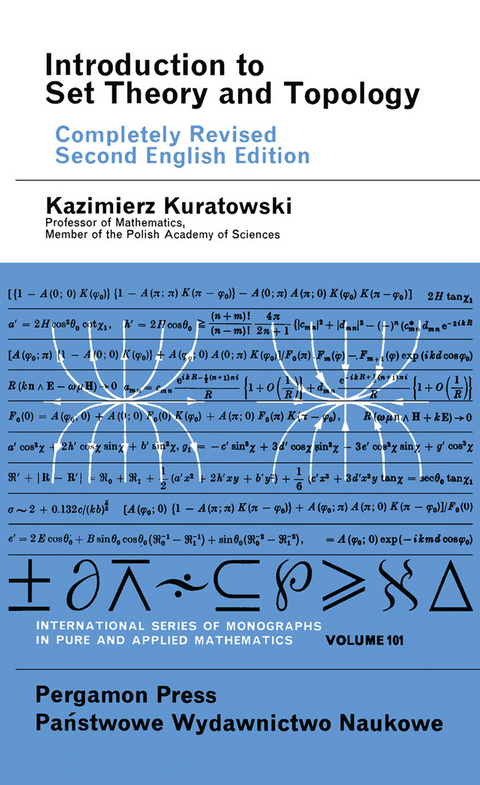
Introduction to Set Theory and Topology (eBook)
352 Seiten
Elsevier Science (Verlag)
978-1-4831-5163-2 (ISBN)
Introduction to Set Theory and Topology describes the fundamental concepts of set theory and topology as well as its applicability to analysis, geometry, and other branches of mathematics, including algebra and probability theory. Concepts such as inverse limit, lattice, ideal, filter, commutative diagram, quotient-spaces, completely regular spaces, quasicomponents, and cartesian products of topological spaces are considered. This volume consists of 21 chapters organized into two sections and begins with an introduction to set theory, with emphasis on the propositional calculus and its application to propositions each having one of two logical values, 0 and 1. Operations on sets which are analogous to arithmetic operations are also discussed. The chapters that follow focus on the mapping concept, the power of a set, operations on cardinal numbers, order relations, and well ordering. The section on topology explores metric and topological spaces, continuous mappings, cartesian products, and other spaces such as spaces with a countable base, complete spaces, compact spaces, and connected spaces. The concept of dimension, simplexes and their properties, and cuttings of the plane are also analyzed. This book is intended for students and teachers of mathematics.
Front Cover 1
Introduction to Set Theory and Topology 4
Copyright Page 5
Table of Contents 6
FOREWORD TO THE FIRST ENGLISH EDITION 12
FOREWORD TO THE SECOND ENGLISH EDITION 14
Part I: SET THEORY 16
INTRODUCTION TO PART I 18
CHAPTER I. PROPOSITIONAL CALCULUS 24
1. The disjunction and conjunction of propositions 24
2. Negation 25
3. Implication 26
Exercises 27
CHAPTER II. ALGEBRA OF SETS. FINITE OPERATIONS 28
1. Operations on sets 28
2. Inter-relationship with the propositional calculus 29
3. Inclusion 31
4. Space. Complement of a set 33
5. The axiomatics of the algebra of sets 34
6. Boolean algebra.+ Lattices 35
7. Ideals and filters 37
Exercises 37
CHAPTER III. PROPOSITIONAL FUNCTIONS.CARTESIAN PRODUCTS 40
1. The operation 40
2. Quantifiers 41
3. Ordered pairs 43
4. Cartesian product 43
5. Propositional functions of two variables. Relations 44
6. Cartesian products of n sets. Propositional functions of n variables 47
7. On the axiomatics of set theory 48
Exercises 50
CHAPTER IV. THE MAPPING CONCEPT. INFINITE OPERATIONS. FAMILIES OF SETS 51
1. The mapping concept 51
2. Set-valued mappings 53
3. The mapping 54
4. Images and inverse images determined by a mapping 55
5· The operations U R and n R. Covers 56
6. Additive and multiplicative families of sets 57
7. Borel families of sets 59
8. Generalized cartesian products 60
Exercises 61
CHAPTER V. THE CONCEPT OF THE POWER OF A SET. COUNTABLESETS 66
1. One-to-one mappings 66
2. Power of a set 68
3. Countable sets 69
Exercises 72
CHAPTER VI. OPERATIONS ON CARDINAL NUMBERS. THE NUMBERS a AND c 74
1. Addition and multiplication 74
2. Exponentiation 76
3. Inequalities for cardinal numbers 80
4. Properties of the number c 82
Exercises 85
CHAPTER VII. ORDER RELATIONS 86
1. Definitions 86
2. Similarity. Order types 86
3. Dense ordering 88
4. Continuous ordering 88
Exercises 91
CHAPTER VIII. WELL ORDERING 92
1. Well ordering 92
2. Theorem on transfinite induction 93
3. Theorems on the comparison of ordinal numbers 93
4. Sets of ordinal numbers 96
5. The number O 96
6. The arithmetic of ordinal numbers 98
7. The well-ordering theorem 101
8. Definitions by transfinite induction 103
Exercises 106
Part II: TOPOLOGY 108
INTRODUCTION TO PART II 110
CHAPTER IX. METRIC SPACES. EUCLIDEAN SPACES 116
1. Metric spaces 116
2. Diameter of a set. Bounded spaces. Bounded mappings 117
3. The Hubert cube 118
4. Convergence of a sequence of points 118
5. Properties of the limit 119
6. Limit in the cartesian product 120
7. Uniform convergence 122
Exercises 123
CHAPTER X. TOPOLOGICAL SPACES 124
1. Definition. Closure axioms 124
2. Relations to metric spaces 124
3. Further algebraic properties of the closure operation 126
4. Closed sets. Open sets 127
5. Operations on closed sets and open sets 128
6. Interior points. Neighbourhoods 130
7. The concept of open set as the primitive term of the notion of topological space 131
8. Base and subbase 132
9. Relativization. Subspaces 133
10. Comparison of topologies 133
11. Cover of a space 134
Exercises 135
CHAPTER XI. BASIC TOPOLOGICAL CONCEPTS 138
1. Borel sets 138
2. Dense sets and boundary sets 139
3. f1-spaces. f2-spaces 140
4. Regular spaces, normal spaces 140
5. Accumulation points. Isolated points 142
6. The derived set 142
7. Sets dense in themselves 143
Exercises 144
CHAPTER XII. CONTINUOUS MAPPINGS 146
1. Continuity 146
2. Homeomorphisms 148
3. Case of metric spaces 150
4. Distance of a point from a set. Normality of metric spaces 155
5. Extension of continuous functions. Tietze theorem 157
6. Completely regular spaces 163
Exercises 164
CHAPTER XIII. CARTESIAN PRODUCTS 166
1. Cartesian product X x Y o f topological spaces 166
2. Projections and continuous mappings 167
3. Invariants of cartesian multiplication 168
4. Diagonal 169
5. Generalized cartesian products 170
6. XT considered as a topological space. The cube JT 171
7. Cartesian products of metric spaces 173
Exercises 174
CHAPTER XIV. SPACES WITH A COUNTABLE BASE 177
1. General properties 177
2. Separable spaces 178
3. Theorems on cardinality in spaces with countable bases 179
4. Imbedding in the Hilbert cube 180
5. Condensation points. The Cantor-Bendixson theorem 182
Exercises 184
CHAPTER XV. COMPLETE SPACES 186
1. Complete spaces 186
2. Cantor theorem 187
3. Baire theorem 187
4. Extension of a metric space to a complete space 189
Exercises 190
CHAPTER XVI. COMPACT SPACES 191
1. Definition 191
2. Fundamental properties of compact spaces 191
3. Cartesian products 193
4. Compactification of completely regular spaces 196
5. Compact metric spaces 198
6· The topology of uniform convergence of Yx 208
7. The compact-open topology of yx 209
8. The Cantor discontinuum 211
9. Continuous mappings of the Cantor discontinuum 214
Exercises 217
XVI. COMPACT SPACES 220
CHAPTER XVII. CONNECTED SPACES 224
1. Definition. Separated sets 224
2. Properties of connected spaces 226
3. Components 230
4. Cartesian products of connected spaces 232
5. Continua 233
6. Properties of continua 234
Exercises 238
CHAPTER XVIII. LOCALLY CONNECTED SPACES 241
1. Definitions and examples 241
2. Properties of locally connected spaces 241
3. Locally connected continua 244
4. Arcs. Arcwise connectedness 246
5. Continuous images of intervals 247
Exercises 253
CHAPTER XIX. THE CONCEPT OF DIMENSION 255
1. O-dimensional spaces 255
2. Properties of 0-dimensional metric separable spaces 255
3. n-dimensional spaces 256
4. Properties of n-dimensional metric separable spaces 258
Exercises 259
CHAPTER XX. SIMPLEXES AND THEIR PROPERTIES 260
1. Simplexes 260
2. Simplicial subdivision 262
3. Dimension of a simplex 266
4. The fixed point theorem 268
Exercises 271
CHAPTER XXI. CUTTINGS OF THE PLANE 274
1. Auxiliary properties of polygonal arcs 274
2. Cuttings 275
3. Complex functions which vanish nowhere. Existence of the logarithm 276
4. Auxiliary theorems 277
5. Corollaries to the auxiliary theorems 281
6. Theorems on the cuttings of the plane 283
7. Janiszewski theorems 285
8. Jordan theorem 286
Exercises 290
SUPPLEMENT: ELEMENTS OF ALGEBRAIC TOPOLOGY 292
Introduction 292
1. Complexes. Polyhedra. Simplicial approximation 293
2. Abelian groups 299
3. Categories and functors 304
4. Homology groups of simplicial complexes 307
5. Chain complexes 317
6. Homology groups of polyhedra 323
7. Homology groups with coefficients 330
8. Cohomology groups 334
Exercises 339
LIST OF IMPORTANT SYMBOLS 344
INDEX 346
OTHER TITLES IN THE SERIES IN PURE AND APPLIED MATHEMATICS 351
| Erscheint lt. Verlag | 10.7.2014 |
|---|---|
| Sprache | englisch |
| Themenwelt | Mathematik / Informatik ► Mathematik ► Geometrie / Topologie |
| Technik | |
| ISBN-10 | 1-4831-5163-8 / 1483151638 |
| ISBN-13 | 978-1-4831-5163-2 / 9781483151632 |
| Informationen gemäß Produktsicherheitsverordnung (GPSR) | |
| Haben Sie eine Frage zum Produkt? |
 PDF (Adobe DRM)
Kopierschutz: Adobe-DRM
Adobe-DRM ist ein Kopierschutz, der das eBook vor Mißbrauch schützen soll. Dabei wird das eBook bereits beim Download auf Ihre persönliche Adobe-ID autorisiert. Lesen können Sie das eBook dann nur auf den Geräten, welche ebenfalls auf Ihre Adobe-ID registriert sind.
Details zum Adobe-DRM
Dateiformat: PDF (Portable Document Format)
Mit einem festen Seitenlayout eignet sich die PDF besonders für Fachbücher mit Spalten, Tabellen und Abbildungen. Eine PDF kann auf fast allen Geräten angezeigt werden, ist aber für kleine Displays (Smartphone, eReader) nur eingeschränkt geeignet.
Systemvoraussetzungen:
PC/Mac: Mit einem PC oder Mac können Sie dieses eBook lesen. Sie benötigen eine
eReader: Dieses eBook kann mit (fast) allen eBook-Readern gelesen werden. Mit dem amazon-Kindle ist es aber nicht kompatibel.
Smartphone/Tablet: Egal ob Apple oder Android, dieses eBook können Sie lesen. Sie benötigen eine
Geräteliste und zusätzliche Hinweise
Buying eBooks from abroad
For tax law reasons we can sell eBooks just within Germany and Switzerland. Regrettably we cannot fulfill eBook-orders from other countries.
aus dem Bereich