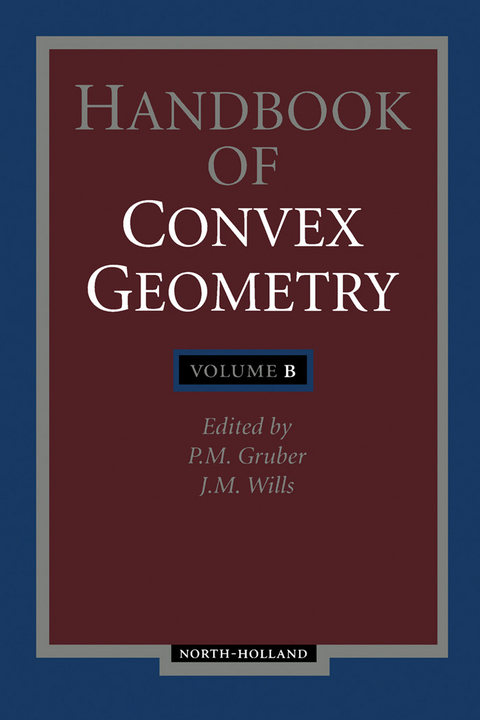
Handbook of Convex Geometry (eBook)
765 Seiten
Elsevier Science (Verlag)
978-0-08-093440-2 (ISBN)
Handbook of Convex Geometry, Volume B offers a survey of convex geometry and its many ramifications and connections with other fields of mathematics, including convexity, lattices, crystallography, and convex functions. The selection first offers information on the geometry of numbers, lattice points, and packing and covering with convex sets. Discussions focus on packing in non-Euclidean spaces, problems in the Euclidean plane, general convex bodies, computational complexity of lattice point problem, centrally symmetric convex bodies, reduction theory, and lattices and the space of lattices. The text then examines finite packing and covering and tilings, including plane tilings, monohedral tilings, bin packing, and sausage problems. The manuscript takes a look at valuations and dissections, geometric crystallography, convexity and differential geometry, and convex functions. Topics include differentiability, inequalities, uniqueness theorems for convex hypersurfaces, mixed discriminants and mixed volumes, differential geometric characterization of convexity, reduction of quadratic forms, and finite groups of symmetry operations. The selection is a dependable source of data for mathematicians and researchers interested in convex geometry.
Front Cover 1
Handbook of Convex Geometry 4
Copyright Page 5
Table of Contents 8
Preface 6
List of Contributors 12
Part 3:
14
CHAPTER 3.1.
16
1. Introduction 18
2. Lattices and the space of lattices 18
3. The fundamental theorems 21
4. The Minkowski–Hlawka theorem 25
5. Successive minima 27
6. Reduction theory 28
7. Selected special problems and results 31
Acknowledgements 34
References 34
CHAPTER 3.2.
42
1. Preliminaries 44
2. Centrally symmetric convex bodies 46
3. General convex bodies 48
4. Lattice polytopes 55
5. Lattice polyhedra in combinatorial optimization 59
6. Computational complexity of lattice point problems 63
Acknowledgment 67
References 67
CHAPTER 3.3.
76
Overview 78
1. Introduction 78
2. Density bounds in d-dimensional Euclidean space 80
3. Packing in non-Euclidean spaces 101
4. Problems in the Euclidean plane 111
5. Additional topics 120
References 127
CHAPTER 3.4.
138
1. Preliminaries 140
2. Sausage problems 142
3. Bin packing 156
4. Miscellaneous packing and covering problems 162
Acknowledgment 168
References 168
CHAPTER 3.5.
176
1· Introduction 178
2. Basic notions 179
3. Plane tilings 183
4. Monohedral tilings 192
5. Non-periodic tilings 198
References 203
CHAPTER 3.6.
210
Introduction 212
1. The basic theory 212
2. The classical examples 216
3. The polytope algebra 221
4. Srniple valuations and dissections 232
5. Characterization theorems 245
References 257
CHAPTER 3.7.
266
Introduction 268
1. Regular systems of points 268
2. Dirichlet domains 273
3. Translation lattices 279
4. Reduction of quadratic forms 286
5. Finite groups of symmetry operations 292
6. Infinite groups of symmetry operations 300
7. Non-regular systems of points 308
References 310
Part 4:
320
CHAPTER 4.1.
322
Introduction 324
1.
325
2. Elementary symmetric functions of principal curvatures respectively principal radii of curvature at Euler points 330
3. Mixed discriminants and mixed volumes 336
4. Differential geometric proof of the Aleksandrov–Fenchel–Jessen inequalities 342
5. Uniqueness theorems for convex hypersurfaces 347
6. Convexity and relative geometry 352
7. Convexity and affine differential geometry 354
References 355
CHAPTER 4.2.
358
1. Basic notions 361
2. Differentiability 367
3. Inequalities 377
References 380
CHAPTER 4.3.
382
Introduction 384
1. Extremum problems for functions 385
2. The basic problem of the calculus of variations 386
3. Multiple integrals in the calculus of variations 399
References 406
CHAPTER 4.4.
408
1. Introduction 410
2. Historical and bibliographical comments 410
3. Rearrangements 411
4. Capacity 414
5. Torsional rigidity 416
6. Clamped membranes 418
7. Clamped plates 420
References 422
CHAPTER 4.5. The Local Theory of Normed Spaces and its Applications to Convexity 426
1. Introduction 428
2. Basic concepts 429
3· lnp Subspaces of Banach spaces 442
4. Ellipsoids in local theory 452
5. Distances and projections 462
6. Applications to classical convexity theory in Rn 477
References 488
CHAPTER 4.6. Nonexpansive Maps and Fixed Points 498
1. Introduction 500
2. Some examples 501
3. Some results (and some history) 502
4. Some generalizations 505
5. A few miscellaneous results 508
6. Some other general facts 509
Acknowledgement 510
References 511
CHAPTER 4.7.
514
1. Motivation 516
2. History 520
3. Hilbert space 521
4· Polytopes 525
5. Open problems 530
References 532
CHAPTER 4.8.
536
1. Notations and basic concepts 538
2. Geometrie applications of Fourier series 545
3. Geometric applications of spherical harmonics 554
Acknowledgements 567
References 567
CHAPTER 4.9.
574
1. Introduction 576
2. Basic definitions and properties 576
3. Analytic characterisations of zonoids 582
4. Centrally symmetric bodies and the spherical Radon transform 584
5. Projections onto hyperplanes 589
6. Projection functions on higher rank Grassmannians 592
7. Classes of centrally symmetric bodies 594
8. Zonoids in integral and stochastic geometry 596
References 598
CHAPTER 4.10.
604
1. Introduction and basic definitions 606
2. A typical proof of a Baire category type result in convexity 606
3. Boundary properties of arbitrary convex bodies 607
4. Smoothness and strict convexity 608
5. Geodesies 610
6. Billiards 611
7. Normals, mirrors and diameters 611
8. Approximation of convex bodies by polytopes 612
9. Points of contact 614
10. Shadow boundaries 614
11. Metric projections 615
12. Miscellaneous results for typical convex bodies 616
13. Starbodies, starsets and compact sets 617
Acknowledgement 618
References 618
Part 5:
624
CHAPTER 5.1.
626
1. Preliminaries: Spaces, groups, and measures 628
2. Intersection formulae 630
3. Minkowski addition and projections 637
4. Distance integrals and contact measures 642
5. Extension to the convex ring 648
6. Translative integral geometry and auxiliary zonoids 652
7. Lines and flats through convex bodies 656
References 663
CHAPTER 5.2.
668
Preliminaries 670
1. Random points in a convex body 672
2. Random flats intersecting a convex body 679
3. Random convex bodies 681
4. Random sets 684
5. Point processes 687
6. Random surfaces 696
7. Random mosaics 700
8. Stereology 705
References 708
Author Index 716
Subject Index 750
| Erscheint lt. Verlag | 28.6.2014 |
|---|---|
| Sprache | englisch |
| Themenwelt | Mathematik / Informatik ► Mathematik ► Geometrie / Topologie |
| Technik | |
| ISBN-10 | 0-08-093440-4 / 0080934404 |
| ISBN-13 | 978-0-08-093440-2 / 9780080934402 |
| Informationen gemäß Produktsicherheitsverordnung (GPSR) | |
| Haben Sie eine Frage zum Produkt? |
 PDF (Adobe DRM)
Kopierschutz: Adobe-DRM
Adobe-DRM ist ein Kopierschutz, der das eBook vor Mißbrauch schützen soll. Dabei wird das eBook bereits beim Download auf Ihre persönliche Adobe-ID autorisiert. Lesen können Sie das eBook dann nur auf den Geräten, welche ebenfalls auf Ihre Adobe-ID registriert sind.
Details zum Adobe-DRM
Dateiformat: PDF (Portable Document Format)
Mit einem festen Seitenlayout eignet sich die PDF besonders für Fachbücher mit Spalten, Tabellen und Abbildungen. Eine PDF kann auf fast allen Geräten angezeigt werden, ist aber für kleine Displays (Smartphone, eReader) nur eingeschränkt geeignet.
Systemvoraussetzungen:
PC/Mac: Mit einem PC oder Mac können Sie dieses eBook lesen. Sie benötigen eine
eReader: Dieses eBook kann mit (fast) allen eBook-Readern gelesen werden. Mit dem amazon-Kindle ist es aber nicht kompatibel.
Smartphone/Tablet: Egal ob Apple oder Android, dieses eBook können Sie lesen. Sie benötigen eine
Geräteliste und zusätzliche Hinweise
Buying eBooks from abroad
For tax law reasons we can sell eBooks just within Germany and Switzerland. Regrettably we cannot fulfill eBook-orders from other countries.
aus dem Bereich