Finite Elements for Analysis and Design (eBook)
560 Seiten
Elsevier Science (Verlag)
978-0-08-050647-0 (ISBN)
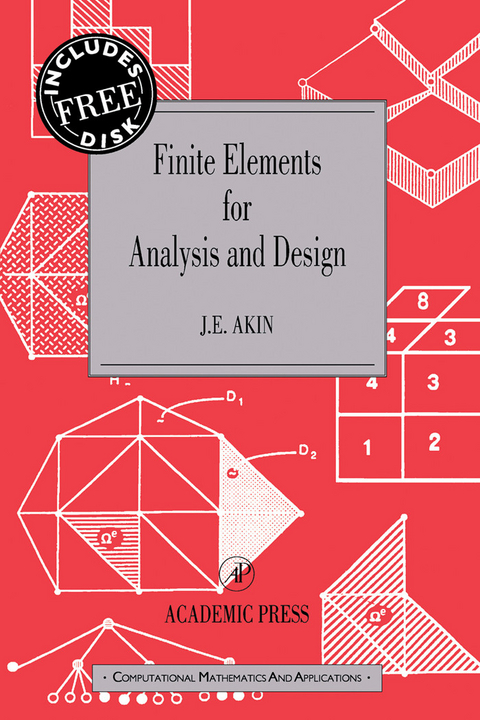
The finite element method (FEM) is an analysis tool for problem-solving used throughout applied mathematics, engineering, and scientific computing. Finite Elements for Analysis and Design provides a thoroughlyrevised and up-to-date account of this important tool and its numerous applications, with added emphasis on basic theory. Numerous worked examples are included to illustrate the material. - Akin clearly explains the FEM, a numerical analysis tool for problem-solving throughout applied mathematics, engineering and scientific computing- Basic theory has been added in the book, including worked examples to enable students to understand the concepts- Contains coverage of computational topics, including worked examples to enable students to understand concepts- Improved coverage of sensitivity analysis and computational fluid dynamics- Uses example applications to increase students' understanding- Includes a disk with the FORTRAN source for the programs cided in the text
Front Cover 1
Finite Elements for Analysis and Design 3
Copyright Page 4
Table of Contents 5
Preface 13
Chapter 1. Introduction 14
1.1 Finite Element Methods 14
1.2 Capabilities of FEA 14
1.3 Outline of Finite Element Procedures 18
1.4 Optimization Concepts 22
1.5 References 27
Chapter 2. Mathematical Preliminaries 28
2.1 Introduction 28
2.2 Linear Spaces and Norms 30
2.3 Sobolev Norms 32
2.4 Self-Adjointness 32
2.5 Weighted Residuals 33
2.6 Essential Boundary Conditions 40
2.7 Elliptic Boundary Value Problems 41
2.8 References 50
Chapter 3. Variational Methods 51
3.1 Introduction 51
3.2 Structural Mechanics 51
3.3 Finite Element Analysis 53
3.4 Continuous Elastic Bar 59
3.5 Flux Recovery for an Element 65
3.6 Thermal Loads on a Bar 67
3.7 Heat Transfer in a Rod 68
3.8 Gradient Estimates 70
3.9 Element Validation 75
3.10 Element Distortion 78
3.11 Euler's Equations of Variational Calculus 80
3.12 System Validation 82
3.13 References 84
Chapter 4. Element Interpolation and Local Coordinates 85
4.1 Introduction 85
4.2 Linear Interpolation 85
4.3 Quadratic Interpolation 88
4.4 Lagrange Interpolation 90
4.5 Hermitian Interpolation 91
4.6 Hierarchical Interpolation 92
4.7 Interpolation Error 99
4.8 References 100
Chapter 5. One-Dimensional Integration 101
5.1 Introduction 101
5.2 Local Coordinate Jacobian 101
5.3 Exact Polynomial Integration 102
5.4 Numerical Integration 103
5.5 Variable Jacobians 108
5.6 References 110
Chapter 6. Beam Analysis 111
6.1 Introduction 111
6.2 Variational Procedure 112
6.3 Hermite Element Matrices 114
6.4 Sample Application 117
6.5 Gradient Estimates 119
6.6 Element Equations via Galerkin's Method 121
6.7 Beams on an Elastic Foundation 121
6.8 Exact Analytic Elements 127
6.9 References 130
Chapter 7. Truss Elements and Axis Transformations 131
7.1 Introduction 131
7.2 Direction Cosines 131
7.3 Transformation of Displacement Components 132
7.4 Transformation of Element Matrices 133
7.5 Example Structures 135
7.6 References 138
Chapter 8. Cylindrical Analysis Problems 139
8.1 Introduction 139
8.2 Heat Conduction in a Cylinder 139
8.3 Cylindrical Stress Analysis 142
8.4 References 145
Chapter 9. General Interpolation 146
9.1 Introduction 146
9.2 Unit Coordinate Interpolation 146
9.3 Natural Coordinates 153
9.4 Isoparametric and Subparametric Elements 153
9.5 Hierarchical Interpolation 164
9.6 Differential Geometry 169
9.7 Parametric Extrapolation 174
9.8 Mass Properties, Equivalent Geometry 176
9.9 Interpolation Error 178
9.10 References 180
Chapter 10. Adaptive Analysis 181
10.1 Introduction 181
10.2 H-Adaptivity 185
10.3 P-Adaptivity 188
10.4 HP-Adaptivity 189
10.5 Adaptive Example 194
10.6 References 201
Chapter 11. Integration Methods 203
11.1 Introduction 203
11.2 Unit Coordinate Integration 204
11.3 Simplex Coordinate Integration 205
11.4 Numerical Integration 208
11.5 Typical Source Distribution Integrals 211
11.6 Minimal, Optimal, Reduced and Selected Integration 214
11.7 References 219
Chapter 12. Heat Transfer 221
12.1 Introduction 221
12.2 Variational Formulation 221
12.3 Element and Boundary Matrices 223
12.4 Example Application 228
12.5 References 231
Chapter 13. Elasticity 232
13.1 Introduction 232
13.2 Minimum Total Potential Energy 234
13.3 Matrices for the Constant Strain Triangle 237
13.4 Stress and Strain Transformations 246
13.5 Anisotropie Materials 249
13.6 Axisymmetric Solids 251
13.7 General Solids 253
13.8 References 254
Chapter 14. Error Measures for Elliptic Problems 255
14.1 Introduction 255
14.2 Error Estimates 258
14.3 Adaptive Process 264
14.4 Hierarchical Error Indicator 267
14.5 Example Error Calculations 268
14.6 Flux Balancing Methods 272
14.7 References 274
Chapter 15. Sensitivity Analysis 276
15.1 Introduction 276
15.2 Structural Models 276
15.3 Optimal Design Problem 278
15.4 Sensitivity Relations 278
15.5 Yield Criteria Sensitivity 280
15.6 Computing Stiffness Sensitivity 283
15.7 Isoparametric Elements 285
15.8 Shape Sensitivity 286
15.9 References 289
Chapter 16. Special Elements 290
16.1 Introduction 290
16.2 Interpolation Enhancement for C° Transition Elements 290
16.3 Singularity Elements 293
16.4 Semi-infinite Elements 298
16.5 Upwind Elements 299
16.6 Gap-Contact Elements 300
16.7 References 301
Chapter 17. Time-Dependent Problems 303
17.1 Introduction 303
17.2 Parabolic Equations 303
17.3 Hyperbolic Equations 310
17.4 Diagonal "Mass" Matrices 317
17.5 Units Diagonal Scaling 322
17.6 References 325
Chapter 18. Computational Fluid Dynamics 326
18.1 Introduction 326
18.2 Mathematical Formulation 327
18.3 Solution Procedure Outline 328
18.4 Algorithm Details 331
18.5 Examples 343
18.6 References 353
Chapter 19. Automatic Mesh Generation 355
19.1 Introduction 355
19.2 Automatic Mesh Generation 355
19.3 Tree Structure Methods 356
19.4 Mapping Methods 363
19.5 References 371
Chapter 20. Computational Procedures 372
20.1 Introduction 372
20.2 Element Calculations 382
20.3 Condensation of Internal Degrees of Freedom 396
20.4 Assembly into the System 400
20.5 Essential Boundary Conditions and Constraints 413
20.6 Economical Solution of the System Equations 419
20.7 Frontal Assembly and Solution Procedures 427
20.8 Iterative Solvers 430
20.9 Programming Parametric Elements 432
20.10 Output of Results 434
20.11 Post-solution Calculations Within the Elements 437
20.12 Sample Graphical Outputs 442
20.13 References 442
Chapter 21. MODEL Applications in 1-D 444
21.1 Introduction 444
21.2 Conductive and Convective Heat Transfer 444
21.3 Plane Truss Structures 450
21.4 Slider Bearing Lubrication 457
21.5 Ordinary Differential Equations 462
21.6 Plane Frame Structures 466
21.7 References 473
Chapter 22. MODEL Applications in 2- and 3-D 474
22.1 Introduction 474
22.2 Plane Stress Analysis 474
22.3 Heat Conduction 484
22.4 Viscous Flow in Straight Ducts 490
22.5 Potential Flow 493
22.6 Electromagnetic Waveguides 505
22.7 Axisymmetric Plasma Equilibria 507
22.8 Neutron Diffusion 511
22.9 Axisymmetric Solenoid Magnet 514
22.10 Three-Dimensional Applications 520
22.11 References 526
Appendices I: Matrix Notation and Operations 528
Appendices II: Subroutines in MODEL library 536
Appendices III: Notation in MODEL 541
Appendices IV: Program Disk Directory 544
INDEX 555
| Erscheint lt. Verlag | 28.6.2014 |
|---|---|
| Mitarbeit |
Herausgeber (Serie): J. H. Davenport, John R. Whiteman |
| Sprache | englisch |
| Themenwelt | Mathematik / Informatik ► Mathematik ► Analysis |
| Technik ► Bauwesen | |
| Technik ► Maschinenbau | |
| ISBN-10 | 0-08-050647-X / 008050647X |
| ISBN-13 | 978-0-08-050647-0 / 9780080506470 |
| Informationen gemäß Produktsicherheitsverordnung (GPSR) | |
| Haben Sie eine Frage zum Produkt? |
 PDF (Adobe DRM)
Kopierschutz: Adobe-DRM
Adobe-DRM ist ein Kopierschutz, der das eBook vor Mißbrauch schützen soll. Dabei wird das eBook bereits beim Download auf Ihre persönliche Adobe-ID autorisiert. Lesen können Sie das eBook dann nur auf den Geräten, welche ebenfalls auf Ihre Adobe-ID registriert sind.
Details zum Adobe-DRM
Dateiformat: PDF (Portable Document Format)
Mit einem festen Seitenlayout eignet sich die PDF besonders für Fachbücher mit Spalten, Tabellen und Abbildungen. Eine PDF kann auf fast allen Geräten angezeigt werden, ist aber für kleine Displays (Smartphone, eReader) nur eingeschränkt geeignet.
Systemvoraussetzungen:
PC/Mac: Mit einem PC oder Mac können Sie dieses eBook lesen. Sie benötigen eine
eReader: Dieses eBook kann mit (fast) allen eBook-Readern gelesen werden. Mit dem amazon-Kindle ist es aber nicht kompatibel.
Smartphone/Tablet: Egal ob Apple oder Android, dieses eBook können Sie lesen. Sie benötigen eine
Geräteliste und zusätzliche Hinweise
Buying eBooks from abroad
For tax law reasons we can sell eBooks just within Germany and Switzerland. Regrettably we cannot fulfill eBook-orders from other countries.
aus dem Bereich