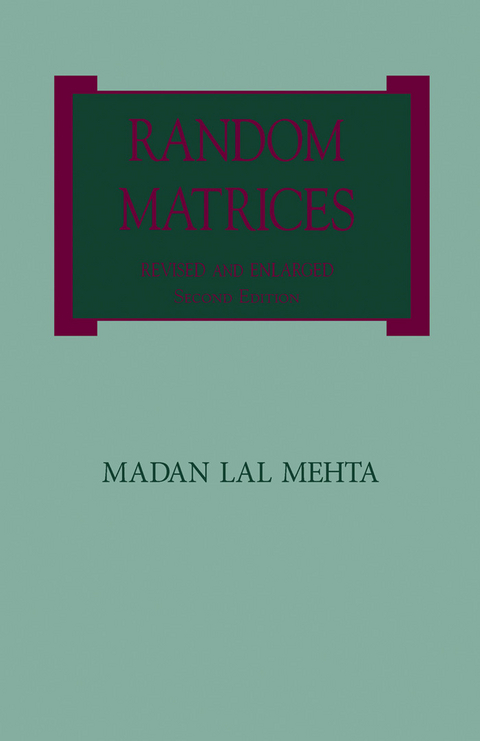
Random Matrices (eBook)
562 Seiten
Elsevier Science (Verlag)
978-1-4832-9595-4 (ISBN)
Since the publication of Random Matrices (Academic Press, 1967) so many new results have emerged both in theory and in applications, that this edition is almost completely revised to reflect the developments. For example, the theory of matrices with quaternion elements was developed to compute certain multiple integrals, and the inverse scattering theory was used to derive asymptotic results. The discovery of Selberg's 1944 paper on a multiple integral also gave rise to hundreds of recent publications. This book presents a coherent and detailed analytical treatment of random matrices, leading in particular to the calculation of n-point correlations, of spacing probabilities, and of a number of statistical quantities. The results are used in describing the statistical properties of nuclear excitations, the energies of chaotic systems, the ultrasonic frequencies of structural materials, the zeros of the Riemann zeta function, and in general the characteristic energies of any sufficiently complicated system. Of special interest to physicists and mathematicians, the book is self-contained and the reader need know mathematics only at the undergraduate level.Key Features* The three Gaussian ensembles, unitary, orthogonal, and symplectic; their n-point correlations and spacing probabilities* The three circular ensembles: unitary, orthogonal, and symplectic; their equivalence to the Gaussian* Matrices with quaternion elements* Integration over alternate and mixed variables* Fredholm determinants and inverse scattering theory* A Brownian motion model of the matrices* Computation of the mean and of the variance of a number of statistical quantities* Selberg's integral and its consequences
Front Cover 1
Random Matrices: Revised and Enlarged 4
Copyright Page 5
Table of Contents 6
Preface to the Second Edition 12
Acknowledgments 16
Preface to the First Edition 18
Chapter 1. Introduction 20
1.1. Random Matrices in Nuclear Physics 20
1.2. Random Matrices in Other Branches of Knowledge 25
1.3. A Summary of Statistical Facts about Nuclear Energy Levels 29
1.4. Definition of a Suitable Function for the Study of Level Correlations 33
1.5. Wigner Surmise 34
1.6. Electromagnetic Properties of Small Metallic Particles 37
1.7. Analysis of Experimental Nuclear Levels 39
1.8. The Zeros of the Riemann Zeta Function 40
1.9. Things Worth Consideration, but Not Treated in This Book 52
Chapter 2. Gaussian Ensembles. The Joint Probability Density Function for the Matrix Elements 55
2.1. Preliminaries 55
2.2. Time-Reversal Invariance 56
2.3. Gaussian Orthogonal Ensemble 58
2.4. Gaussian Symplectic Ensemble 60
2.5. Gaussian Unitary Ensemble 65
2.6. Joint Probability Density Function for Matrix Elements 66
2.7. Another Gaussian Ensemble of Hermitian Matrices 71
2.8. Antisymmetric Hermitian Matrices 72
Summary of Chapter 2 72
Chapter 3. Gaussian Ensembles. The Joint Probability Density Function for the Eigenvalues 74
3.1. Orthogonal Ensemble 74
3.2. Symplectic Ensemble 78
3.3. Unitary Ensemble 81
3.4. Ensemble of Antisymmetric Hermitian Matrices 84
3.5. Another Gaussian Ensemble of Hermitian Matrices 85
3.6. Random Matrices and Information Theory 86
Summary of Chapter 3 88
Chapter 4. Gaussian Ensembles. Level Density 89
4.1. The Partition Function 89
4.2. The Asymptotic Formula for the Level Density. Gaussian Ensembles 91
4-3. The Asymptotic Formula for the Level Density. Other Ensembles 94
Summary of Chapter 4 97
Chapter 5. Gaussian Unitary Ensemble 98
5.1. Generalities 99
5.2. The n-Point Correlation Function 108
5.3. Level Spacings 114
5.4. Several Consecutive Spacings 120
5.5. Some Remarks 128
Summary of Chapter 5 140
Chapter 6. Gaussian Orthogonal Ensemble 142
6.1. Generalities 142
6.2. Quaternion Matrices 144
6.3. The Probability Density Function as a Quaternion Determinant 147
6.4. The Correlation and Cluster Functions 154
6.5. Level Spacings. Integration over Alternate Variables 157
6.6. Several Consecutive Spacings: n = 2r 161
6.7. Several Consecutive Spacings: n = 2r – 1 166
6.8. Bounds for the Distribution Function of the Spacings 171
Summary of Chapter 6 179
Chapter 7. Gaussian Symplectic Ensemble 181
7.1. A Quaternion Determinant 181
7.2. Correlation and Cluster Functions 184
7.3. Level Spacings 186
Summary of Chapter 7 188
Chapter 8. Gaussian Ensembles: Brownian Motion Model 189
8.1. Stationary Ensembles 189
8.2. Nonstationary Ensembles 189
8.3. Some Ensemble Averages 195
Summary of Chapter 8 198
Chapter 9. Circular Ensembles 200
9.1. The Orthogonal Ensemble 201
9.2. Symplectic Ensemble 204
9.3. Unitary Ensemble 206
9.4. The Joint Probability Density Function for the Eigenvalues 207
Summary of Chapter 9 212
Chapter 10. Circular Ensembles (Continued) 213
10.1. Unitary Ensemble. Correlation and Cluster Functions 213
10.2. Unitary Ensemble. Level Spacings 216
10.3. Orthogonal Ensemble. Correlation and Cluster Functions 218
10.4. Orthogonal Ensemble. Level Spacings 225
10.5. Symplectic Ensemble. Correlation and Cluster Functions 229
10.6. Relation between Orthogonal and Symplectic Ensembles 231
10.7. Symplectic Ensemble. Level Spacings 233
10.8. Brownian Motion Model 235
10.9. Wigner's Method for the Orthogonal Circular Ensemble 237
Summary of Chapter 10 241
Chapter 11. Circular Ensembles. Thermodynamics 243
11.1. The Partition Function 243
11.2. Thermodynamic Quantities 246
11.3. Statistical Interpretation of U and C 249
11.4. Continuum Model for the Spacing Distribution 251
Summary of Chapter 11 257
Chapter 12. Asymptotic Behavior of Eß( 0 , s) for Large s 258
12.1. Asymptotics of the ..( t ) 259
12.2. Asymptotics of Toeplitz Determinants 262
12.3. Fredholm Determinants and the Inverse Scattering Theory 263
12.4. Application of the Gel'fand–Levitan Method 266
12.5. Application of the Marchenko Method 271
12.6. Asymptotic Expansions 274
Summary of Chapter 12 277
Chapter 13. Gaussian Ensemble of Antisymmetric Hermitian Matrices 279
13.1. Level Density. Correlation Functions 279
13.2. Level Spacings 282
Summary of Chapter 13 285
Chapter 14. Another Gaussian Ensemble of Hermitian Matrices 286
14.1. Summary of Results. Matrix Ensembles from GOE to GUE and Beyond 287
14.2. Matrix Ensembles from GSE to GUE and Beyond 294
14.3. Joint Probability Density for the Eigenvalues 298
14.4. Correlation and Cluster Functions 309
Summary of Chapter 14 312
Chapter 15. Matrices with Gaussian Element Densities but with No Unitary or Hermitian Conditions Imposed 313
15.1. Complex Matrices 313
15.2. Quaternion Matrices 320
15.3. Real Matrices 328
Summary of Chapter 15 329
Chapter 16. Statistical Analysis of a Level Sequence 330
16.1. Linear Statistics or the Number Variance 333
16.2. Least Square Statistic 338
16.3. Energy Statistic 343
16.4. Covariance of Two Consecutive Spacings 346
16.5. The F Statistic 349
16.6. The A Statistic 351
16.7. Statistics Involving Three- and Four-Level Correlations 352
16.8. Other Statistics 353
Summary of Chapter 16 357
Chapter 17. Selberg's Integral and Its Consequences 358
17.1. Selberg's Integral 358
17.2. Selberg's Proof of Equation (17.1.3) 359
17.3. Aomoto's Proof of Equation (17.1.4) 364
17.4. Other Averages 368
17.5. Other Forms of Selberg's Integral 368
17.6. Some Consequences of Selberg's Integral 371
17.7. Normalization Constant for the Circular Ensembles 375
17.8. Averages with Laguerre or Hermite Weights 375
17.9. Connection with Finite Reflection Groups 378
17.10. A Second Generalization of the Beta Integral 380
17.11. Some Related Difficult Integrals 383
Summary of Chapter 17 388
Chapter 18. Gaussian Ensembles. Level Density in the Tail of the Semicircle 390
18.1. Level Density near the Inflection Point 391
Summary of Chapter 18 395
Chapter 19. Restricted Trace Ensembles. Ensembles Related to the Classical Orthogonal Polynomials 396
19.1. Fixed Trace Ensemble 396
19.2. Bounded Trace Ensemble 400
19.3. Matrix Ensembles and Classical Orthogonal Polynomials 401
Summary of Chapter 19 403
Chapter 20. Bordered Matrices 405
20.1. Random Linear Chain 406
20.2. Bordered Matrices 410
Summary of Chapter 20 412
Chapter 21. Invariance Hypothesis and Matrix Element Correlations 413
21.1. Random Orthonormal Vectors 414
Summary of Chapter 21 418
Appendices 419
Notes 554
References 564
Author Index 574
Subject Index 578
| Erscheint lt. Verlag | 19.5.2014 |
|---|---|
| Sprache | englisch |
| Themenwelt | Mathematik / Informatik ► Mathematik ► Algebra |
| Naturwissenschaften ► Physik / Astronomie ► Quantenphysik | |
| Technik | |
| ISBN-10 | 1-4832-9595-8 / 1483295958 |
| ISBN-13 | 978-1-4832-9595-4 / 9781483295954 |
| Informationen gemäß Produktsicherheitsverordnung (GPSR) | |
| Haben Sie eine Frage zum Produkt? |
 PDF (Adobe DRM)
Kopierschutz: Adobe-DRM
Adobe-DRM ist ein Kopierschutz, der das eBook vor Mißbrauch schützen soll. Dabei wird das eBook bereits beim Download auf Ihre persönliche Adobe-ID autorisiert. Lesen können Sie das eBook dann nur auf den Geräten, welche ebenfalls auf Ihre Adobe-ID registriert sind.
Details zum Adobe-DRM
Dateiformat: PDF (Portable Document Format)
Mit einem festen Seitenlayout eignet sich die PDF besonders für Fachbücher mit Spalten, Tabellen und Abbildungen. Eine PDF kann auf fast allen Geräten angezeigt werden, ist aber für kleine Displays (Smartphone, eReader) nur eingeschränkt geeignet.
Systemvoraussetzungen:
PC/Mac: Mit einem PC oder Mac können Sie dieses eBook lesen. Sie benötigen eine
eReader: Dieses eBook kann mit (fast) allen eBook-Readern gelesen werden. Mit dem amazon-Kindle ist es aber nicht kompatibel.
Smartphone/Tablet: Egal ob Apple oder Android, dieses eBook können Sie lesen. Sie benötigen eine
Geräteliste und zusätzliche Hinweise
Buying eBooks from abroad
For tax law reasons we can sell eBooks just within Germany and Switzerland. Regrettably we cannot fulfill eBook-orders from other countries.
aus dem Bereich