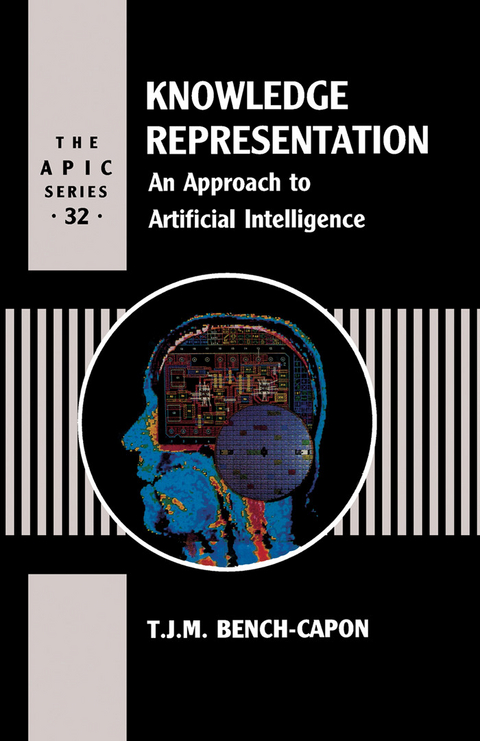
Knowledge Representation (eBook)
220 Seiten
Elsevier Science (Verlag)
978-1-4832-9710-1 (ISBN)
Although many texts exist offering an introduction to artificial intelligence (AI), this book is unique in that it places an emphasis on knowledge representation (KR) concepts. It includes small-scale implementations in PROLOG to illustrate the major KR paradigms and their developments.****back cover copy:**Knowledge representation is at the heart of the artificial intelligence enterprise: anyone writing a program which seeks to work by encoding and manipulating knowledge needs to pay attention to the scheme whereby he will represent the knowledge, and to be aware of the consequences of the choices made.****The book's distinctive approach introduces the topic of AI through a study of knowledge representation issues. It assumes a basic knowledge of computing and a familiarity with the principles of elementary formal logic would be advantageous.****Knowledge Representation: An Approach to Artificial Intelligence develops from an introductory consideration of AI, knowledge representation and logic, through search technique to the three central knowledge paradigms: production rules, structured objects, and predicate calculus. The final section of the book illustrates the application of these knowledge representation paradigms through the Prolog Programming language and with an examination of diverse expert systems applications. The book concludes with a look at some advanced issues in knowledge representation.****This text provides an introduction to AI through a study of knowledge representation and each chapter contains exercises for students. Experienced computer scientists and students alike, seeking an introduction to AI and knowledge representations will find this an invaluable text.
Front Cover 1
Knowledge Representation: An Approach to Artificial Intelligence 4
Copyright Page 5
Table of Contents 8
Preface 6
Chapter 1. Introduction to Artificial Intelligence and Knowledge-Based Systems 14
1.1. Artificial and intelligent 14
References 21
Chapter 2. Introduction to Knowledge Representation 24
2.1. What is knowledge representation? 24
2.2. Criteria of adequacy 26
2.3. Expressiveness 28
2.4. Example of the use of these criteria 31
2.5. Major paradigms 32
2.6. Manipulation of representations 33
Reference 38
Chapter 3. Logic 40
3.1. Basics 40
3.2. Basics of propositional calculus 41
3.3. Basics of predicate calculus 47
3.4. Exotic logics 52
3.5. Modal logics 53
References 53
Chapter 4. Search 54
4.1. Search spaces 54
4.2. Search methods 57
4.3. Limitations of search 68
4.4. Human problem solving 70
Reference 74
Chapter 5. Production Rules 76
5.1. Form of production rules 76
5.2. Components of a production system 79
5.3. Operation of a production system 81
5.4. Pros and cons of production systems 88
References 90
Chapter 6. Structured Objects 92
6.1. Semantic networks 92
6.2. Frames 99
References 113
Chapter 7. Logic and Predicate Calculus 116
7.1. Advantages of predicate calculus 117
7.2. Foundations of logic programming 118
7.3. Main ideas of logic programming 130
References 134
Chapter 8. Prolog 136
8.1. Features of Prolog 137
8.2. Prolog for logic programming 138
8.3. Prolog as a deductive database 140
8.4. Non-logical features of PROLOG 142
8.5. Prolog an AI programming language 150
8.6. Summary 151
References 153
Chapter 9. Expert Systems 154
9.1. Why expert systems? 154
9.2. What is an expert? 156
9.3. What is an expert system? 157
9.4. Basic expert systems components 161
9.5. Early expert systems 165
9.6. Expert system shells 170
9.7. Typical facilities of an expert system shell 173
9.8. Trends in expert systems 177
9.9. Examples of current expert systems 180
References 182
Chapter 10. Some Issues in Knowledge Representation 184
10.1. Similarities between the paradigms 184
10.2. Expressiveness of Horn Clauses 186
10.3. Non-monotonicreasoning 195
10.4. Inexact reasoning and rule-based systems 203
10.5. Representation of control knowledge 215
10.6. Time 218
10.7. Model-based representation 219
10.8. Conclusion 222
References 223
Bibliography 224
Index 228
| Erscheint lt. Verlag | 28.6.2014 |
|---|---|
| Sprache | englisch |
| Themenwelt | Mathematik / Informatik ► Informatik ► Programmiersprachen / -werkzeuge |
| Informatik ► Theorie / Studium ► Künstliche Intelligenz / Robotik | |
| ISBN-10 | 1-4832-9710-1 / 1483297101 |
| ISBN-13 | 978-1-4832-9710-1 / 9781483297101 |
| Informationen gemäß Produktsicherheitsverordnung (GPSR) | |
| Haben Sie eine Frage zum Produkt? |
 PDF (Adobe DRM)
Kopierschutz: Adobe-DRM
Adobe-DRM ist ein Kopierschutz, der das eBook vor Mißbrauch schützen soll. Dabei wird das eBook bereits beim Download auf Ihre persönliche Adobe-ID autorisiert. Lesen können Sie das eBook dann nur auf den Geräten, welche ebenfalls auf Ihre Adobe-ID registriert sind.
Details zum Adobe-DRM
Dateiformat: PDF (Portable Document Format)
Mit einem festen Seitenlayout eignet sich die PDF besonders für Fachbücher mit Spalten, Tabellen und Abbildungen. Eine PDF kann auf fast allen Geräten angezeigt werden, ist aber für kleine Displays (Smartphone, eReader) nur eingeschränkt geeignet.
Systemvoraussetzungen:
PC/Mac: Mit einem PC oder Mac können Sie dieses eBook lesen. Sie benötigen eine
eReader: Dieses eBook kann mit (fast) allen eBook-Readern gelesen werden. Mit dem amazon-Kindle ist es aber nicht kompatibel.
Smartphone/Tablet: Egal ob Apple oder Android, dieses eBook können Sie lesen. Sie benötigen eine
Geräteliste und zusätzliche Hinweise
Buying eBooks from abroad
For tax law reasons we can sell eBooks just within Germany and Switzerland. Regrettably we cannot fulfill eBook-orders from other countries.
aus dem Bereich