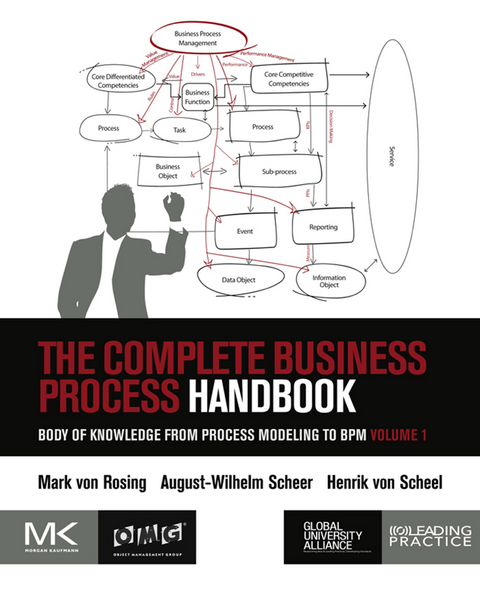
Complete Business Process Handbook (eBook)
776 Seiten
Elsevier Science (Verlag)
978-0-12-800472-2 (ISBN)
Mark von Rosing is a best-selling author, a sought-after speaker, researcher and board-room advisor. He is a pioneer in the field of climate control and Sustainability. Through his research, publications and effort with standard bodies (ISO, IEEE, OMG, CEN, NIST, LEADing Practice, NATO, UN, W3C) he has been involved of developing 200+ Enterprise Standards and 52 different Industry Standards. Beyond, he left his mark in the field of process modelling having published the best-selling book series The Complete Business Process Handbook, published by Elsevier. Companies such as SAP AG have involved him in developing and leading their Sustainability approaches as well as the Sustainability architecture approaches.
The Complete Business Process Handbook is the most comprehensive body of knowledge on business processes with revealing new research. Written as a practical guide for Executives, Practitioners, Managers and Students by the authorities that have shaped the way we think and work with process today. It stands out as a masterpiece, being part of the BPM bachelor and master degree curriculum at universities around the world, with revealing academic research and insight from the leaders in the market. This book provides everything you need to know about the processes and frameworks, methods, and approaches to implement BPM. Through real-world examples, best practices, LEADing practices and advice from experts, readers will understand how BPM works and how to best use it to their advantage. Cases from industry leaders and innovators show how early adopters of LEADing Practices improved their businesses by using BPM technology and methodology. As the first of three volumes, this book represents the most comprehensive body of knowledge published on business process. Following closely behind, the second volume uniquely bridges theory with how BPM is applied today with the most extensive information on extended BPM. The third volume will explore award winning real-life examples of leading business process practices and how it can be replaced to your advantage. - Learn what Business Process is and how to get started- Comprehensive historical process evolution- In-depth look at the Process Anatomy, Semantics and Ontology- Find out how to link Strategy to Operation with value driven BPM- Uncover how to establish a way of Thinking, Working, Modelling and Implementation- Explore comprehensive Frameworks, Methods and Approaches- How to build BPM competencies and establish a Center of Excellence- Discover how to apply Social BPM, Sustainable and Evidence based BPM- Learn how Value & Performance Measurement and Management- Learn how to roll-out and deploy process- Explore how to enable Process Owners, Roles and Knowledge Workers- Discover how to Process and Application Modelling- Uncover Process Lifecycle, Maturity, Alignment and Continuous Improvement- Practical continuous improvement with the way of Governance- Future BPM trends that will affect business- Explore the BPM Body of Knowledge
Front Cover 1
The Complete Business Process Handbook 4
Copyright 5
Contents 6
Authors Biographies 26
Foreword 94
Abbreviation Meaning 100
Introduction to the Book 104
Phase 1: Process Concept Evolution 106
INTRODUCTION 106
PROCESS CONCEPT EVOLUTION 107
End Notes 113
Phase 2: Process Concept Evolution 116
INTRODUCTION 116
GANTT CHART 118
FRANK B. GILBRETH 119
ALLAN H. MOGENSEN 121
BOEING B17 122
BENJAMIN S. GRAHAM 123
ASME: AMERICAN SOCIETY OF MECHANICALENGINEERS 123
FUNCTIONAL FLOW BLOCK DIAGRAM OF PERT 125
DATA FLOW DIAGRAMS AND IDEF 127
ZERO DEFECTS 130
TOYOTA PRODUCTION SYSTEM 132
End Notes 139
Phase 3: Process Concept Evolution 142
INTRODUCTION 142
PROF. DR. H.C. MULT. AUGUST-WILHELM SCHEER 144
JOHN A. ZACHMAN—THE ARRIVAL OF ENTERPRISE ARCHITECTURE 147
LEAN THINKING, LEAN PRACTICE AND LEAN CONSUMPTION 151
BUSINESS PROCESS REENGINEERING 155
TOTAL QUALITY MANAGEMENT 163
TOOLS FOR TQM 168
SIX SIGMA 175
End Notes 178
Phase 4: What Is Business Process Management? 184
INTRODUCTION 184
DEFINITION AND RESEARCH 184
INSIGHTS GAINED 188
CONCLUSION: ONE COMMON DEFINITION 192
End Notes 193
The BPM Way of Thinking 194
INTRODUCTION 194
The Value of Ontology 196
INTRODUCTION 196
WHAT IS ONTOLOGY? 196
ONTOLOGY CLASSIFICATION BASED ON CONTEXT DEPENDENCY 197
ONTOLOGY MATURITY AND THE MATURING PROCESS 197
STATE OF THE ART 198
CONCLUSIONS AND DIRECTIONS FOR FUTURE RESEARCH 200
End Notes 201
The BPM Ontology 206
INTRODUCTION 206
THE BPM ONTOLOGY AS A FOLKSONOMY: SHARING FUNDAMENTAL PROCESS CONCEPTS 206
THE BPM ONTOLOGY AS A THESAURUS: STRUCTURING PROCESS KNOWLEDGE BY DEFINING RELATIONS 211
THE BPM ONTOLOGY AS A FRAME: THE ONTOLOGICAL STRUCTURE OF THE LEADING PRACTICE PROCESS META MODEL 219
DISCUSSION OF THE BPM ONTOLOGY 224
SUMMARY 225
End Notes 226
Process Tagging—A Process Classification and Categorization Concept 228
INTRODUCTION 228
LOGICAL CLUSTERING: LEARNING FROM OTHER AREAS 228
CONCEPTUAL AND LOGICAL PROCESS CLASSIFICATION AND CATEGORIZATION 230
CLASSIFICATION OF PROCESS BY METHOD OF EXECUTION 233
THE NATURE OF PROCESS DECOMPOSITION 234
DESCRIBING WORK 238
PROCESS AREA 241
PROCESS GROUP 243
PROCESS 248
THE NATURE OF PROCESSES 251
PROCESS LIFECYCLE VERB TAXONOMY 252
PROCESS STEP 253
THE NATURE OF PROCESS STEPS 261
ACTIVITY 261
THE NATURE OF ACTIVITY 263
THE WORK SYSTEM 263
PROCEDURE 264
CONNECTING THE WORK SPACES 265
PROCESS SCENARIOS 266
PROCESS TYPE 267
PROCESS TIER 269
PROCESS NATURE 272
MISCATEGORIZATION AND MISCLASSIFICATION 274
CONCLUSIONS 274
End Notes 275
Why Work with Process Templates 278
INTRODUCTION 278
THE RELATIONSHIP BETWEEN BUSINESS PROCESS MANAGEMENT ONTOLOGY AND PROCESS TEMPLATES 278
WHAT ARE PROCESS TEMPLATES? 280
PROCESS MAPS 280
PROCESS MATRIX 282
PROCESS MODEL 283
THE MOST COMMON PROCESS TEMPLATES 286
BENEFITS OF PROCESS TEMPLATES 286
CONCLUSION 288
End Notes 289
The BPM Way of Working 290
INTRODUCTION 290
Business Process Trends 292
INTRODUCTION 292
THE IMPORTANCE OF TRENDS 292
MATURITY OF THE SUBJECT 293
MEGA TRENDS 294
EMERGING TRENDS 295
PROCESS TRENDS 296
EARLY ADOPTION 296
EARLY ADOPTER OF PROCESS TRENDS 298
INDUSTRY ADOPTION 309
STANDARD ADOPTION 316
STANDARDS ADOPTION OF PROCESS TRENDS 316
CONCLUSION 321
End Notes 321
BPM Center of Excellence 322
INTRODUCTION 322
THE CHALLENGE BPM COE FACES 322
WHAT HAPPENS WITHOUT A BPM COE? 325
CAUSE AND EFFECT MATRIX 327
LESSONS LEARNED REGARDING BPM COE 327
CONCLUSION 343
End Notes 343
Understanding Business Process Management Roles 346
INTRODUCTION 346
MOTIVATION FOR DEFINING YOUR BPM ROLES 346
RELEVANCE CONTEXT 347
WHAT IS A ROLE? 347
STANDARDS THAT LINK TO ROLE CONCEPTS 351
CURRENT METHODS 352
ROLE CONTEXT 353
ABILITIES TO ACT 355
ROLE PROFILE 356
COMMON ROLES INVOLVED WITH ROLE MODELING 357
ROLES WITHIN BPM 358
TYPICAL BPM COE ROLES 359
ADDITIONAL ROLES 365
ROLE PROFILE WITHIN BPM COE 366
ROLE PROFILE WITHIN BPM PROJECTS 367
CONCLUSION 368
End Notes 368
Working with the Business Process Management (BPM) Life Cycle 370
Mark von Rosing, Ulrik Foldager, Maria Hove, Joshua von Scheel, Anette Falk Bøgebjerg 370
INTRODUCTION 370
PHASE 1: ANALYZE—PROJECT PREPARATION AND BLUEPRINT 371
PHASE 2: DESIGN—PROJECT REALIZATION AND DESIGN 383
PHASE 3: BUILD—FINAL PROJECT PREPARATION 392
PHASE 4: DEPLOY/IMPLEMENT—GO LIVE 400
PHASE 5: RUN/MAINTAIN—RUN PROCESSES AND GOVERN PERFORMANCE 411
PHASE 6: CONTINUOUS IMPROVEMENT—CONTINUOUSLY OPTIMIZE AND DEVELOP PROCESSES 421
CONCLUSION 441
End Notes 445
The Chief Process Officer: An Emerging Top Leadership Role 448
INTRODUCTION 448
THE EMERGING ROLE OF THE CPO 448
KEY TASKS OF THE CPO 450
POSITIONING OF THE CPO IN THE ORGANIZATION 451
CONCLUSION 452
End Notes 452
iBPM—Intelligent Business Process Management 454
THE EVOLUTION OF INTELLIGENT BPM 455
FROM AUTOMATION TO ORCHESTRATION: THE REALIGNMENT OF BPM AROUND SERVICE-ORIENTED ARCHITECTURES 456
APPLY SOA STRATEGIES TO INTEGRATING UNSTRUCTURED INFORMATION 457
REALIZING ADAPTABILITY: SHIFTING FROM EVENT-DRIVEN TO GOAL-DRIVEN 458
PHASE THREE: INTELLIGENT BPM 459
INTELLIGENT BPM LEVERAGES BIG DATA 461
THE VALUE OF SOCIAL MEDIA TO INTELLIGENT BPM 464
CONCLUSION 465
End Notes 466
Evidence-Based Business Process Management 468
INTRODUCTION 468
EVIDENCE-BASED BPM: WHAT FOR? 468
THE ANSWER: PROCESS MINING 469
DESCRIPTIVE APPROACHES 470
PROCESS PERFORMANCE ANALYTICS 471
AUTOMATED PROCESS DISCOVERY 471
MODEL ENHANCEMENT 472
DEVIANCE MINING 473
PROCESS VARIANT AND OUTLIER IDENTIFICATION 474
PREDICTIVE APPROACHES 474
CASE STUDIES AND LESSONS IN EVIDENCE-BASED BPM 475
CASE STUDIES IN AUTOMATED PROCESS AND VARIANT DISCOVERY 475
CASE STUDIES IN DEVIANCE MINING 476
CASE STUDIES IN PREDICTIVE MONITORING 478
CONCLUSION 478
End Notes 479
Social Media and Business Process Management 482
INTRODUCTION 482
THE DIGITAL MIND-SET IS CHANGING 482
SOCIAL MEDIA ARE RESHAPING BUSINESS 484
ENABLING CUSTOMER-CENTRICITY 488
LESSONS LEARNED AROUND SOCIAL-ORIENTED PROCESS MODELING 489
TARGET MARKETING CAMPAIGNS WITH SOCIAL MEDIA 490
IMPROVING THE PROSPECT QUALIFICATION PROCESS 491
CUSTOMER PROFILE DATA FOR PROCESS (SIMPLIFICATION) 491
CUSTOMER NOTIFICATIONS FOR PROCESS (VISIBILITY) 492
ALTERNATIVE CHANNELS FOR SALES 492
SELECTION OF THE RIGHT OFFERING/SOLUTION 492
SOCIAL MEDIA AND BPM FOR CUSTOMER SERVICING 492
CUSTOMER RELATIONSHIP MANAGEMENT 493
SOCIAL MEDIA PROCESS FLOW 495
CONCLUSION 497
End Notes 499
BPM and Maturity Models 500
INTRODUCTION 500
HISTORIC DEVELOPMENT OF MATURITY MODELS 501
THE DIFFERENT STAGES OF MATURITY MODELS 504
THE MISSING PARTS OF THE MATURITY MODELS 506
BPM MATURITY MODEL 508
MATURITY LEVELS 508
FROM MATURITY LEVEL ASSESSMENT TO MATURITY BENCHMARK 526
CONCLUSION 529
End Notes 529
The BPM Way of Modeling 532
INTRODUCTION 532
Business Process Model and Notation—BPMN 534
INTRODUCTION 534
WHAT IS BPMN? 534
THE HISTORIC DEVELOPMENT OF BPMN 535
THE BPMN NOTATIONS/SHAPES 536
BPMN DIAGRAMS 544
TO POINT (1) PRIVATE (INTERNAL) BUSINESS PROCESSES 544
PUBLIC PROCESSES 545
COLLABORATIONS 546
TO POINT (2) CHOREOGRAPHY 546
TO POINT (3) CONVERSATIONS 547
BPMN USAGE 548
DIAGRAM POINT OF VIEW 549
UNDERSTANDING THE BEHAVIOR OF DIAGRAMS 549
BPMN EXAMPLE 549
BPMN CAVEATS 552
THE FUTURE OF BPMN 552
FULFILLING THE BPMN VISION 553
IMPLEMENTATION LEVEL MODELING 554
CASE MANAGEMENT MODELING 556
CONCLUSIONS 557
End Notes 557
Variation in Business Processes 560
INTRODUCTION 560
BUSINESS PROCESS VARIANCES: WHAT IS IT? 560
COMPLICATIONS AND CHALLENGES 562
SOLUTION DESCRIPTION 564
COST CALCULATION OF PROCESS VARIANCES 575
LESSONS LEARNED 576
CONCLUSION AND SUMMARY 577
End Notes 577
Focusing Business Processes on Superior Value Creation: Value-oriented Process Modeling 580
INTRODUCTION 580
VALUE IS A DIFFERENT KIND OF CONCEPT FOR PROCESS TEAMS 580
CONCLUSION 596
End Notes 596
Sustainability Oriented Process Modeling 598
INTRODUCTION 598
SITUATION, COMPLICATIONS, AND THE MAIN QUESTIONS 598
CONDITIONS, CIRCUMSTANCES, AND COMPLEXITY 599
THE MAIN QUESTIONS COVERED 600
THE ANSWER 601
THE WAY OF THINKING AROUND SUSTAINABILITY ORIENTED PROCESS MODELING 601
SUSTAINABILITY ORIENTED PROCESS MODELING: THE WAY OF WORKING 602
SUSTAINABILITY ORIENTED PROCESS MODELING: WAY OF MODELING 610
SUSTAINABILITY ORIENTED PROCESS MODELING: WAY OF IMPLEMENTING 612
SUSTAINABILITY ORIENTED PROCESS MODELING: WAY OF GOVERNING 613
BENEFITS OF COMBINING BPM AND SUSTAINABILITY ORIENTED PROCESS MODELING 613
CONCLUSIONS 614
End Notes 614
Information Modeling and Process Modeling 616
INTRODUCTION 616
INTENDED AUDIENCE 616
PROCESS LIFE CYCLE 617
PROCESS ATTRIBUTES 621
WHY THE SUBJECT IS IMPORTANT AND THE PROBLEMS AND CHALLENGES IT WILL SOLVE 622
INFORMATION MODELS WITHIN AS-IS AND TO-BE MODELS 623
EXAMPLE AS-IS MODEL (SALES AND DISTRIBUTION) 634
EXAMPLE OF TO-BE (BPMN) MODEL (MATERIALS MANAGEMENT) 641
LESSON LEARNED 649
WHAT WORKED 649
WHAT DID NOT WORK 651
CONCLUSIONS 652
End Notes 653
The BPM Way of Implementation and Governance 656
INTRODUCTION 656
End Notes 656
Applying Agile Principles to BPM 658
INTRODUCTION 658
WHAT IS AGILE? 658
AGILE CHARACTERISTICS 660
AGILE VALUES 661
AGILE PRINCIPLES 661
AGILE PRACTICES 662
AGILE VERSUS TRADITIONAL WAYS OF WORKING 662
AGILE BPM 664
AGILITY ADOPTION AND IMPROVEMENT MODEL 679
CONCLUSION 680
End Notes 681
BPM Change Management 684
INTRODUCTION 684
LESSONS LEARNED AROUND BPM CHANGE MANAGEMENT 684
LESSONS LEARNED OF THE OUTPERFORMERS AND UNDERPERFORMERS 686
LESSONS LEARNED AROUND BENEFIT AND VALUE REALIZATION 687
LEADING PRACTICE SUGGESTIONS ON WHAT REALLY WORKS WELL 687
CONCLUSION 701
End Notes 702
Business Process Management Governance 704
INTRODUCTION 704
WHY IS BPM GOVERNANCE IMPORTANT? 704
WHAT IS BPM GOVERNANCE? 705
BPM CENTER OF EXCELLENCE AND GOVERNANCE 706
HOW DOES BPM GOVERNANCE WORK? 709
BPM GOVERNANCE AND INCIDENT MANAGEMENT 711
BPM PORTFOLIO MANAGEMENT AND GOVERNANCE 712
LESSONS LEARNED 714
BENEFITS AND VALUE OF BPM GOVERNANCE 715
CONCLUSIONS 716
End Notes 716
Business Process Portfolio Management 718
FROM BUSINESS PROCESS MANAGEMENT TO BUSINESS PROCESS PORTFOLIO MANAGEMENT 718
COMMON PITFALLS WHEN IMPLEMENTING BPPM 719
ESTABLISHING BPPM 721
COMPARISON OF PPM, BPPM, AND BPM 722
CREATING A BPPM COMPETENCY 723
ALIGNMENT CONSIDERATIONS WHEN IMPLEMENTING BPPM 725
BPPM LIFE CYCLE 726
BUSINESS PROCESS HIERARCHY 732
BPPM INFORMATION, MEASUREMENTS, AND REPORTING 733
SUMMARY OF ESTABLISHING BPPM 735
LESSONS LEARNED FROM IMPLEMENTING BPPM 735
RIGHT TIME TO IMPLEMENT BPPM 735
EFFECT OF LIMITED OR NO IMPLEMENTED BPPM IN THE LONG RUN 736
CONCLUSIONS 736
End Notes 738
Real-Time Learning: Business Process Guidance at the Point of Need 740
INTRODUCTION 740
REAL-TIME LEARNING TO CLOSE THE KNOWLEDGE GAP 742
ELECTRONIC PERFORMANCE SUPPORT: DELIVERING KNOWLEDGE AT THE POINT OF NEED 743
BUSINESS PROCESS GUIDANCE 743
COMPONENTS OF A BPG SYSTEM 744
BPG IN PRACTICAL USE 744
SUPPORTING ENTRY OF CORRECT DATA 744
SUPPORTING MULTIPLE APPLICATIONS 745
ENHANCING COMMUNICATION WITH THE SUPPORT DESK 745
INTRODUCING BPG IN AN ORGANIZATION 746
MAJOR STEPS TO CREATE THE REPOSITORY 747
CONCLUSIONS AND OUTLOOK 747
End Notes 748
Business Process Management Alignment 750
INTRODUCTION 750
BACKGROUND TO A NEW WAY OF LOOKING AT ALIGNMENT FOR BPM 750
ALIGNMENT OF BPM 752
ESTABLISHING ALIGNMENT TO BPM 752
BUSINESS SCENARIOS THAT WOULD REQUIRE BUSINESS PROCESS ALIGNMENT 757
BENEFITS OF BPM ALIGNMENT 760
CONCLUSIONS 761
End Notes 761
Business Process Outsourcing 762
INTRODUCTION 762
BUSINESS PROCESS OUTSOURCING: WHAT IS IT? 762
BUSINESS PROCESS OUTSOURCING VALUE CASE 763
THE BPO MARKET 765
BUSINESS PROCESS OUTSOURCING: POSSIBLE PITFALLS 766
BUSINESS PROCESS OUTSOURCING: HOW TO GO ABOUT IT 767
CONCLUSIONS 773
End Notes 774
The Business Process Management Way of Training and Coaching 776
INTRODUCTION 776
The Need for a Standardized and Common Way of Process Training 778
INTRODUCTION 778
SKILLS REQUIREMENTS 778
LEARNING VERSUS FORGETTING CURVE 779
STANDARDIZED WAY OF TRAINING FOR PROCESS PROFESSIONALS 780
End Notes 781
Process Expert Training 782
CONTENT OF THE PROGRAM 783
PROCESS EXPERT LEARNING MODEL 784
WHAT THE PRACTITIONER GETS 784
Process Architect Training 786
CONTENT OF THE PROGRAM 787
PROCESS ARCHITECT LEARNING MODEL 787
WHAT YOU GET 788
Process Engineer Training 790
CONTENT OF THE PROGRAM 791
PROCESS ENGINEER LEARNING MODEL 792
WHAT YOU GET 792
CONCLUSIONS 792
Process Owner Training 794
PROGRAM TYPE 794
CONTENT OF THE PROGRAM 795
PROCESS OWNER LEARNING MODEL 796
WHAT THE PRACTITIONER GETS 797
Conclusion 798
Author Index 800
Subject Index 802
Authors Biographies
Mark von Rosing
Henrik von Scheel
August-Wilhelm Scheer
| Erscheint lt. Verlag | 6.12.2014 |
|---|---|
| Sprache | englisch |
| Themenwelt | Mathematik / Informatik ► Informatik ► Software Entwicklung |
| Wirtschaft ► Betriebswirtschaft / Management ► Logistik / Produktion | |
| Wirtschaft ► Betriebswirtschaft / Management ► Unternehmensführung / Management | |
| ISBN-10 | 0-12-800472-X / 012800472X |
| ISBN-13 | 978-0-12-800472-2 / 9780128004722 |
| Informationen gemäß Produktsicherheitsverordnung (GPSR) | |
| Haben Sie eine Frage zum Produkt? |
 EPUB (Adobe DRM)
Kopierschutz: Adobe-DRM
Adobe-DRM ist ein Kopierschutz, der das eBook vor Mißbrauch schützen soll. Dabei wird das eBook bereits beim Download auf Ihre persönliche Adobe-ID autorisiert. Lesen können Sie das eBook dann nur auf den Geräten, welche ebenfalls auf Ihre Adobe-ID registriert sind.
Details zum Adobe-DRM
Dateiformat: EPUB (Electronic Publication)
EPUB ist ein offener Standard für eBooks und eignet sich besonders zur Darstellung von Belletristik und Sachbüchern. Der Fließtext wird dynamisch an die Display- und Schriftgröße angepasst. Auch für mobile Lesegeräte ist EPUB daher gut geeignet.
Systemvoraussetzungen:
PC/Mac: Mit einem PC oder Mac können Sie dieses eBook lesen. Sie benötigen eine
eReader: Dieses eBook kann mit (fast) allen eBook-Readern gelesen werden. Mit dem amazon-Kindle ist es aber nicht kompatibel.
Smartphone/Tablet: Egal ob Apple oder Android, dieses eBook können Sie lesen. Sie benötigen eine
Geräteliste und zusätzliche Hinweise
Buying eBooks from abroad
For tax law reasons we can sell eBooks just within Germany and Switzerland. Regrettably we cannot fulfill eBook-orders from other countries.
aus dem Bereich