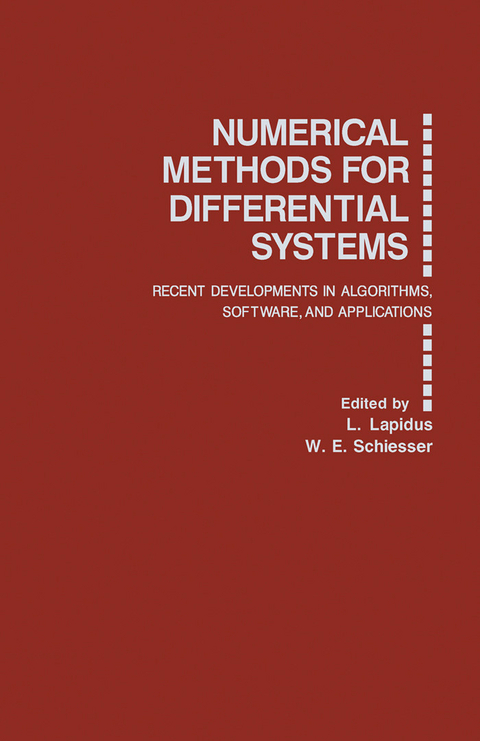
Numerical Methods for Differential Systems (eBook)
304 Seiten
Elsevier Science (Verlag)
978-1-4832-6985-6 (ISBN)
Numerical Methods for Differential Systems: Recent Developments in Algorithms, Software, and Applications reviews developments in algorithms, software, and applications of numerical methods for differential systems. Topics covered include numerical algorithms for ordinary and partial differential equations (ODE/PDEs); theoretical approaches to the solution of nonlinear algebraic and boundary value problems via associated differential systems; integration algorithms for initial-value ODEs with particular emphasis on stiff systems; finite difference algorithms; and general- and special-purpose computer codes for ODE/PDEs. Comprised of 15 chapters, this book begins with an introduction to high-order A-stable averaging algorithms for stiff differential systems, followed by a discussion on second derivative multistep formulas based on g-splines; numerical integration of linearized stiff ODEs; and numerical solution of large systems of stiff ODEs in a modular simulation framework. Subsequent chapters focus on numerical methods for mass action kinetics; a systematized collection of codes for solving two-point boundary value problems; general software for PDEs; and the choice of algorithms in automated method of lines solution of PDEs. The final chapter is devoted to quality software for ODEs. This monograph should be of interest to mathematicians, chemists, and chemical engineers.
Front Cover 1
Numerical Methods for Differential Systems: Recent Developments in Algorithms, Software, and Applications 4
Copyright Page 5
Table of Contents 6
List of Contributors 8
Preface 10
Chapter 1. High-Order A-Stable Averaging Algorithms
14
REFERENCES 36
Chapter 2. Second Derivative Multistep Formulas
38
1. INTRODUCTION 38
2. NOTATION AND DEFINITIONS 38
3. CONSTRUCTION OF FORMULAS 40
4. COMPARISONS OF FORMULAS 44
5. SUMMARY AND CONCLUSIONS 48
REFERENCES 50
Chapter 3. Numerical Integration of Linearized
52
1. INTRODUCTION 52
2. THE NUMERICAL METHOD 52
3. APPLICATIONS 53
4. TEST RESULTS 55
5. CONCLUSIONS 57
REFERENCES 57
Chapter 4. Comparing Numerical Methods for the Solution of Stiff Systems of ODEs Arising
58
1. INTRODUCTION 58
2. TESTING NUMERICAL METHODS 60
3. RESULTS AND RECOMMENDATIONS 63
REFERENCES 74
Appendix: Specification of Test Problems 77
Chapter 5. On the Construction of Differential Systems for the Solution of Nonlinear Algebraic and Transcendental Systems of
80
1. INTRODUCTION 80
2. A GLOBAL ASYMPTOTIC STABILITY THEOREM 82
3. DIFFERENTIAL METHODS LIMITED TO INVERTIBLE SYSTEMS 85
4. DIFFERENTIAL METHODS FOR NON-INVERTIBLE SYSTEMS 88
5. EXAMPLES AND CONVERGENCE RATES 93
REFERENCES 97
Chapter 6. Differential Procedures for Systems of Implicit Relations and Implicitly Coupled Nonlinear Boundary-Value
98
1. INTRODUCTION AND PRELIMINARY CONSIDERATIONS 98
2. GENERATION OF A SOLUTION ON A GRID IN 100
3. GENERATION OF THE STARTING VALUES FOR THE GRID 102
4. MULTIPLE BRANCH SOLUTIONS 105
5. NONLINEAR BOUNDARY VALUE PROBLEMS WITH IMPLICIT COUPLING 105
REFERENCES 108
Chapter 7. Numerical Solution of Large Systems of Stiff Ordinary Differential Equations
110
1. INTRODUCTION 110
2. NUMERICAL SOLUTION OF STIFF O.D.E.S. 110
3. NUMERICAL SOLUTION OF SPARSE LINEAR ALGEBRAIC EQUATIONS 111
4. NUMERICAL TESTING OF STIFF TECHNIQUES 113
5. THE DYNSYS 2.0 EXECUTIVE PROGRAM 118
6. EPILOGUE 119
APPENDIX A: TEST EXAMPLES 120
APPENDIX B: GEAR'S METHOD 123
REFERENCES 123
Chapter 8. FAST: A Translator for the Solution of Stiff and Nonlinear
138
1. INTRODUCTION 138
2. MATHEMATICAL CONDITIONS 139
3. FAST TRANSLATOR 142
4. THE NON-LINEARITIES 147
5. DESCRIPTION OF THE TRANSLATOR'S OPERATION 149
6. EXAMPLES 150
CONCLUSIONS 155
BIBLIOGRAPHY 158
ACKNOWLEDGEMENTS 159
Chapter 9. Applications of EPISODE: An Experimental Package for the Integration of
160
1. Introduction 160
2. Examples 163
3. Package Description 177
REFERENCES 179
Chapter 10. SETKIN: A Chemical Kenetics Preprocessor Code 180
1. INTRODUCTION 180
2. EXAMPLE 182
3. QKCALC
183
4. BUSTER (Rate equation construction) 185
5. DIFFUN (Differential Equation Function) 190
6. PEDERV: (Jacobian Calculation) 191
7. SENSIT: (Sensitivity Analysis) 192
REFERENCES 193
Chapter 11. Numerical Methods for Mass Action Kinetics 194
1. INTRODUCTION 194
2. SOME MATHEMATICAL PROPERTIES OF MASS ACTION KINETICS 196
3. APPROXIMATE METHODS FOR MASS ACTION KINETICS 199
4. CONCLUSIONS 205
5. ACKNOWLEDGEMENTS 206
REFERENCES 206
Chapter 12. A Systematized Collection of Codes for Solving
210
1. Introduction 210
2. Methods 211
3. Integration Methods 217
4. Codes 219
5. Numerical Examples 224
References 238
Chapter 13. General Software for Partial Differential Equations 242
1. Introduction 242
2. Class of Problems 243
3. Piecewise Polynomials 244
4. Collocation Method 245
5. Numerical Examples 247
6. Conclusions 254
REFERENCES 255
Chapter 14. The Choice of Algorithms in Automated Method of Lines Solution of Partial Differential Equations 256
INTRODUCTION 256
THE FORSIM PDE PACKAGE 258
THE INTEGRATION ALGORITHM 258
THE HINDMARSH-GEAR ALGORITHM 258
THE SPARSE MATRIX OPTION WITH JACOBIAN EVALUATION OPTIMIZATION 259
THE DISCRETIZATION FORMULAE FOR SPATIAL DERIVATIVES 260
LAGRANGE FORMULAE 260
HERMITE FORMULAE 261
OTHER TECHNIQUES 262
IMPLEMENTATION 262
UNEQUAL SPATIAL DIVISION 263
ERROR AND THE SPATIAL DERIVATIVE APPROXIMATION 263
PARABOLIC AND ELLIPTIC EQUATIONS 265
HYPERBOLIC EQUATIONS 266
ARTIFICIAL DISSIPATION 268
UPWIND DIFFERENCING 269
BOUNDARY CONDITIONS 269
CONSERVATION EQUATIONS 270
INCREASING EFFICIENCY FOR PRODUCTION RUNS 275
CONCLUSIONS 275
REFERENCES 275
Chapter 15. Panel Discussion of Quality Software for ODEs 280
1. Introduction (G. D. Byrne). 280
2. Some Features of Quality Codes for ODE's* (G. D. Byrne) 280
3. The Use of Quality O.D.E. Codes in User Packages (C. W. Gear). 282
4. Quality Software for Ordinary Differential Equations at
285
REFERENCES 287
5. Testing and Certification of ODE
288
6.
290
REFERENCES 294
7. Quality Software for Non-Stiff Ordinary Differential
294
8. Question and Answer Session 297
Subject Index 300
| Erscheint lt. Verlag | 12.5.2014 |
|---|---|
| Sprache | englisch |
| Themenwelt | Mathematik / Informatik ► Mathematik ► Analysis |
| Technik | |
| ISBN-10 | 1-4832-6985-X / 148326985X |
| ISBN-13 | 978-1-4832-6985-6 / 9781483269856 |
| Informationen gemäß Produktsicherheitsverordnung (GPSR) | |
| Haben Sie eine Frage zum Produkt? |
 PDF (Adobe DRM)
Kopierschutz: Adobe-DRM
Adobe-DRM ist ein Kopierschutz, der das eBook vor Mißbrauch schützen soll. Dabei wird das eBook bereits beim Download auf Ihre persönliche Adobe-ID autorisiert. Lesen können Sie das eBook dann nur auf den Geräten, welche ebenfalls auf Ihre Adobe-ID registriert sind.
Details zum Adobe-DRM
Dateiformat: PDF (Portable Document Format)
Mit einem festen Seitenlayout eignet sich die PDF besonders für Fachbücher mit Spalten, Tabellen und Abbildungen. Eine PDF kann auf fast allen Geräten angezeigt werden, ist aber für kleine Displays (Smartphone, eReader) nur eingeschränkt geeignet.
Systemvoraussetzungen:
PC/Mac: Mit einem PC oder Mac können Sie dieses eBook lesen. Sie benötigen eine
eReader: Dieses eBook kann mit (fast) allen eBook-Readern gelesen werden. Mit dem amazon-Kindle ist es aber nicht kompatibel.
Smartphone/Tablet: Egal ob Apple oder Android, dieses eBook können Sie lesen. Sie benötigen eine
Geräteliste und zusätzliche Hinweise
Buying eBooks from abroad
For tax law reasons we can sell eBooks just within Germany and Switzerland. Regrettably we cannot fulfill eBook-orders from other countries.
aus dem Bereich