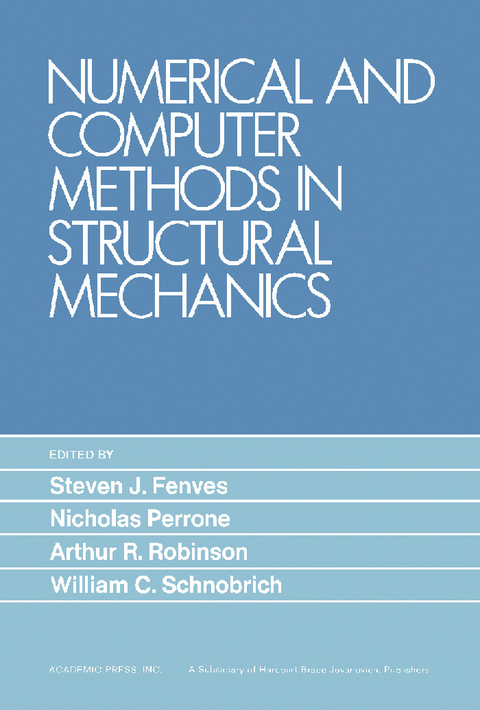
Numerical and Computer Methods in Structural Mechanics (eBook)
698 Seiten
Elsevier Science (Verlag)
9781483272542 (ISBN)
Numerical and Computer Methods in Structural Mechanics is a compendium of papers that deals with the numerical methods in structural mechanics, computer techniques, and computer capabilities. Some papers discus the analytical basis of the computer technique most widely used in software, that is, the finite element method. This method includes the convergence (in terms of variation principles) isoparametrics, hybrid models, and incompatible displacement models. Other papers explain the storage or retrieval of data, as well as equation-solving algorithms. Other papers describe general-purpose structural mechanics programs, alternatives to, and extension of the usual finite element approaches. Another paper explores nonlinear, dynamic finite element problems, and a direct physical approach to determine finite difference models. Special papers explain structural mechanics used in computing, particularly, those related to integrated data bases, such as in the Structures Oriented Exchange System of the Office of Naval Research and the integrated design of tanker structures. Other papers describe software and hardware capabilities, for example, in ship design, fracture mechanics, biomechanics, and crash safety. The text is suitable for programmers, computer engineers, researchers, and scientists involved in materials and industrial design.
Front Cover 1
Numerical and Computer Methods in Structural Mechanics 4
Copyright Page 5
Table of Contents 6
LIST OF CONTRIBUTORS 16
PREFACE 20
PART
22
Chapter 1. Variational Procedures and Convergence of Finite-Element Methods 22
References 32
Chapter 2. Isoparametric and Allied Numerically Integrated Elements— A Review 34
1. Introduction 34
2. Basic Principles of Shape Function (Interpolation ) Mapping 35
3. Uniqueness of Mapping 37
4. Iso-, Sub-, and Superparametric Elements 39
5. Evaluation of Element Properties in Curvilinear Coordinates 40
6. Required Accuracy of Numerical Integration 41
7. Some Useful Elements for Two- and Three-Dimensional Analysis 43
8. Degeneration of Quadrilateral or Brick Elements 47
9. Computation Efficiency of Numerical Integration 49
10. Practical Examples and Stress Computation 50
11. Shells and Plates as Limiting Cases of Three-Dimensional Analysis 52
12. Applications to Nonlinear Analysis 55
13. Concluding Remarks—Other
58
References 60
Chapter 3. Incompatible Displacement Models 64
1. Introduction 64
2. Source of Errors 65
3. Addition of Incompatible Modes for Two-Dimensional Isoparametric Elements 66
4. Three-Dimensional Elements 72
5. Thick Shell Element 73
6. Thick Shell Examples 76
References 78
Chapter 4. Hybrid Models 80
1. Introduction 80
2. Formulation of Hybrid Stress Model 81
3. Features of Hybrid Stress Model 84
4. Hybrid Displacement Models 95
5. Conclusion 97
References 97
Chapter 5. Computer Implementation of the Finite-Element Procedure 100
1. Introduction 100
2. Prerequisites 101
3. Solution Methods for the Load-Deflection Equations 104
4. Incorporation of Different Finite-Element Types 125
5. Modular Design 127
6. Problem Description and Representation of the Results 133
Acknowledgments 138
References 138
PART
144
Chapter 6. Review of the ASKA Program 144
1. Introduction 144
2. General Information 145
3. Element Library 146
4. Preparation of an ASKA Job 152
5. Special Features in ASKA 155
6. Dynamic Analysis 158
7. Problems Solved with ASKA 159
8. Concluding Remarks 168
Acknowledgment 169
References 169
Chapter 7. A Critical View of NASTRAN 172
1. Introduction 172
2. History of NASTRAN 172
3. Boeing Evaluation Project 173
4. Analytic Capability 174
5. Element Technology 179
6. Numerical Methods 182
7. Ease of Use 185
8. Problem Size 186
9. Performance 187
10. Design Criteria 188
11. Maintainability 189
12. Conclusion 189
Appendix A. Future NASTRAN Developments 190
Appendix B. Examples of Analysis 191
References 194
Chapter 8. The DAISY Code 196
1. Introduction 197
2. Some Features of DAISY 199
3. Lockheed's Development of DAISY 203
4. Some Examples of Problems Solved with DAISY 218
5. Future Plans 230
Chapter 9. An Evaluation of the STARDYNE
232
1. Introduction 232
2. STARDYNE 232
3. Examples of Problems Solved 237
4. Performance 245
5. Conclusions 247
Chapter 10. Analysis and Design Capabilities of STRUDL Program 250
1. Introduction 250
2. Definition of the Problem 251
3. Analysis Facilities 252
4. Design Facilities 256
5. Nondestructive Save/Restore and
258
6. Maintenance, Improvements, and Implementation 259
7. Machine Configuration 260
8. Computer Cost 260
9. Conclusion 265
References 266
Chapter 11. Elastic-Plastic and Creep Analysis via the MARC Finite-Element Computer Program 268
1. Introduction 268
2. Example 1—Plasticit y Analysis 269
3. Example 2—Primar y Creep Analysis 275
4. Other Examples 278
5. The Merits of MARC 284
6. Conclusions 284
References 284
PART
286
Chapter 12. A Survey of Finite-Difference Methods for Partial Differential Equations 286
1. Introduction 286
2. General Discussion 288
3. Hyperbolic Systems 289
4. Parabolic Systems 292
5. Elliptic Systems 293
6. Tensor Product—Fast
296
7. Implicit versus Explicit Methods—Flexibility Concept 298
8. The Method of Fractional Steps 300
9. Stability and the Energy Method 304
References 307
Chapter 13. Finite-Difference Energy Models versus Finite-Element Models:
312
Nomenclature 313
1. Introduction 315
2. Analysis 316
3. Numerical Results 331
4. Comments on Application to Two-Dimensional Problems 346
5. Conclusions 352
Appendix 353
References 356
Chapter 14. Comparison of Finite-Element and Finite-Difference Methods 358
1. Introduction 358
2. A Problem in Wave Mechanics 359
3. Early Literature 368
References 371
Chapter 15. Incremental Stiffness Method for Finite Element Analysis of the Nonlinear Dynamic Problem 374
1. Introduction 374
2. Review of Literature 375
3. Theoretical Considerations 376
4. Solution Procedure 378
5. Note on Solution Convergence 378
6. Computer Program 380
7. Case Studies 380
8. Discussion and Conclusions 394
Acknowledgments 396
References 396
Chapter 16. The Lumped-Parameter or Bar-Node Model Approach to Thin-Shell Analysis 398
1. Introduction 398
2. Shallow Shell Equations 400
3. Lumped-Parameter Model 402
4. Boundary Conditions 407
5. Selection of Proper Model 411
6. Conclusions 419
Appendix A. Lumped-Parameter Element Stiffness Matrices 420
References 422
PART
424
Chapter 17. Design Philosophy of Large Interactive Systems 424
1. Introduction 425
2. Components of Data Base 426
3. Program Design 428
4. Data Structure Design 430
5. Control System Design 432
6. Who Will Do It 433
7. Conclusions 434
References 435
Chapter 18. Integrated Design of Tanker Structures 436
1. Introduction 436
2. Presentation of the Structural Problem 437
3. Design Procedure 440
4. Synthesis 445
5. Software System 449
6. Concluding Remarks 451
Acknowledgment 451
Appendix I. Automated Design and Optimization Programs 451
Appendix II. Example of BOSS Session 454
References 457
Chapter 19. The STORE Project (The Structures Oriented Exchange) 460
1. Introduction 460
2. Basic Concepts of STORE 462
3. Description of the STORE System 464
4. Use of the STORE System 467
5. Costs 471
6. Distinguishing Characteristics of the STORE System 472
7. Illustrative Example—Typica l STOR E Program Documentation 473
8. Present Status, Conclusions, and Recommendations 478
Appendix A. List of Programs in Project STORE 478
References 479
PART
480
Chapter 20. Symbolic Computing 480
1. Introduction 480
2. Organization of Data and Data Processors 481
3. The Role of Symbolic Computation in Mechanics 487
4. Discussion and Conclusion 496
References 497
Chapter 21. A Review of the Capabilities and Limitations of Parallel
500
1. Introduction 500
2. The Parallel Computer 501
3. The Pipeline Processor 502
4. Parallel and Pipeline 504
5. Parallel and Pipeline Execution Times 505
6. Parallel versus Pipeline : Efficiency 509
7. Languages for the Parallel and Pipeline Computers 511
8. Application Programming 512
9. Performance on Large Problems 513
10. Conclusion 515
Acknowledgments 516
References 516
Chapter 22. Equation-Solving Algorithms for the Finite-Element Method 518
1. Introduction 518
2. Types of Record Encountered 518
3. Principal Types of Organization 519
4. Gaussian Reduction 522
5. Error Diagnostics 523
6. The Conjugate Gradient
524
7. The Alternating-Direction Approach 529
8. Multivector Iteration 530
9. Conclusions 531
Appendix I. The Prefront with Variable Numbers of Degrees of Freedom at Different Nodes 531
Appendix II. Avoidance of Zeros within the Front 532
References 532
Chapter 23. FLING— A FORTRAN Language for Interactive Graphics 534
1. Introduction 534
2. Basic Graphic Subroutines 537
3. Example Problems 544
Appendix A. IBM 360 Interface Package 559
PART VI.
564
Chapter 24. Trends and Directions in the Applications of Numerical Analysis 564
1. Introduction 564
2. Alternative Variational Principles 565
3. Constraint Equation Procedures 568
4. Interdisciplinary Applications 570
5. Concluding Remarks 573
References 575
Chapter 25. Vehicle Crashworthiness 578
1. Introduction 578
2. Crash Environment 579
3. Injury Causes and Patterns 585
4. Crash Survival 590
5. Conclusions 604
References 605
Chapter 26. Computational Fracture Mechanics 606
1. Introduction 606
2. Numerical Determination of Elastic Stress Intensity Factors (Two-Dimensional Problems) 608
3. Crack Tip Plasticity 613
4. Singular Finite-Element Formation and Results 620
5. Three-Dimensional Problems 635
6. Micromechanic s and Development of Fracture Criteria 637
7. Conclusion 641
Acknowledgment 642
References 642
Chapter 27. Biomechanics 646
1. Mechanics in Living Systems 646
2. The Tasks of Biomechanics 647
3. A Function-Oriented Taxonomy of the Mechanics of Living Systems 648
4. Characteristics of Biomechanics Problems 652
5. The Role of Numerical Solutions in Biomechanics 654
6. State of the Art Examples of Numerical Solutions in Biomechanics 655
7. Conclusions: Artimechanics, Physimechanics, and Biomechanics 661
References 662
Chapter 28. The Computer in Ship Structure Design 664
1. Introduction 664
2. Current and Future Developments in Computer Hardware 665
3. Current and Future Developments in Structural Analysis Software 666
4. Relationship between the Computer and the Engineer 666
5. Future Trends in Ship Structure Analysis 667
6. Problems and Useful Techniques in Interactive Analysis 668
7. The Local Analysis Procedure 669
8. The Reduced Substructure Technique (RESS) 670
9. Automatic Data Generation and Interpretation of Results 673
10. Data Banks 677
11. Multistep Solutions 678
12. Dynamic Modeling Using Compatible Finite Elements of Different Order 679
13. The Problem of Storage in a Small Computer 681
14. Method of Additional Constraints (MAC) 682
15. Variations on the Gauss-Seidel Iterative Technique 685
16. Conclusion 688
Acknowledgments 688
Appendix A. Nomenclature 688
References 689
AUTHOR INDEX 690
| Erscheint lt. Verlag | 10.5.2014 |
|---|---|
| Sprache | englisch |
| Themenwelt | Mathematik / Informatik ► Mathematik |
| Technik ► Bauwesen | |
| ISBN-13 | 9781483272542 / 9781483272542 |
| Informationen gemäß Produktsicherheitsverordnung (GPSR) | |
| Haben Sie eine Frage zum Produkt? |
 PDF (Adobe DRM)
Kopierschutz: Adobe-DRM
Adobe-DRM ist ein Kopierschutz, der das eBook vor Mißbrauch schützen soll. Dabei wird das eBook bereits beim Download auf Ihre persönliche Adobe-ID autorisiert. Lesen können Sie das eBook dann nur auf den Geräten, welche ebenfalls auf Ihre Adobe-ID registriert sind.
Details zum Adobe-DRM
Dateiformat: PDF (Portable Document Format)
Mit einem festen Seitenlayout eignet sich die PDF besonders für Fachbücher mit Spalten, Tabellen und Abbildungen. Eine PDF kann auf fast allen Geräten angezeigt werden, ist aber für kleine Displays (Smartphone, eReader) nur eingeschränkt geeignet.
Systemvoraussetzungen:
PC/Mac: Mit einem PC oder Mac können Sie dieses eBook lesen. Sie benötigen eine
eReader: Dieses eBook kann mit (fast) allen eBook-Readern gelesen werden. Mit dem amazon-Kindle ist es aber nicht kompatibel.
Smartphone/Tablet: Egal ob Apple oder Android, dieses eBook können Sie lesen. Sie benötigen eine
Geräteliste und zusätzliche Hinweise
Buying eBooks from abroad
For tax law reasons we can sell eBooks just within Germany and Switzerland. Regrettably we cannot fulfill eBook-orders from other countries.
aus dem Bereich