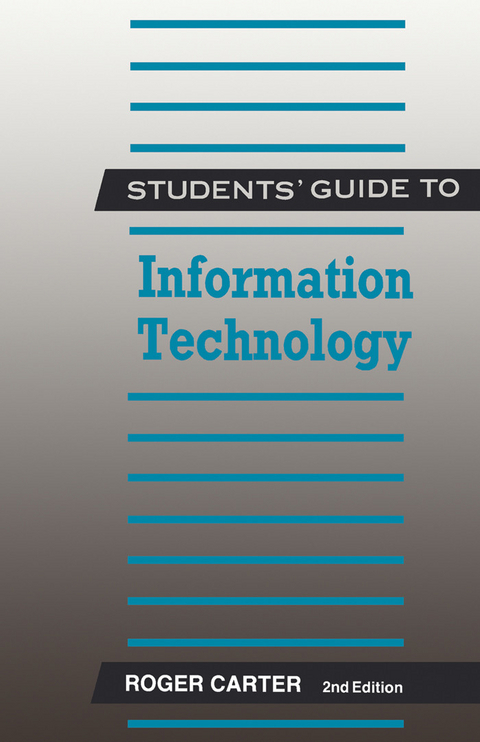
Students' Guide to Information Technology (eBook)
266 Seiten
Elsevier Science (Verlag)
978-1-4831-8383-1 (ISBN)
Students' Guide to Information Technology, Second Edition provides up-to-date coverage of significant developments in information technology, including office automation, telecommunications, expert systems, computer-aided manufacture, and computer-based training. The book first offers information on computers and computer peripherals and applications. Discussions focus on how a microprocessor handles information, microprocessors and logic, neural networks, digital signal processors, processing speeds, computer memory, monitors, printers, and input and storage devices. The manuscript then surveys computer software and technical convergence. Topics cover analogue and digital information, audio and video systems, technological convergence in audio systems, compact disc for multimedia applications, interactive video, programming languages, operating software, operating system commands, application software, and software reliability. The publication tackles the role of information technology in manufacturing and in the office, communications, and information systems. Concerns include electronic data interchange, computer-aided design, data processing systems, office automation systems, and dataflow diagrams. The manuscript is a dependable source of data for computer science experts and researchers interested in information technology.
Front Cover 1
Students' Guide to Information Technology 4
Copyright Page 5
Table of Contents 6
Preface 10
Chapter 1. The information revolution 12
Scenario 12
What is information? 12
Four kinds of information 13
Information processing 14
What is information technology? 15
IT devices 17
The IT revolution 18
The impact of the IT revolution 19
IT and employment 21
Chapter 2. Computers 25
Scenario 25
What is a computer? 25
Computer hardware 26
Microprocessors 27
How a microprocessor handles information 28
Binary numbers 30
Microprocessors and logic 31
Arithmetic and logic gates 35
Logic circuits 36
Microprocessors and computers 37
Neural networks 42
Digital signal processors 43
Processing speeds 43
Computer memory 44
Types of computer 47
The evolution of the personal computer 49
Chapter 3. Computer peripherals and applications 59
Scenario 59
Using a computer 60
Input devices 61
Storage devices 68
Output devices: monitors 72
Output devices: printers 75
The benefits of computers 80
The uses of computers 80
Chapter 4. Computer software 84
Scenario 84
The importance of software 84
What is software? 85
How software works 86
Programming languages 87
Software reliability 93
Program specification 93
Declarative languages 94
Object-oriented languages 95
System software 96
Operating systems 97
How the operating system organizes the disk 98
Operating system commands 102
Operating environments 102
Windows 105
Using Windows 105
Other environments for PCs 111
Utilities 112
Application software 113
Features of application packages 114
Chapter 5. Technical convergence 118
Scenario 118
Technological convergence 118
Analogue and digital information 120
Audio and video systems 123
Technological convergence in audio systems 128
Technological convergence in video systems 129
Multimedia 130
Interactive video 131
Compact discs 134
Compact disc for multimedia applications 136
Data compression 137
Virtual reality systems 137
Chapter 6. Communications 142
Scenario 142
What do we mean by communications? 142
How do electromagnetic communications work? 144
Technological convergence and communications 145
Fibre optics 147
The telecommunications problem 147
Carrier waves and modulation 149
Multiplexing 151
Modems 152
Communications systems and networks 154
Inter-computer communications 154
Local area networks 156
Circuit-switched networks 157
Packet-switched networks 158
The Open Systems Interconnection (OSI) reference model 159
Broadcast networks 160
Telecommunications services 163
On-line databases and bulletin boards 170
Electronic data interchange 172
Chapter 7. Information systems 175
Scenario 175
Introduction to information systems 175
The systems project life cycle 177
Systems analysis 179
The essential model 181
Reasons for using graphical modelling tools 181
The statement of purpose 183
The context diagram 184
The event list 186
Dataflow diagrams 187
The entity-relationship diagram 190
The data dictionary 191
Process specifications 193
Designing and implementing the system 194
Chapter 8. IT in the office 198
Scenario 198
Office automation 198
The benefits and implications of office automation 199
Office automation systems 201
Office automation and the paperless office 202
Database software 203
Spreadsheet software 211
Business graphics and presentations 216
Word processing and desktop publishing 221
Personal productivity software 229
Ideas organizers 229
Chapter 9. IT in manufacturing 235
Scenario 235
The main steps in the manufacturing process 235
Data processing systems 237
Expert systems 241
Computer-aided design 245
Computer-integrated manufacturing 249
The evolution of manufacturing technology 250
The impact of CIM 253
Creating the integrated factory 254
Controlling the integrated factory 255
Computer-aided manufacture 256
Flexible manufacturing systems 257
Index 262
| Erscheint lt. Verlag | 12.5.2014 |
|---|---|
| Sprache | englisch |
| Themenwelt | Mathematik / Informatik ► Informatik ► Theorie / Studium |
| Mathematik / Informatik ► Mathematik ► Finanz- / Wirtschaftsmathematik | |
| Technik ► Bauwesen | |
| Wirtschaft | |
| ISBN-10 | 1-4831-8383-1 / 1483183831 |
| ISBN-13 | 978-1-4831-8383-1 / 9781483183831 |
| Informationen gemäß Produktsicherheitsverordnung (GPSR) | |
| Haben Sie eine Frage zum Produkt? |
 PDF (Adobe DRM)
Kopierschutz: Adobe-DRM
Adobe-DRM ist ein Kopierschutz, der das eBook vor Mißbrauch schützen soll. Dabei wird das eBook bereits beim Download auf Ihre persönliche Adobe-ID autorisiert. Lesen können Sie das eBook dann nur auf den Geräten, welche ebenfalls auf Ihre Adobe-ID registriert sind.
Details zum Adobe-DRM
Dateiformat: PDF (Portable Document Format)
Mit einem festen Seitenlayout eignet sich die PDF besonders für Fachbücher mit Spalten, Tabellen und Abbildungen. Eine PDF kann auf fast allen Geräten angezeigt werden, ist aber für kleine Displays (Smartphone, eReader) nur eingeschränkt geeignet.
Systemvoraussetzungen:
PC/Mac: Mit einem PC oder Mac können Sie dieses eBook lesen. Sie benötigen eine
eReader: Dieses eBook kann mit (fast) allen eBook-Readern gelesen werden. Mit dem amazon-Kindle ist es aber nicht kompatibel.
Smartphone/Tablet: Egal ob Apple oder Android, dieses eBook können Sie lesen. Sie benötigen eine
Geräteliste und zusätzliche Hinweise
Buying eBooks from abroad
For tax law reasons we can sell eBooks just within Germany and Switzerland. Regrettably we cannot fulfill eBook-orders from other countries.
aus dem Bereich