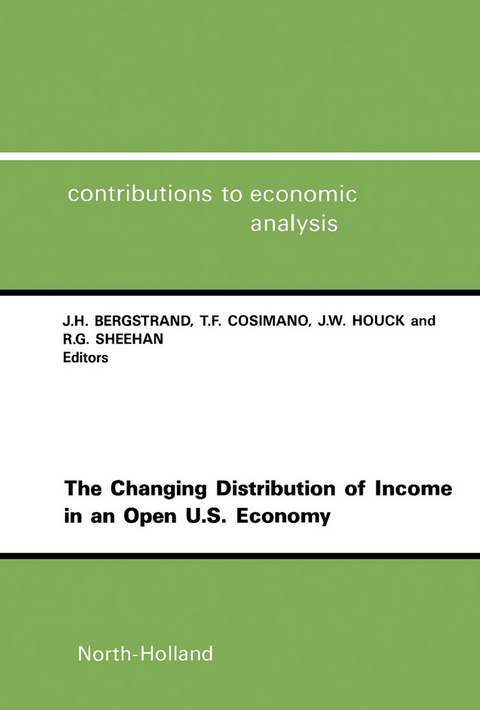
Changing Distribution of Income in an Open U.S. Economy (eBook)
412 Seiten
Elsevier Science (Verlag)
978-1-4832-9626-5 (ISBN)
There have been dramatic changes in the distribution of earnings and income in the United States during recent years. This volume presents original papers, contributed by eminent economists, on the measurement and causes of growing income inequality in the U.S. and other major industrialized countries. The first part examines the definition of income, decomposition of earnings into capacity and capacity utilization rates, and alternative methodologies for estimating income and earnings dispersion. The second part investigates theoretically or empirically alternative causes of income inequality: international trade, macroeconomic conditions and policies, technological progress, productivity growth, institutions, demographic labor supply, and sectoral labor demand. In the final part of the volume policy implications and recommendations are discussed.The volume will be valuable for academic departments (economics, political science, sociology); economic policy institutes and Federal Reserve Bank research departments; economists in government.
Front Cover 1
The Changing Distribution of Income in an Open U.S. Economy 4
Copyright Page 5
Table of Contents 10
Preface 8
List of Figures 18
List of Tables 22
List of Conference Speakers 26
PART 1: ISSUES IN THE MEASUREMENT OF INCOME INEQUALITY 28
CHAPTER 1. THE SCOPE, GROWTH, AND CAUSES OF INCOME INEQUALITY IN AN OPEN U.S. ECONOMY 30
1.1 Introduction 30
1.2 Issues in the Measurement of Income Inequality 34
1.3 Issues in the Causes of Income Inequality 41
1.4 Policy Implications and Recommendations 49
1.5 Conclusions 53
Endnotes 54
References 54
CHAPTER 2. LEVELS OF AND CHANGES IN THE DISTRIBUTION OF U.S. INCOME 56
2.1 Introduction 56
2.2 Methodological Issues 63
2.3 The Distribution of Earnings 75
2.4 Social, Demographic, and Economic Factors Related to the Changing Distribution of Income 79
2.5 Future Research 86
Endnotes 87
References 89
CHAPTER 3. A DOMINANCE EVALUATION OF DISTRIBUTIONS OF INCOME AND THE BENEFITS OF ECONOMIC GROWTH 92
3.1 Introduction 92
3.2 The Dominance Method 94
3.3 Dominance Comparisons and the U.S. Income Distribution 108
3.4 The Distribution of the Benefits of U.S. Economic Growth 113
3.5 Why Has the Distribution of the Benefits of Growth Changed? 122
3.6 Conclusion 123
Endnotes 124
References 127
CHAPTER 4. THE GROWTH IN MALE EARNINGS INEQUALITY, 1973-1988: THE ROLE OF EARNINGS CAPACITY AND UTILIZATION 132
4.1 Introduction 132
4.2 A Brief Literature Review 136
4.3 Patterns of Male Earnings Inequality, 1973-1988 141
4.4 Patterns of Earnings Capacity Inequality, 1973-1988 143
4.5 Patterns of Earnings Capacity Utilization, 1973-1988 148
4.6 Sources of Increased Earnings Inequality, 1973-1988 151
4.7 Conclusions 153
Endnotes 156
References 161
Appendix A 163
Appendix B1 166
Appendix B2 167
Appendix B3 168
Appendix B4 169
Appendix C 170
CHAPTER 5. DIMENSIONS OF INEQUALITY IN LABOR INCOME 172
5.1 Introduction 172
5.2 The Data 175
5.3 The Metrics for Earnings Comparisons 176
5.4 Trends in Earnings of White Men 178
5.5 Relative Earnings of White Women, Black Men, and Black Women 182
5.6 Earnings Differentials Between High School and College Graduates and By Time Since Leaving School 187
5.7 Summary 193
Endnotes 195
References 197
Appendix 198
PART 2: ISSUES IN THE CAUSES OF INCOME INEQUALITY 208
CHAPTER 6. USING REGIONAL DATA TO REEXAMINE THE CONTRIBUTION OF DEMOGRAPHIC AND SECTORAL CHANGES TO INCREASING U.S. WAGE INEQUALITY 210
6.1 Introduction 210
6.2 CPS Wage Data 212
6.3 Regional Differences In Wage Inequality 213
6.4 Decomposition Analysis 223
6.5 Regression Analysis 229
6.6 Conclusions 237
Endnotes 239
References 241
CHAPTER 7. THE RELATIONSHIP BETWEEN WAGE INEQUALITY AND INTERNATIONAL TRADE 244
7.1 Introduction 244
7.2 Data 246
7.3 Time-Series Evidence 247
7.4 A Model of the Link between Wages and Rents 257
7.5 Trends in Labor Compensation in Some Key Industries 261
7.6 Summary 264
Endnotes 264
References 265
CHAPTER 8. A MACROECONOMETRIC MODEL OF INCOME INEQUALITY IN THE UNITED STATES 270
8.1 Introduction 270
8.2 The Increase in Income Inequality in the 1980s 271
8.3 Methodology and Variables Considered 272
8.4 Empirical Results 277
8.5 Historical Decompositions 292
8.6 Summary and Concluding Remarks 300
Endnotes 301
References 302
CHAPTER 9. TECHNOLOGICAL PROGRESS AND INCOME INEQUALITY: A MODEL WITH HUMAN CAPITAL AND BEQUESTS 306
9.1 Introduction 306
9.2 The Model 308
9.3 Income-Distribution Effects of Technological Innovations 313
9.4 Concluding Remarks 316
References 317
Appendix A 319
Appendix . 320
Appendix C 321
Appendix D 321
CHAPTER 10. PRODUCTIVITY AND INCOME INEQUALITY GROWTH RATES IN THE UNITED STATES 326
10.1 Introduction 326
10.2 Relationships Between Income Inequality and Productivity 329
10.3 Data and Methodology 330
10.4 Empirical Results 336
10.5 Concluding Remarks 345
References 351
PART 3: POLICY IMPLICATIONS AND RECOMMENDATIONS 356
CHAPTER 11. OLD THEORIES IN NEW BOTTLES: TOWARD AN EXPLANATION OF GROWING WORLD-WIDE INCOME INEQUALITY 358
11.1 Introduction 358
11.2 The Emerging Consensus around Inequality Trends 359
11.3 Possible Explanations for the Trends in the Wage Distribution 360
11.4 Sorting Out the Explanations 361
11.5 Heckscher-Ohlin Factor-Price-Equalization Theory 363
11.6 Evidence for the Heckscher-Ohlin Effect 364
11.7 Policies to Combat Growing Inequality 365
References 367
CHAPTER 12. GENERAL ECONOMIC THEORY AND INCOME INEQUALITY 370
12.1 Introduction 370
12.2 Income and Earnings 370
12.3 Transaction Costs 371
12.4 Dynamic Theories 372
CHAPTER 13. HAVE WE UNDERINVESTED IN EDUCATION? 376
13.1 Introduction 376
13.2 The Ideal Experiment 377
13.3 Intra-Family Schooling-Income Relations: Fathers, Sons, Brothers, Twins 377
13.4 Have We Underinvested in Education? 378
13.5 How Do We Finance Educational Investments? 379
Endnote 380
References 380
CHAPTER 14. THE CHANGING DISTRIBUTION OF INCOME IN AN OPEN U.S. ECONOMY: FINDINGS AND LESSONS 382
14.1 Introduction 382
14.2 Causes of Income Inequality 383
14.3 Important Questions 384
14.4 Policy Implications 385
CHAPTER 15. SUMMARY AND CONCLUSIONS 388
15.1 Introduction 388
15.2 Measurement Issues 390
15.3 Behavior of Inequality Measures 394
15.4 Determinants of Changes in Inequality 396
15.5 Policy Implications 405
Endnotes 406
References 406
Index 408
| Erscheint lt. Verlag | 1.6.2015 |
|---|---|
| Sprache | englisch |
| Themenwelt | Geschichte ► Teilgebiete der Geschichte ► Wirtschaftsgeschichte |
| Mathematik / Informatik ► Informatik ► Datenbanken | |
| Sozialwissenschaften ► Politik / Verwaltung ► Staat / Verwaltung | |
| Sozialwissenschaften ► Soziologie ► Empirische Sozialforschung | |
| Wirtschaft ► Betriebswirtschaft / Management ► Logistik / Produktion | |
| Wirtschaft ► Betriebswirtschaft / Management ► Marketing / Vertrieb | |
| Wirtschaft ► Betriebswirtschaft / Management ► Unternehmensführung / Management | |
| Wirtschaft ► Volkswirtschaftslehre ► Makroökonomie | |
| Wirtschaft ► Volkswirtschaftslehre ► Ökonometrie | |
| Wirtschaft ► Volkswirtschaftslehre ► Wirtschaftspolitik | |
| ISBN-10 | 1-4832-9626-1 / 1483296261 |
| ISBN-13 | 978-1-4832-9626-5 / 9781483296265 |
| Informationen gemäß Produktsicherheitsverordnung (GPSR) | |
| Haben Sie eine Frage zum Produkt? |
 PDF (Adobe DRM)
Kopierschutz: Adobe-DRM
Adobe-DRM ist ein Kopierschutz, der das eBook vor Mißbrauch schützen soll. Dabei wird das eBook bereits beim Download auf Ihre persönliche Adobe-ID autorisiert. Lesen können Sie das eBook dann nur auf den Geräten, welche ebenfalls auf Ihre Adobe-ID registriert sind.
Details zum Adobe-DRM
Dateiformat: PDF (Portable Document Format)
Mit einem festen Seitenlayout eignet sich die PDF besonders für Fachbücher mit Spalten, Tabellen und Abbildungen. Eine PDF kann auf fast allen Geräten angezeigt werden, ist aber für kleine Displays (Smartphone, eReader) nur eingeschränkt geeignet.
Systemvoraussetzungen:
PC/Mac: Mit einem PC oder Mac können Sie dieses eBook lesen. Sie benötigen eine
eReader: Dieses eBook kann mit (fast) allen eBook-Readern gelesen werden. Mit dem amazon-Kindle ist es aber nicht kompatibel.
Smartphone/Tablet: Egal ob Apple oder Android, dieses eBook können Sie lesen. Sie benötigen eine
Geräteliste und zusätzliche Hinweise
Buying eBooks from abroad
For tax law reasons we can sell eBooks just within Germany and Switzerland. Regrettably we cannot fulfill eBook-orders from other countries.
aus dem Bereich