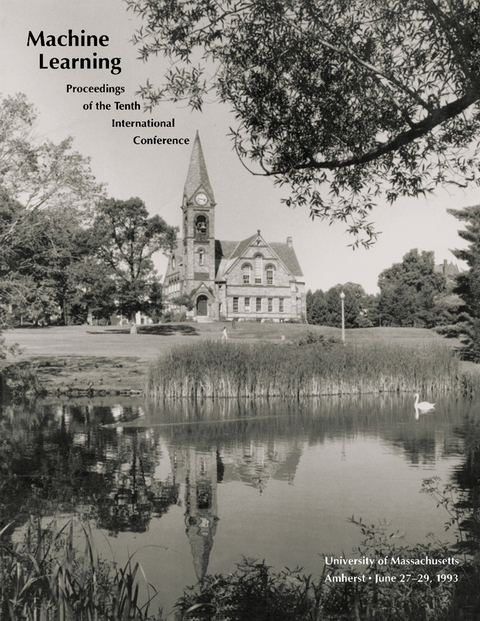
Machine Learning Proceedings 1993 (eBook)
540 Seiten
Elsevier Science (Verlag)
978-1-4832-9862-7 (ISBN)
Machine Learning Proceedings 1993
Front Cover 1
Machine Learning 2
Copyright Page 3
Table of Contents 4
PREFACE 8
ORGANIZING COMMITTEE 9
PROGRAM COMMITTEE 9
WORKSHOPS 10
Chapter 1. The Evolution of Genetic Algorithms: Towards Massive Parallelism 14
Abstract 14
1 INTRODUCTION 14
2 TRADITIONAL GAs 14
3 COARSE-GRAIN PARALLEL GAs 15
4 FINE-GRAIN PARALLEL GAs 16
5 FINE VS. COARSE-GRAIN PARALLELISIM 17
6 SUMMARY & FUTURE DIRECTIONS
References 21
CHAPTER 2. ÉLÉNA: A BOTTOM-UP LEARNING METHOD 22
ABSTRACT 22
INTRODUCTION 22
1 PRESENTATION OF THE SYSTEM 23
2 THE LEARNING COMPONENT 24
3 EXPERIMENTS 25
4 RELATED WORK 27
CONCLUSION 28
Acknowledgements 28
References 28
Chapter 3. Addressing the Selective Superiority Problem: Automatic Algorithm/Model Class Selection 30
Abstract 30
1 THE PROBLEM OF SELECTIVE SUPERIORITY 30
2 AUTOMATIC ALGORITHM SELECTION 30
3 KNOWLEDGE-BASED SEARCH 31
4 RECURSIVE COMBINATION OF MODEL CLASSES 32
5 MCS: A MODEL CLASS SELECTION SYSTEM 32
6 ILLUSTRATION 34
7 FUTURE WORK 36
8 CONCLUSION 37
Acknowledgments 37
References 37
Chapter 4. Using Decision Trees to Improve Case-Based Learning 38
Abstract 38
1 INTRODUCTION 38
2 LEARNING THE DEFINITION OF UNKNOWN WORDS 39
3 COMPARING THE DECISION TREE, CBL, AND HYBRID APPROACHES 40
4 RELATED WORK AND CONCLUSIONS 43
Acknowledgments 44
References 44
Chapter 5. GALOIS : An order-theoretic approach to conceptual clustering 46
Abstract 46
1 INTRODUCTION 46
2 THE CONCEPT LATTICE: BACKGROUND 47
3 AN ALGORITHM FOR THE INCREMENTAL DETERMINATION OF THE CONCEPT LATTICE 48
4 COMPUTATIONAL COMPLEXITY 50
5 EMPIRICAL EVALUATION OF GALOIS AS A LEARNING SYSTEM 50
6 RELATED WORK 52
7 CONCLUSION AND FUTURE WORK 53
Acknowledgements 53
References 53
Capter 6. Multitask Learning: A Knowledge-Based Source of Inductive Bias 54
Abstract 54
1 INTRODUCTION 54
2 MULTITASK LEARNING AND INDUCTIVE BIAS 54
3 AN EXAMPLE OF MULTITASK CONNECTIONIST LEARNING 55
4 MULTITASK CONNECTIONIST LEARNING IN MORE DETAIL 58
5 MULTITASK DECISION TREES 59
6 RELATED WORK 60
7 SUMMARY 60
Acknowledgements 61
References 61
Chapter 7. Using Qualitative Models to Guide Inductive Learning 62
Abstract 62
1 INTRODUCTION 62
2 CONTEXT & RELATED WORK
3 LEARNING METHOD 63
4 EXPERIMENTAL EVALUATION 65
5 DISCUSSION AND CONCLUSION 69
References 69
Chapter 8. Automating Path Analysis for Building Causal Models from Data 70
Abstract 70
1. INTRODUCTION 70
2. BACKGROUND: REGRESSION 70
3· PATH ANALYSIS 71
4. PATH ANALYSIS OF PHOENIX DATA 72
5· AUTOMATIC GENERATION OF PATH MODELS 73
6. EXPERIMENTS 74
7. CONCLUSION 76
APPENDIX: DATA GENERATION 76
Acknowledgments 77
References 77
Chapter 9. Constructing Hidden Variables in Bayesian Networks via Conceptual Clustering 78
Abstract 78
1 INTRODUCTION 78
2 HIDDEN VARIABLES 78
3 LEARNING IN TANTRA 79
4 RESULTS 82
5 RELATED WORK 83
6 DISCUSSION 84
References 85
Chapter 10. Learning Symbolic Rules Using Artificial Neural Networks 86
Abstract 86
1 INTRODUCTION 86
2 EXTRACTING RULES FROM
87
3 EXTENDING NofM WITH SOFT WEIGHT-SHARING 88
4 DATA SETS 89
5 EXPERIMENTAL RESULTS 89
6 CONCLUSIONS 92
ACKNOWLEDGEMENTS 93
REFERENCES 93
Chapter 11. Small Disjuncts in Action: Learning to Diagnose Errors in the Local Loop of the Telephone Network 94
Abstract 94
1 INTRODUCTION 94
2 THE NYNEX MAX DOMAIN 95
3 C4.5 RESULTS 96
4 RL RESULTS 97
5 GENERALITY VS. ACCURACY 98
6 DISCUSSION: DISJUNCT SIZES AND NOISE 99
7 CONCLUSIONS 101
References 101
Chapter 12. Concept Sharing: A Means to Improve Multi-Concept Learning 102
Abstract 102
1 Introduction 102
2 Relational Horn clause learning algorithms 102
3 Multiple concept FOCL 103
4 Evaluation 104
5 Related Work 108
6 Discussion 108
Acknowledgments 109
References 109
Chapter 13. Discovering Dynamics 110
Abstract 110
1 Introduction 110
2 The LAGRANGE Algorithm 111
3 Experimental evaluation 112
4 Related work 114
5 Discussion 114
References 115
Chapter 14. Synthesis of Abstraction Hierarchies for Constraint Satisfaction by Clustering Approximately Equivalent Objects 117
Abstract 117
1 Introduction 117
2 Abstract Search Spaces 118
3 Parameterized CSPs 119
4 Synthesis of Problem Solvers 119
5 Experimental Results 121
6 Future Work 122
7 Related Work 123
8 Summary 123
References 124
Chapter 15. SKICAT: A Machine Learning System for Automated Cataloging of Large Scale Sky Surveys 125
ABSTRACT 125
1. INTRODUCTION 125
2. MACHINE LEARNING BACKGROUND 125
3· CLASSIFYING SKY OBJECTS 127
4. CONCLUSIONS AND FUTURE WORK 131
REFERENCES 132
Chapter 16. Learning From Entailment: An Application to Prepositional Horn Sentences 133
Abstract 133
1 INTRODUCTION 133
2 RELATED WORK 135
3 THE ALGORITHM 136
4 APPLICATION TOAPPROXIMATE ENTAILMENT 138
5 SUMIVIARY AND FUTUREWORK 139
Acknowledgments 140
References 140
Chapter 17. Efficient Domain-Independent Experimentation 141
Abstract 141
1 Introduction 141
2 Learning by Experimentation 142
3 Domain-independent Heuristics for Efficient Experimentation 143
4 Results 144
5 Conclusion 145
Acknowledgments 146
References 147
Chapter 18. Learning Search Control Knowledge for Deep Space Network Scheduling 148
Abstract 148
1 INTRODUCTION 148
2 COMPOSER 149
3 THE DEEP SPACE NETWORK 149
4 EXPERIMENT AND RESULTS 152
5 DISCUSSION 153
Acknowledgements 154
References 154
Chapter 19. Learning procedures from interactive natural language instructions 156
Abstract 156
1 INTRODUCTION 156
2 RELATED WORK 157
3 INSTRUCTION WITHIN AN AUTONOMOUS AGENT 157
4 LEARNING FROM INSTRUCTION 158
5 EXAMPLE 159
6 RESULTS 161
7 CONCLUSION 162
References 162
Chapter 20. Generalization under Implication by Recursive Anti-unification 164
Abstract 164
1 INTRODUCTION 164
2 PRELIMINARIES 165
3 GENERALIZATION BY RECURSIVE ANTI-UNIFICATION 166
4 RELATED WORK 170
5 CONCLUDING REMARKS 170
References 171
Chapter 21. Supervised learning and divide-and-conquer: A statistical approach 172
Abstract 172
1 INTRODUCTION 172
2 HIERARCHICAL MIXTURES OF EXPERTS 173
3 CONCLUSIONS 178
4 APPENDIX 179
Acknowledgements 179
References 179
Chapter 22. Hierarchical Learning in Stochastic Domains: Preliminary Results 180
Abstract 180
1 INTRODUCTION 180
2 Q AND DG LEARNING 180
3 LANDMARK NETWORKS 182
4 HDG LEARNING ALGORITHM 183
5 PRELIIMINARY EXFERIIMENTAL RESULT S 184
6 RELATED WORK 185
7 FUTURE WORK 185
References 186
Chapter 23. Constraining Learning with Search Control 187
Abstract 187
1 Introduction 187
2 Decisions Based on Lack of Knowledge 189
3 Experimental Results 190
4 Summary and Discussion 193
Acknowledgments 193
References 193
Chapter 24. Scaling Up Reinforcement Learning for Robot Control 195
Abstract 195
1 Introduction 195
2 The Learning Algorithm 195
3 The Domain: A Mobile Robot Simulator 196
4 A Docking Task and Teaching 197
5 Hierarchical Learning 198
6 Hidden State 200
Acknowledgements 202
References 202
Chapter 25. Overcoming Incomplete Perception with Utile Distinction Memory 203
Abstract 203
1 INTRODUCTION 203
2 UTILITY-BASED DISTINCTIONS FOR MEMORY 204
3 DETAILS OF THE ALGORITHM 204
4 EXPERIMENTAL RESULTS 207
5 CONCLUSIONS 207
References 208
Chapter 26. Explanation Based Learning: A Comparison of Symbolic and Neural Network Approaches 210
Abstract 210
1 Introduction 210
2 An Overview of EBNN 210
3 Correspondence between Symbolic and Neural Network EBL 213
4 Summary and Conclusions 216
Acknowledgments 217
References 217
Chapter 27. Combinatorial optimizationin in ductive concept learning 218
Abstract 218
1 INTRODUCTION 218
2 PROBLEM DEFINITION 219
3 COMBINATORIAL OPTIMIZATION ALGORITHMS USED FOR RULE INDUCTION 219
4 ATRIS: A SHELL FOR RULEINDUCTION 220
5 EXPERIMENTS AND RESULTS 221
6 CONCLUSION AND FURTHER WORK 223
Acknowledgements 223
References 223
Chapter 28. Decision Theoretic Subsampling for Induction on Large Databases 225
Abstract 225
1 INTRODUCTION 225
2 OVERVIEW 226
3 INFORMATION CONTENT DISTRIBUTIONS 227
4 EXPECTED LOSS 227
5 SAMPLING STRATEGY 228
6 EVALUATION 229
7 CONCLUSION 231
Acknowledgements 232
References 232
Chapter 29. Learning DNF Via Probabilistic Evidence Combination 233
Abstract 233
1 INTRODUCTION 233
2 LEARNING CONJUNCTIONS AS INCREMENTAL PROBABILISTIC EVIDENCE COMBINATION 234
3 EXAMPLES OF NOISE MODELS 235
4 LEARNING DNF FROM NOISY DATA 236
5 EXPERIMENTAL RESULTS 237
6 FUTURE WORK 239
7 SUMMARY 239
References 240
Chapter 30. Explaining and Generalizing Diagnostic Decisions 241
Abstract 241
1 EXPLAINING AND GENERALIZING DECISIONS 241
2 EMPIRICAL EVALUATION 243
3 ORDER OF MAGNITUDE REASONING 245
4 RELATED WORK 247
5 CONCLUSION 247
Acknowledgements 248
References 248
Chapter 31. Combining Instance-Based and Model-Based Learning 249
Abstract 249
1 INTRODUCTION 249
2 USING MODELS AND INSTANCES 249
3 EMPIRICAL EVALUATION 250
4 CONCLUSION 255
Acknowledgements 255
References 255
Chapter 32. Data Mining of Subjective Agricultural Data 257
Abstract 257
1 INTRODUCTION 257
2 OVERVIEW 258
3 STATISTICAL PROCESSING OF THE NTEP DATA 258
4 INITIAL STUDY: PREDICTING CULTIVAR PERFORMANCE 259
5 LEARNING MODELS FROM THE NTEP DATA 260
6 CONCLUSIONS 263
References 263
Chapter 33. Lookahead Feature Construction for Learning Hard Concepts 265
Abstract 265
1 Introduction 265
2 The LFC Algorithm 266
3 Empirical Results 268
4 Discussion and Related Work 270
5 Conclusion 271
Acknowledgments 272
References 272
Chapter 34. Adaptive Neuro Controi: How Black Box and Simple can it be 273
Abstract 273
1 INTRODUCTION 273
2 FROM NARENDRA'S APPROACH TO JORDAN'S APPROACH 274
3 THREE POSSIBLE EXTENSIONS OF JORDAN'S METHOD 276
4 COMPARISON OF THE FIVE METHODS 277
5 CONCLUSIONS 278
References 278
Chapter 35. An SE-tree based Characterization of the Induction Problem 281
Abstract 281
1 INTRODUCTION 281
2 A THEORY FOR INDUCTION 281
3 A LEARNING ALGORITHM 283
4 CLASSIFICATION ALGORITHMS 284
5 BIAS IN THE LEARNING PHASE 285
6 SE-TREE AND DECISION TREES 286
7 CONCLUSION AND FUTURE RESEARCH DIRECTIONS 287
Acknowledgements 288
References 288
Chapter 36. Density-Adaptive Learning and Forgetting 289
Abstract 289
1 Introduction and Motivation 289
2 Learning Algorithm 290
3 Density-Adaptive Forgetting 292
4 Conclusion and Future Extensions 294
Acknowledgements 296
References 296
Chapter 37. Efficiently Inducing Determinations: A Complete and Systematic Search Algorithm that Uses Optimal Pruning 297
Abstract 297
1 INTRODUCTION 297
2 RELATED WORK 297
3 VERIFYING A DETERMINATION 298
4 SEARCHING FOR DETERMINATIONS 300
5 CONCLUSIONS 303
Acknowledgements 303
References 303
Chapter 38. Compiling Bayesian Networks into Neural Networks 304
Abstract 304
1 Introduction 304
2 Bayesian Propagation Network Definition 305
3 Backpropagation 306
4 Representing Distributions 307
5 Empirical Evaluation of Generalization 308
6 Related Work 309
7 Conclusion 309
Acknowledgments 310
References 310
Chapter 39. A Reinforcement Learning Method for Maximizing Undiscounted Rewards 311
Abstract 311
1 Introduction 311
2 Background 311
3 IVf easures of Performance 312
4 The Connection Between Discounted andUndiscounted Value 314
5 Learning T-Optimal Policies 314
6 Advantages of R-Leaming 315
7 Experimental Results 317
8 Related Work 317
9 Conclusion 318
Acknowledgements 318
References 318
Chapter 40. ATM Scheduling with Queuing Delay Predictions 319
Abstract 319
Introduction 319
ATM Networking 319
On-Line Dynamic Programming 320
Experimental Evaluation 323
Simulations 324
Conclusions 325
Acknowledgements 325
References 326
Chapter 41. Online Learning with Random Representations 327
Abstract 327
1 Online Learning 327
2 Learning with Expanded Representations 328
3 A Basic RR Network 329
4 Performance vs Representation Size 330
5 Unsupervised Learning 331
6 Many Irrelevant Inputs 332
7 RR V S Backpropagation 332
8 Conclusions 333
Acknowledgments 334
References 334
Chapter 42. Learning from Queries and Examples with Tree-structured Bias 335
Abstract 335
1 Introduction 335
2 Tree-structured Bias 336
3 The PAC Learning Framework 336
4 The Learning Algorithm 337
5 Experimental Results 340
6 Discussion and Related Work 341
7 Conclusions and Future Work 342
Acknowledgments 342
References 342
Chapter 43. Multi-Agent Reinforcement Learning: Independent vs. Cooperative Agents 343
Abstract 343
1 INTRODUCTION 343
2 RELATED WORK 344
3 REINFORCEMENT LEARNING 344
4 TASK DESCRIPTION 345
5 CASE 1: SHARING SENSATION 345
6 CASE 2: SHARING POLICIES OR EPISODES 346
7 CASE 3: ON JOINT TASKS 348
8 CONCLUSIONS AND FUTURE WORK 349
Acknowledgments 350
References 350
Chapter 44. Better Learners Use Analogical Problem Solving Sparingly 351
Abstract 351
1 WHEN TO ANALOGIZE 351
2 GAP FILLING 352
3 AVOIDING ANALOGY 353
4 USING ANALOGY SPARINGLY 355
5 DISCUSSION 356
Acknowledgements 358
References 358
AUTHOR INDEX 359
SUBJECT INDEX 360
| Erscheint lt. Verlag | 23.5.2014 |
|---|---|
| Sprache | englisch |
| Themenwelt | Informatik ► Theorie / Studium ► Künstliche Intelligenz / Robotik |
| ISBN-10 | 1-4832-9862-0 / 1483298620 |
| ISBN-13 | 978-1-4832-9862-7 / 9781483298627 |
| Informationen gemäß Produktsicherheitsverordnung (GPSR) | |
| Haben Sie eine Frage zum Produkt? |
 PDF (Adobe DRM)
Kopierschutz: Adobe-DRM
Adobe-DRM ist ein Kopierschutz, der das eBook vor Mißbrauch schützen soll. Dabei wird das eBook bereits beim Download auf Ihre persönliche Adobe-ID autorisiert. Lesen können Sie das eBook dann nur auf den Geräten, welche ebenfalls auf Ihre Adobe-ID registriert sind.
Details zum Adobe-DRM
Dateiformat: PDF (Portable Document Format)
Mit einem festen Seitenlayout eignet sich die PDF besonders für Fachbücher mit Spalten, Tabellen und Abbildungen. Eine PDF kann auf fast allen Geräten angezeigt werden, ist aber für kleine Displays (Smartphone, eReader) nur eingeschränkt geeignet.
Systemvoraussetzungen:
PC/Mac: Mit einem PC oder Mac können Sie dieses eBook lesen. Sie benötigen eine
eReader: Dieses eBook kann mit (fast) allen eBook-Readern gelesen werden. Mit dem amazon-Kindle ist es aber nicht kompatibel.
Smartphone/Tablet: Egal ob Apple oder Android, dieses eBook können Sie lesen. Sie benötigen eine
Geräteliste und zusätzliche Hinweise
Buying eBooks from abroad
For tax law reasons we can sell eBooks just within Germany and Switzerland. Regrettably we cannot fulfill eBook-orders from other countries.
aus dem Bereich