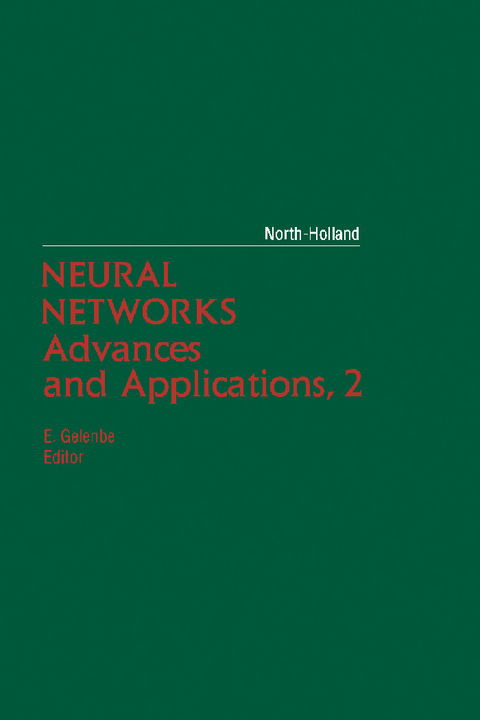
Neural Networks (eBook)
232 Seiten
Elsevier Science (Verlag)
978-1-4832-9709-5 (ISBN)
The present volume is a natural follow-up to Neural Networks: Advances and Applications which appeared one year previously. As the title indicates, it combines the presentation of recent methodological results concerning computational models and results inspired by neural networks, and of well-documented applications which illustrate the use of such models in the solution of difficult problems. The volume is balanced with respect to these two orientations: it contains six papers concerning methodological developments and five papers concerning applications and examples illustrating the theoretical developments. Each paper is largely self-contained and includes a complete bibliography.The methodological part of the book contains two papers on learning, one paper which presents a computational model of intracortical inhibitory effects, a paper presenting a new development of the random neural network, and two papers on associative memory models. The applications and examples portion contains papers on image compression, associative recall of simple typed images, learning applied to typed images, stereo disparity detection, and combinatorial optimisation.
Front Cover 1
Neural Networks: Advances and Applications, 2 4
Copyright Page 5
Table of Contents 10
Preface 6
Chapter 1. Learning in the Recurrent Random Neural Network 12
Abstract 12
1. Introduction 12
2. The random network model 14
3. Learning with the recurrent random network model 17
Appendix : Existence and Uniqueness of Network Solutions 20
Remark 22
Acknowledgements 22
References 22
Chapter 2. Generalization Performance of Feed-Forward Neural Networks 24
Abstract 24
1. Introduction 24
2. Generalization Problems, Algorithms and Measures 26
3. GNET : Generalization Neural Network Evaluation Tool 34
4. Performance Evaluation Studies 41
5. Conclusions 46
6. Acknowledgements 47
7. References 47
Chapter 3. The Nature of Intracortical Inhibitory Effects 50
Abstract 50
1. PERISTIMULUS INHIBITION 50
2. COMPETITIVE DISTRIBUTION HYPOTHESIS 55
3. A SPECIFIC FORMULATION 58
4. MODELS I AND C 63
5. PREDICTION OF INTERELEMENT RELATIONSHIPS 65
6. SIMULATION RESULTS 70
7.0 DISCUSSION 81
References 86
APPENDIX 90
Chapter 4. Random Neural Networks with Multiple Classes of Signals 94
Abstract 94
1. The model 95
2. Non-linear signal flow equations and product form stationary solution 98
3. Stability conditions 101
4. Conclusions 103
References 104
Chapter 5. The Microcircuit Associative Memory Architecture 106
Abstract 106
1. Introduction 106
2. Cerebellar Structure and Function 107
3. The Importance of Basket Interneurons 110
4. Experimental Paradigm 111
5. The Marr Model 112
6. The Microcircuit 113
7. The Microcircuit Associative Memory 117
8. Experimental Verification 128
9. Comparative Analysis 131
10. Observations 132
11. Summary 133
References 134
Acknowledgments 138
Chapter 6. Generalised Associative Memory and the Computation of Membership Functions 140
Abstract 140
1. Introduction 140
2. Sparse distributed memory 143
3. Asymptotic analysis of SDM 146
4. Associative memory and the computation of membership functions 149
References 150
Chapter 7. Layered Neural Network for Stereo Disparity Detection 152
Abstract 152
1 Introduction 152
2 Network design 154
3 Experiments 161
4 Discussion 161
5 Conclusion 162
Acknowledgement 162
References 164
Chapter 8. Storage and Recognition Methods for The Random Neural Network 166
Abstract 166
1. Introduction 166
2. Some definitions 168
3. The random neural network as an auto-associative memory 169
4. Learning Algorithm 171
5. Some recognition methods 172
7. Method comparative analysis 181
8. Learning method with local parameters 182
9. Conclusion 185
Appendix: heuristic to determine . and . 186
Remark 186
References 187
Chapter 9. Neural Networks for Image Compression 188
1 Simple NN's for image compression 188
2 Improved structures 196
3 Simulation results 202
4 Conclusions 205
Acknowledgments 208
References 208
Chapter 10. Autoassociative Memory with the Random Neural Network using Gelenbe's Learning Algorithm 210
Abstract 210
1 Introduction 210
2 Autoassociative memory operation 212
3 Simulations and performance results 217
5 Conclusion 224
References 225
Chapter 11. Minimum Graph Covering with the Random Neural Network Model 226
Abstract 226
1. Introduction 226
2. Random network solution 229
3. Conclusions 233
References 233
| Erscheint lt. Verlag | 28.6.2014 |
|---|---|
| Sprache | englisch |
| Themenwelt | Mathematik / Informatik ► Informatik ► Netzwerke |
| Informatik ► Theorie / Studium ► Künstliche Intelligenz / Robotik | |
| ISBN-10 | 1-4832-9709-8 / 1483297098 |
| ISBN-13 | 978-1-4832-9709-5 / 9781483297095 |
| Informationen gemäß Produktsicherheitsverordnung (GPSR) | |
| Haben Sie eine Frage zum Produkt? |
 PDF (Adobe DRM)
Kopierschutz: Adobe-DRM
Adobe-DRM ist ein Kopierschutz, der das eBook vor Mißbrauch schützen soll. Dabei wird das eBook bereits beim Download auf Ihre persönliche Adobe-ID autorisiert. Lesen können Sie das eBook dann nur auf den Geräten, welche ebenfalls auf Ihre Adobe-ID registriert sind.
Details zum Adobe-DRM
Dateiformat: PDF (Portable Document Format)
Mit einem festen Seitenlayout eignet sich die PDF besonders für Fachbücher mit Spalten, Tabellen und Abbildungen. Eine PDF kann auf fast allen Geräten angezeigt werden, ist aber für kleine Displays (Smartphone, eReader) nur eingeschränkt geeignet.
Systemvoraussetzungen:
PC/Mac: Mit einem PC oder Mac können Sie dieses eBook lesen. Sie benötigen eine
eReader: Dieses eBook kann mit (fast) allen eBook-Readern gelesen werden. Mit dem amazon-Kindle ist es aber nicht kompatibel.
Smartphone/Tablet: Egal ob Apple oder Android, dieses eBook können Sie lesen. Sie benötigen eine
Geräteliste und zusätzliche Hinweise
Buying eBooks from abroad
For tax law reasons we can sell eBooks just within Germany and Switzerland. Regrettably we cannot fulfill eBook-orders from other countries.
aus dem Bereich