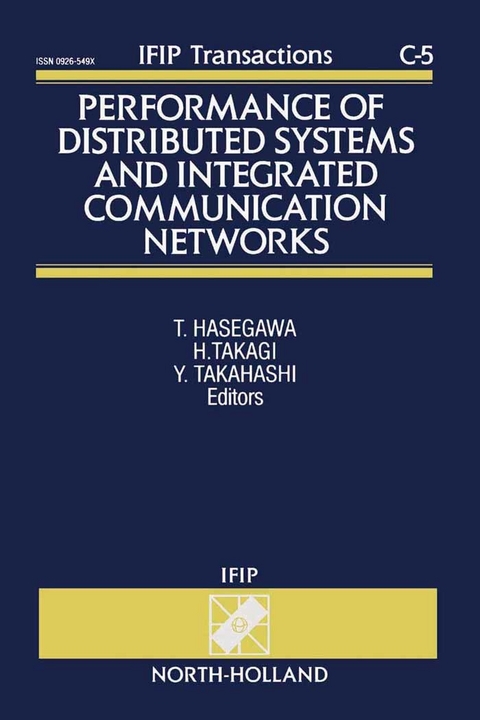
Performance of Distributed Systems and Integrated Communication Networks (eBook)
436 Seiten
Elsevier Science (Verlag)
978-1-4832-9846-7 (ISBN)
This book explores new analytical techniques and tools for the performance evaluation of distributed and integrated computer communication systems. The systems considered are those arising in LAN, MAN, WAN broadband ISDN, and ATM switching. These systems are mathematically modelled and analysed. Analytical results are presented on the basic queueing models such as multi-queue, priority queue, queueing network, queue with bursty input and superposed input, and multi-server queue. These results can be usefully applied for the performance evaluation of all the above systems.
Front Cover 1
Performance of Distributed Systems and Integrated Communication Networks 4
Copyright Page 5
Table of Contents 10
PREFACE 6
COMMITTEES 8
Part I: KEYNOTE ADDRESS 14
Chapter 1. Technological Competition and Cooperation 14
Part II: MAN 20
Chapter 2. TRAFFIC ENGINEERING FOR HIGH SPEED NETWORKS 20
1. INTRODUCTION 20
2. NETWORKING APPLICATONS AND SERVICES 21
3. NETWORKING CONCEPTS 22
4. HIGH SPEED LOCAL AND METROPOLITAN AREA NETWORKS 24
5. BROADBAND - ISDN 25
6. MAN/ B-ISDN INTERCONNECTION 27
7. TRAFFIC CONTROL AND ENGINEERING 28
CONCLUSION 30
References 31
Chapter 3. Performance Analysis of the CRMA-Protocol in High- Speed Networks 40
Abstract 40
1. THE CRMA-PROTOCOL 40
2. PERFORMANCE MODEL AND DELAY ANALYSIS 44
3. RESULTS 52
4. CONCLUSION AND OUTLOOK 58
Acknowledgement 59
References 59
Chapter 4. DQDB Modeling: Problem complexity reduction and solution via Markov chains 60
Abstract 60
1. INTRODUCTION 60
2. DQDB PROTOCOL DESCRIPTION 61
3. DQDB MODELING: REDUCING THE COMPLEXITY 61
4. BUSY TRAIN MODELING 62
5.0 NODE MODELING WITH BWB DISABLED 68
6. CONCLUSIONS 69
REFERENCES 70
Part III: Network Performance 76
Chapter 5. An object-oriented approach for quality of service and network performance modeling 76
Abstract 76
1. INTRODUCTION 76
2. DEFINITION OF QOS AND NP 77
3. QOS AND NP PARAMETERS 78
4. LAYERED NETWORKS A N D SERVICES 80
5. THE ORTHOGONAL MODEL 82
6. AN OBJECT-ORIENTED APPROACH OF QOS A N D NP 83
7. AN EXAMPLE 85
8. CONCLUSIONS 89
9. REFERENCES 89
Chapter 6. Performance of Connection Management Policies for a LAN to Broadband ISDN Gateway 92
Abstract 92
1.0 Introduction 92
2.0 Description of BERGATE 94
3.0 Modelling Approach 96
4.0 ISDN Channel allocation policies 99
5.0 Arrival Process Description 100
6.0 Measured Characteristics 103
7.0 Conclusions and Directions for Further Work 109
Acknowledgments 110
Abbreviations 110
References 110
Part IV: Multi-queue Models 112
Chapter 7. A HETEROGENEOUS SCAN SERVICE POLLING MODEL WITH SINGLE-MESSAGE BUFFER 112
Abstract 112
1. INTRODUCTION 112
2. THE MODEL 113
3. SOME USEFUL MEASURES FOR THE SYSTEM 115
4. PERFORMANCE MEASURES 119
5. SOME NUMERICAL RESULTS AND CONCLUSIONS 120
6. ACKNOWLEDGEMENT 124
7. REFERENCES 124
Chapter 8. Analysis of a Priority Queue with Bernoulli Schedules 126
Abstract 126
1. Introduction 126
2. Queueing Model 128
3. Queueing Analysis 129
4. Mean Waiting Times 134
5. Some Comments 140
6. Conclusions 143
References 143
Part V: ATM Switching Networks 146
Chapter 9. Buffered Multistage Interconnection Networks:Simulations Results and Modelling Trials 146
Abstract 146
1. INTRODUCTION 146
2. A PROBABILISTIC MODEL 148
3. APPLICATION OF THE MODEL AND COMPARISON TO THE SIMULATION RESULTS 156
4. CONCLUDING REMARKS 162
5. REFERENCES 164
Chapter 10. A MODULAR ATM SWITCH FOR BROADBAND ISDN SWITCHING 166
abstract 166
1 INTRODUCTION 166
2 SWITCH ARCHITECTURE 168
3 Modular Architecture of a Large Switch 173
4 PERFORMANCE ANALYSIS 174
5 CONCLUSION 180
References 180
Chapter 11. Blocking in Asynchronous, Buffered Banyan Networks 182
Abstract 182
1 Introduction 182
2 Model and Notations 183
3 Numerical Examples 200
4 Conclusions 201
References 201
Part VI: Modeling Computer Systems 202
Chapter 12. Performance Analysis of a Processor Sharing Policy with Interactive and Background Jobs 202
Abstract 202
1. INTRODUCTION 202
2. The PSBJ Model 204
3. STABILITY CONDITIONS 205
4. APPROXIMATE ANALYSIS 206
5. ITERATIVE ALGORITHM FOR SOLVING qi's& ITS CONVERGENCE
6. NUMERICAL RESULTS 215
7. CONCLUSIONS & FUTURE WORK
8. ACKNOWLEDGEMENTS 219
9. REFERENCES 219
Part VII: Queueing Networks 222
Chapter 13. Probabilistic methods for Jackson networks 222
Abstract 222
INTRODUCTION 223
1 Ergodicity conditions for Jackson networks 223
2 Main results 229
3 Geometric construction 230
4 Analytic Lyapounov families 232
5 Lyapounov functions 234
References 235
Chapter 14. Estimating response time distributions in queueing networks 238
Abstract 238
1. INTRODUCTION 238
2. THE QUEUEING NETWORK MODEL 240
3. CHARACTERIZATION OF THE RESPONSE TIME 241
4. APPLICATION OF UNIFORMIZATION 243
5. MARKOV MONTE CARLO SIMULATION 245
6. STRATIFIED SAMPLING PLAN 246
7. METHOD OF STRATIFICATION 247
8. SAMPLING OF CR USING IMPORTANCE SAMPLING 249
9. NUMERICAL EXAMPLE 252
10. CONCLUSION 252
11. REFERENCES 257
Chapter 15. Optimal Deadlock Free Buffer Allocation in Multiple Chain Blocking Networks of Queues 258
Abstract 258
1 Introduction 258
2 Model Description 260
3 Conditions For Deadlock Freedom 261
4 Deadlock Free Buffer Allocation Algorithm 263
5 Cycle Finding Algorithm 266
6 Examples 269
7 Conclusions 274
References 274
Appendix 275
Chapter 16. Asymptotic analysis of closed queueing networks with bottlenecks 278
Abstract 278
1 Introduction 278
2 Networks with a Fixed Number of Stations 279
3 Several Large Groups of LQD Stations 283
4 Numerical Results 286
5 Generalization to Large Multiple Chain Networks 288
6 Conclusions 291
References 292
Part VIII: Performance Evalutaion Tools 294
Chapter 17. Concurrent Stochastic Simulation: Experiments with EcliPSe 294
Abstract 294
1 Introduction 294
2 Issues motivating design 295
3 The EcliPSe Toolkit 296
4 Empirical Results 299
5 Conclusion 311
References 311
Part IX: ATM Modeling and Analysis 314
Chapter 18. Queueing systems for modelling ATM networks 314
Abstract 314
1. ATM networks 314
2. Models of a bursty arrival process 315
3. Discrete-time queueing systems 316
4. The superposition of arrival processes 322
5. Modelling ATM switch architectures 323
6. Congestion control in an ATM network 325
7. Adaptation layer and transport protocols 326
References 327
Chapter 19. Analysis and Application of an MMPP/PH/n/m Multi-Server Model 336
Abstract 336
1 Introduction 336
2 Description of the MMPP/PH/n/m model 338
3 Construction of the generator matrix 340
4 Computation of the steady-state distribution by numerical solution methods 344
5 Performance measures of the model 347
6 Investigation of some MMPP/PH/n/m models 351
7 Conclusion 352
Acknowledgment 352
References 353
Chapter 20. A Method of Computation of the Consecutive Cell Loss Probability for an Individual Source in Superposed Traffic 356
Abstract 356
1 Introduction 357
2 Presentation of our model 358
3 Patterns of consecutive cell loss 361
4 The dynamics of the system 362
5 Study for a Poisson process 364
6 Study for a N-process 365
7 Some particular cases 367
8 Conclusion 374
References 375
Chapter 21. Cell Loss Behavior in a Statistical Multiplexer with Bursty Input 376
Abstract 376
1 Introduction 377
2 Queueing model and definitions 378
3 Analysis of the lossy and the non-lossy periods 379
4 Cell loss probability in one lossy period 383
5 Numerical Results 388
6 Conclusion 389
References 390
Part X: Queueing Systems 396
Chapter 22. Exact computation of blocking probabilities in state-dependent multi-facility blocking models 396
Abstract 396
1. INTRODUCTION 396
2. RECURSIVE ALGORITHM 399
3. DYNAMIC SCALING 403
4. CONCLUDING REMARKS 404
REFERENCES 404
Chapter 23. Space priority mechanisms with bursty traffic 406
Abstract 406
1. INTRODUCTION 406
2. SOURCE CHARACTERIZATION 407
3. SYSTEM WITH PARTIAL BUFFER SHARING MECHANISM 409
4. SYSTEM WITH THE PUSH-OUT MECHANISM 414
5. ASSESSMENT OS SPACE PRIORITY MECHANISMS WITH BURSTY TRAFFIC 418
6. DETAILED STUDY OF THE PARTIAL BUFFER SHARING 422
7. CONCLUSIONS 424
Acknowledgement 424
References 424
Chapter 24. BUFFER SIZE REQUIREMENTS UNDER LONGEST QUEUE FIRST 426
Abstract 426
1 Introduction 427
2 Model Description and Background Material 428
3 Longest Queue First 430
4 Discussion 436
References 437
| Erscheint lt. Verlag | 28.6.2014 |
|---|---|
| Sprache | englisch |
| Themenwelt | Mathematik / Informatik ► Informatik ► Netzwerke |
| Mathematik / Informatik ► Informatik ► Theorie / Studium | |
| ISBN-10 | 1-4832-9846-9 / 1483298469 |
| ISBN-13 | 978-1-4832-9846-7 / 9781483298467 |
| Informationen gemäß Produktsicherheitsverordnung (GPSR) | |
| Haben Sie eine Frage zum Produkt? |
 PDF (Adobe DRM)
Kopierschutz: Adobe-DRM
Adobe-DRM ist ein Kopierschutz, der das eBook vor Mißbrauch schützen soll. Dabei wird das eBook bereits beim Download auf Ihre persönliche Adobe-ID autorisiert. Lesen können Sie das eBook dann nur auf den Geräten, welche ebenfalls auf Ihre Adobe-ID registriert sind.
Details zum Adobe-DRM
Dateiformat: PDF (Portable Document Format)
Mit einem festen Seitenlayout eignet sich die PDF besonders für Fachbücher mit Spalten, Tabellen und Abbildungen. Eine PDF kann auf fast allen Geräten angezeigt werden, ist aber für kleine Displays (Smartphone, eReader) nur eingeschränkt geeignet.
Systemvoraussetzungen:
PC/Mac: Mit einem PC oder Mac können Sie dieses eBook lesen. Sie benötigen eine
eReader: Dieses eBook kann mit (fast) allen eBook-Readern gelesen werden. Mit dem amazon-Kindle ist es aber nicht kompatibel.
Smartphone/Tablet: Egal ob Apple oder Android, dieses eBook können Sie lesen. Sie benötigen eine
Geräteliste und zusätzliche Hinweise
Buying eBooks from abroad
For tax law reasons we can sell eBooks just within Germany and Switzerland. Regrettably we cannot fulfill eBook-orders from other countries.
aus dem Bereich