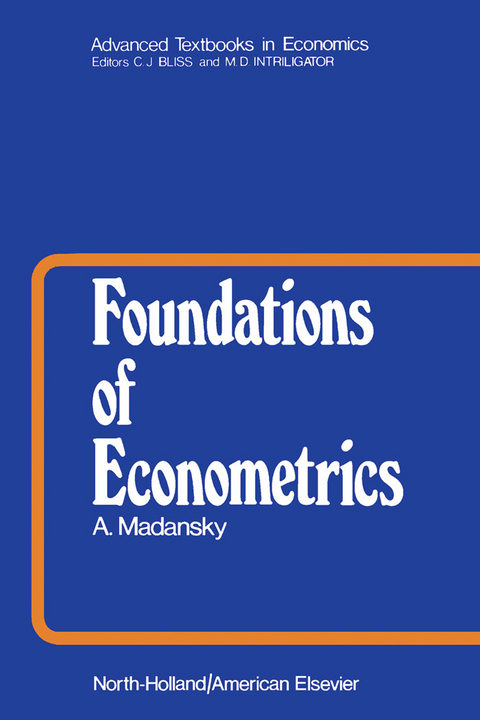
Foundations of Econometrics (eBook)
274 Seiten
Elsevier Science (Verlag)
978-1-4832-7525-3 (ISBN)
Advanced Textbooks in Economics, Volume 7: Foundations of Econometrics focuses on the principles, processes, methodologies, and approaches involved in the study of econometrics. The publication examines matrix theory and multivariate statistical analysis. Discussions focus on the maximum likelihood estimation of multivariate normal distribution parameters, point estimation theory, multivariate normal distribution, multivariate probability distributions, Euclidean spaces and linear transformations, orthogonal transformations and symmetric matrices, and determinants. The manuscript then ponders on linear expected value models and simultaneous equation estimation. Topics include random exogenous variables, maximum likelihood estimation of a single equation, identification of a single equation, linear stochastic difference equations, and errors-in-variables models. The book takes a look at a prolegomenon to econometric model building, tests of hypotheses in econometric models, multivariate statistical analysis, and simultaneous equation estimation. Concerns include maximum likelihood estimation of a single equation, tests of linear hypotheses, testing for independence, and causality in economic models. The publication is a valuable source of data for economists and researchers interested in the foundations of econometrics.
Front Cover 1
Foundations of Econometrics 4
Copyright Page 5
Table of Contents 8
Preface 6
Chapter 1. Matrix theory 10
1. Matrix operations 11
2. Euclidean space and linear transformations 18
3. Matricial representations of linear transformations 25
4. Projection transformations 29
5. Determinants 32
6. Orthogonal transformations and symmetric matrices 45
7. Generalized inverse 53
8. Derivatives of functions of matrices 59
9. References 62
Chapter 2. Multivariate statistical analysis: Distribution and point estimation theory 64
1. Multivariate probability distributions 65
2. Multivariate normal distribution 82
3. Point estimation theory 88
4. Maximum likelihood method of point estimation 98
5. Maximum likelihood estimation of multivariate normal distribution parameters 104
6. References 106
Chapter 3. Linear expected value models 110
1. Independent samples 112
2. Correlated samples 124
3. Linear stochastic difference equations 134
4. Errors-in-variables models 141
5. References 155
Chapter 4. Simultaneous equation estimation 160
1. Identification of a single equation 170
2. Maximum likelihood estimation of a single equation 175
3. Maximum likelihood estimation of a system of simultaneous equations 185
4. Simultaneous least squares estimation 193
5. Simultaneous equation estimation via instrumental variables 195
6. Iterative least squares estimate 207
7. Random exogenous variables 209
8. References 210
Chapter 5. Multivariate statistical analysis: Hypothesis testing theory 212
1. Hypothesis testing theory 213
2. Sampling distributions 219
3. Tests of linear hypotheses 224
4. References 231
Chapter 6. Tests of hypotheses in econometric models 232
1. One-way analysis of variance 233
2. Tests of linear hypotheses in regression models 234
3. Test of equality of regressions 236
4. Testing that multiple regression coefficient is zero 238
5. Testing for independence 240
6. Testing for identifiability 257
7. References 259
Chapter 7. A prolegomenon to econometric model building 262
1. The error term in economic modeling 263
2. Causality in economic models 267
3. Simultaneous equation model types 269
4. References 272
Index 274
| Erscheint lt. Verlag | 22.7.2014 |
|---|---|
| Sprache | englisch |
| Themenwelt | Mathematik / Informatik ► Mathematik ► Angewandte Mathematik |
| Mathematik / Informatik ► Mathematik ► Finanz- / Wirtschaftsmathematik | |
| Wirtschaft ► Betriebswirtschaft / Management ► Finanzierung | |
| Wirtschaft ► Volkswirtschaftslehre ► Ökonometrie | |
| ISBN-10 | 1-4832-7525-6 / 1483275256 |
| ISBN-13 | 978-1-4832-7525-3 / 9781483275253 |
| Informationen gemäß Produktsicherheitsverordnung (GPSR) | |
| Haben Sie eine Frage zum Produkt? |
 PDF (Adobe DRM)
Kopierschutz: Adobe-DRM
Adobe-DRM ist ein Kopierschutz, der das eBook vor Mißbrauch schützen soll. Dabei wird das eBook bereits beim Download auf Ihre persönliche Adobe-ID autorisiert. Lesen können Sie das eBook dann nur auf den Geräten, welche ebenfalls auf Ihre Adobe-ID registriert sind.
Details zum Adobe-DRM
Dateiformat: PDF (Portable Document Format)
Mit einem festen Seitenlayout eignet sich die PDF besonders für Fachbücher mit Spalten, Tabellen und Abbildungen. Eine PDF kann auf fast allen Geräten angezeigt werden, ist aber für kleine Displays (Smartphone, eReader) nur eingeschränkt geeignet.
Systemvoraussetzungen:
PC/Mac: Mit einem PC oder Mac können Sie dieses eBook lesen. Sie benötigen eine
eReader: Dieses eBook kann mit (fast) allen eBook-Readern gelesen werden. Mit dem amazon-Kindle ist es aber nicht kompatibel.
Smartphone/Tablet: Egal ob Apple oder Android, dieses eBook können Sie lesen. Sie benötigen eine
Geräteliste und zusätzliche Hinweise
Buying eBooks from abroad
For tax law reasons we can sell eBooks just within Germany and Switzerland. Regrettably we cannot fulfill eBook-orders from other countries.
aus dem Bereich