Multi-Objective Programming in the USSR (eBook)
398 Seiten
Elsevier Science (Verlag)
978-1-4832-6550-6 (ISBN)
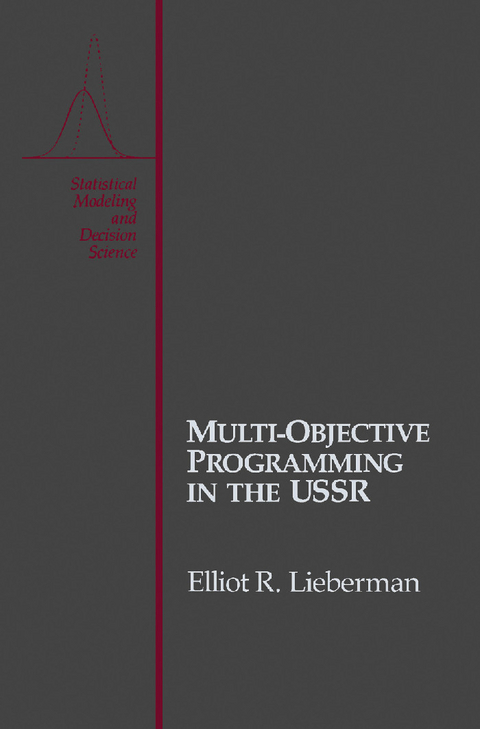
Statistical Modeling and Decision Science: Multi-Objective Programming in the USSR provides information pertinent to multi-objective programming that has emerged as an increasingly active area of research in the fields of applied mathematics, operations research, and decision and management science. This book traces and analyzes the development of Soviet multi-objective programming. Organized into 24 chapters, this book begins with an overview of the research institutes most actively involved in multi-objective programming research. This text then presents an analytical framework for grouping and classifying the diverse Soviet methods. Other chapters consider the methods and then evaluated according to the significance and soundness of its basic approach and its kinship to other methods. This book discusses as well some significant Soviet theoretical research and several distinctive approaches proposed by Soviet researchers for comparing the effectiveness of alternative interactive multi-objective programming method. The final chapter deals with distinctive Soviet tendencies in multi-objective research. This book is a valuable resource for economists.
Front Cover 1
Multi-Objective Programming in the USSR 4
Copyright Page 5
Table of Contents 8
List of Tables 12
List of Figures 16
Preface 20
Acknowledgements 26
Chapter 1. Origins of Soviet Multi-Objective Programming 30
Chapter 2. A Framework for Approaching Soviet Multi-Objective Programming 40
Part I: No Articulation of Preferences 48
Chapter 3. Salukvadze's Ideal Distance Minimization Method 52
Chapter 4. Multi-Objective Programming and the Maximal Effectiveness Principle 56
Chapter 5. Velichenko's Minimax Method 68
Part II: A Priori Articulation of Preferences 72
Chapter 6. Multi-Objective Decomposition for Scalar Problems 76
Part III: Progressive Articulation of Preferences 80
Using Target Values 84
Chapter 7. The Hierarchical Decomposition Approach to High Dimension Multi-Objective Programming Problems 86
Chapter 8. The STEM Method 96
Chapter 9. Multi-Objective Graph Theory 100
Chapter 10. Method of Constraints 108
Chapter 11. Parameter Space Investigation Method 118
Ranking of Alternatives or Objectives 144
Chapter 12. The Random Search Method 146
Chapter 13. The Vector-Relaxation Method 152
Chapter 14. The Interactive e-Grid Method 158
Other Forms of Preference Information 166
Chapter 15. Adaptive Search Method for Multi-Objective Optimization 168
Chapter 16. Pareto Boundary Maps 178
Part IV: A Posteriori Articulation of Preferences 186
Chapter 17. Dynamic Multi-Objective Programming 190
Chapter 18. The Reachable Sets Method 200
Chapter 19. Piecewise Linear Approximation 222
Part V: Other Noteworthy Research 228
Chapter 20. Methodological Research at VNIISI 232
Chapter 21. Rastrigin and Eiduk's Methodological Work 246
Chapter 22. The Theory of Parametric Scalarization 252
Chapter 23. Miscellaneous Other Research 258
23.1 Moldavskii's Evaluative Model 258
23.2 Podinovskii and Nogin's Research 259
23.3 Lotov's Taxonomy 262
Chapter 24. Some Concluding Observations 266
Appendix 276
A The Method of Constraints 276
B Terminology 332
C Soviet Books on Multi-Objective Subjects 336
D Soviet Researchers' Institutional Affiliations 338
E Cyrillic—Roman Transliteration Conventions 344
Bibliography 346
Soviet Sources 346
Non-Soviet Sources 382
Index 392
| Erscheint lt. Verlag | 12.5.2014 |
|---|---|
| Sprache | englisch |
| Themenwelt | Mathematik / Informatik ► Informatik ► Theorie / Studium |
| ISBN-10 | 1-4832-6550-1 / 1483265501 |
| ISBN-13 | 978-1-4832-6550-6 / 9781483265506 |
| Informationen gemäß Produktsicherheitsverordnung (GPSR) | |
| Haben Sie eine Frage zum Produkt? |
 PDF (Adobe DRM)
Kopierschutz: Adobe-DRM
Adobe-DRM ist ein Kopierschutz, der das eBook vor Mißbrauch schützen soll. Dabei wird das eBook bereits beim Download auf Ihre persönliche Adobe-ID autorisiert. Lesen können Sie das eBook dann nur auf den Geräten, welche ebenfalls auf Ihre Adobe-ID registriert sind.
Details zum Adobe-DRM
Dateiformat: PDF (Portable Document Format)
Mit einem festen Seitenlayout eignet sich die PDF besonders für Fachbücher mit Spalten, Tabellen und Abbildungen. Eine PDF kann auf fast allen Geräten angezeigt werden, ist aber für kleine Displays (Smartphone, eReader) nur eingeschränkt geeignet.
Systemvoraussetzungen:
PC/Mac: Mit einem PC oder Mac können Sie dieses eBook lesen. Sie benötigen eine
eReader: Dieses eBook kann mit (fast) allen eBook-Readern gelesen werden. Mit dem amazon-Kindle ist es aber nicht kompatibel.
Smartphone/Tablet: Egal ob Apple oder Android, dieses eBook können Sie lesen. Sie benötigen eine
Geräteliste und zusätzliche Hinweise
Buying eBooks from abroad
For tax law reasons we can sell eBooks just within Germany and Switzerland. Regrettably we cannot fulfill eBook-orders from other countries.
aus dem Bereich