Teaching Machines and Programming (eBook)
214 Seiten
Elsevier Science (Verlag)
978-1-4832-2595-1 (ISBN)
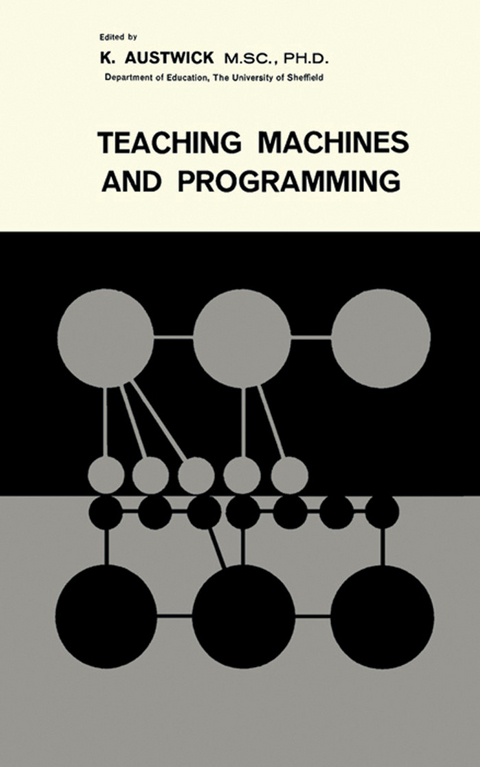
Teaching Machines and Programming covers the significant developments in teaching machines and automated teaching, as well as the major theoretical issues and attributes involved in these procedures. After a brief introduction to teaching machine procedures, this six-chapter text goes on summarizing the industrial and military applications of teaching machines. The succeeding chapters consider the underlying theory, function, and schema of the adaptive teaching system, which are related to recognizable teaching functions performed by a human tutor. The last chapters discuss the development and features of linear programs and their application as new teaching aid. These chapters also look into some practical problems arising in programming for schools. This book will prove useful to computer programmers, school administrators, teachers, and students.
Front Cover 1
Teaching Machines and Programming 4
Copyright Page 5
Table of Contents 6
EDITOR'S PREFACE 8
CHAPTER 1. GENERAL INTRODUCTION TO TEACHING MACHINE PROCEDURES 10
1. INTRODUCTION 10
2. A COMMUNICATION PROBLEM 11
3. REPRESENTATIVE TYPES OF TEACHING MACHINES AND PROGRAMMES 15
4. CRITICISM OF AUTOMATED PROCEDURES 33
5. ATTRIBUTES OF PROGRAMMED PROCEDURES 45
REFERENCES 50
CHAPTER 2. TEACHING MACHINES IN INDUSTRIAL AND MILITARY TRAINING 52
1. TRAINING DEVICES, SIMULATORS AND TEACHING MACHINES 52
2. SOME ACTUAL AND POSSIBLE USES OF TEACHING MACHINES IN INDUSTRIAL AND MILITARY TRAINING 65
3. TEACHING MACHINES FOR TRAINING SPECIFIC SKILLS 70
4. THE USE OF COMPUTERS 74
5. PRACTICAL CONSIDERATIONS 77
6. POSSIBLE CONSEQUENCES OF USING TEACHING MACHINES 85
REFERENCES 86
CHAPTER 3. THE ADAPTIVE TEACHING SYSTEM 88
1. ASSUMPTIONS AND BASIC IDEAS 88
2. STRUCTURED SKILLS 89
3. THE ESSENTIAL TEACHING PROCESS 95
4. THE FUNCTIONAL PICTURE AND A SIMPLE SPECIAL CASE 101
5. OTHER ADAPTIVE TEACHING METHODS AND GROUP TEACHING SYSTEMS 112
SELECTED BIBLIOGRAPHY 120
CHAPTER 4. THE ELEMENTS OF A TEACHING SYSTEM 122
ELEMENTS OF THE SYSTEM 125
THE CONTROLLER 133
CHAPTER 5. LINEAR PROGRAMMING AND LEARNING 145
1. INTRODUCTION 145
2. COMPOSED RESPONSES 146
3. BLANKS AND QUESTIONS 148
4. LINEAR PROGRAMMES AND INDIVIDUAL DIFFERENCES 148
5. DEVELOPMENT OF PROGRAMMES 153
6. PROGRAMMING AND LEARNING 164
7. CONCLUSIONS 180
CHAPTER 6. AUTOMATION IN SCHOOLS 183
1. AUTOMATING TEACHING 183
2. PROGRAMMING FOR SCHOOLS 198
3. FUTURE PROSPECTS 208
INDEX 212
| Erscheint lt. Verlag | 12.5.2014 |
|---|---|
| Sprache | englisch |
| Themenwelt | Mathematik / Informatik ► Informatik ► Theorie / Studium |
| ISBN-10 | 1-4832-2595-X / 148322595X |
| ISBN-13 | 978-1-4832-2595-1 / 9781483225951 |
| Informationen gemäß Produktsicherheitsverordnung (GPSR) | |
| Haben Sie eine Frage zum Produkt? |
 PDF (Adobe DRM)
Kopierschutz: Adobe-DRM
Adobe-DRM ist ein Kopierschutz, der das eBook vor Mißbrauch schützen soll. Dabei wird das eBook bereits beim Download auf Ihre persönliche Adobe-ID autorisiert. Lesen können Sie das eBook dann nur auf den Geräten, welche ebenfalls auf Ihre Adobe-ID registriert sind.
Details zum Adobe-DRM
Dateiformat: PDF (Portable Document Format)
Mit einem festen Seitenlayout eignet sich die PDF besonders für Fachbücher mit Spalten, Tabellen und Abbildungen. Eine PDF kann auf fast allen Geräten angezeigt werden, ist aber für kleine Displays (Smartphone, eReader) nur eingeschränkt geeignet.
Systemvoraussetzungen:
PC/Mac: Mit einem PC oder Mac können Sie dieses eBook lesen. Sie benötigen eine
eReader: Dieses eBook kann mit (fast) allen eBook-Readern gelesen werden. Mit dem amazon-Kindle ist es aber nicht kompatibel.
Smartphone/Tablet: Egal ob Apple oder Android, dieses eBook können Sie lesen. Sie benötigen eine
Geräteliste und zusätzliche Hinweise
Buying eBooks from abroad
For tax law reasons we can sell eBooks just within Germany and Switzerland. Regrettably we cannot fulfill eBook-orders from other countries.
aus dem Bereich