Parallelism and Programming in Classifier Systems (eBook)
232 Seiten
Elsevier Science (Verlag)
978-0-08-051355-3 (ISBN)
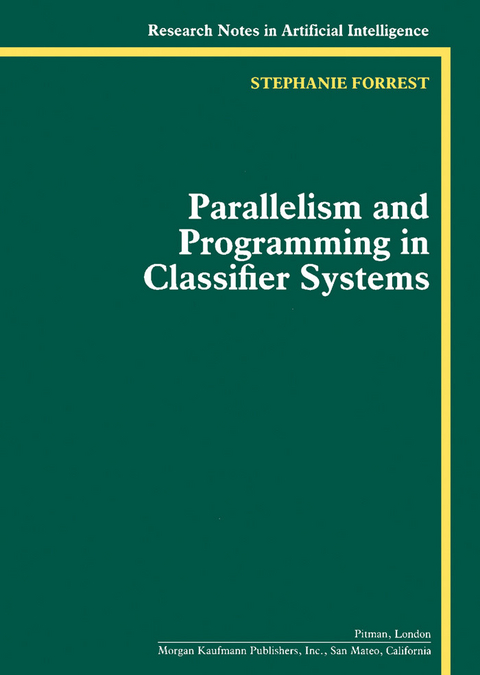
Parallelism and Programming in Classifier Systems deals with the computational properties of the underlying parallel machine, including computational completeness, programming and representation techniques, and efficiency of algorithms. In particular, efficient classifier system implementations of symbolic data structures and reasoning procedures are presented and analyzed in detail. The book shows how classifier systems can be used to implement a set of useful operations for the classification of knowledge in semantic networks. A subset of the KL-ONE language was chosen to demonstrate these operations. Specifically, the system performs the following tasks: (1) given the KL-ONE description of a particular semantic network, the system produces a set of production rules (classifiers) that represent the network; and (2) given the description of a new term, the system determines the proper location of the new term in the existing network. These two parts of the system are described in detail. The implementation reveals certain computational properties of classifier systems, including completeness, operations that are particularly natural and efficient, and those that are quite awkward. The book shows how high-level symbolic structures can be built up from classifier systems, and it demonstrates that the parallelism of classifier systems can be exploited to implement them efficiently. This is significant since classifier systems must construct large sophisticated models and reason about them if they are to be truly "e;"e;intelligent."e;"e; Parallel organizations are of interest to many areas of computer science, such as hardware specification, programming language design, configuration of networks of separate machines, and artificial intelligence This book concentrates on a particular type of parallel organization and a particular problem in the area of AI, but the principles that are elucidated are applicable in the wider setting of computer science.
Front Cover 1
Parallelism and Programming in Classifier Systems 4
Copyright Page 5
Table of Contents 6
Dedication 11
List of Figures 8
List of Appendices 9
Preface 10
Chapter 1. Introduction 12
1.1 Parallelism and Classifier Systems 13
1.2 Classification and KL-ONE 15
1.3 Subsymbolic Models of Intelligence 16
1.4 Overview 17
Chapter 2. Background Information 20
2.1 Parallelism 20
2.2 Classifier Systems 27
2.3 KL-ONE 35
2.4 Summary 44
Chapter 3. Approach 46
3.1 Implementation 46
3.2 Evaluation 49
3.3 Summary 50
Chapter 4. Classifier Systems 52
4.1 Computational Properties of Classifier Systems 52
4.2 Classifier System Algorithms 56
4.3 Summary 74
Chapter 5. Classifier System Implementation of KL-ONE 76
5.1 Representation 76
5.2 Algorithms 87
5.3 Summary 114
Chapter 6 Analysis of Results 116
6.1 Time of Computation 117
6.2 Number and Size of Processors 120
6.3 Inter-Processor Communication 121
6.4 Comparison with Sequential Algorithm 122
6.5 Computational Tradeoffs 126
6.6 Summary of Results 126
Chapter 7. Conclusions 130
7.1 Classifer Systems 130
7.2 KL-ONE 133
7.3 Parallelism 134
APPENDICES: Backus Normal Form Description of Input Language 138
Bibliography 218
| Erscheint lt. Verlag | 28.6.2014 |
|---|---|
| Sprache | englisch |
| Themenwelt | Informatik ► Theorie / Studium ► Algorithmen |
| Informatik ► Theorie / Studium ► Künstliche Intelligenz / Robotik | |
| ISBN-10 | 0-08-051355-7 / 0080513557 |
| ISBN-13 | 978-0-08-051355-3 / 9780080513553 |
| Informationen gemäß Produktsicherheitsverordnung (GPSR) | |
| Haben Sie eine Frage zum Produkt? |
 PDF (Adobe DRM)
Kopierschutz: Adobe-DRM
Adobe-DRM ist ein Kopierschutz, der das eBook vor Mißbrauch schützen soll. Dabei wird das eBook bereits beim Download auf Ihre persönliche Adobe-ID autorisiert. Lesen können Sie das eBook dann nur auf den Geräten, welche ebenfalls auf Ihre Adobe-ID registriert sind.
Details zum Adobe-DRM
Dateiformat: PDF (Portable Document Format)
Mit einem festen Seitenlayout eignet sich die PDF besonders für Fachbücher mit Spalten, Tabellen und Abbildungen. Eine PDF kann auf fast allen Geräten angezeigt werden, ist aber für kleine Displays (Smartphone, eReader) nur eingeschränkt geeignet.
Systemvoraussetzungen:
PC/Mac: Mit einem PC oder Mac können Sie dieses eBook lesen. Sie benötigen eine
eReader: Dieses eBook kann mit (fast) allen eBook-Readern gelesen werden. Mit dem amazon-Kindle ist es aber nicht kompatibel.
Smartphone/Tablet: Egal ob Apple oder Android, dieses eBook können Sie lesen. Sie benötigen eine
Geräteliste und zusätzliche Hinweise
Buying eBooks from abroad
For tax law reasons we can sell eBooks just within Germany and Switzerland. Regrettably we cannot fulfill eBook-orders from other countries.
aus dem Bereich