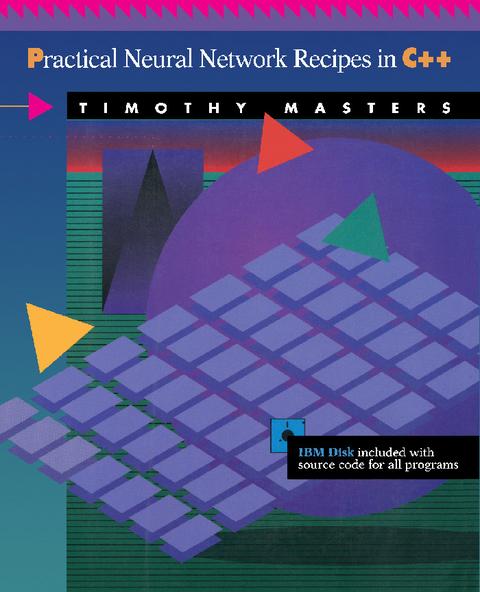
Practical Neural Network Recipies in C++ (eBook)
493 Seiten
Elsevier Science (Verlag)
978-0-08-051433-8 (ISBN)
This text serves as a cookbook for neural network solutions to practical problems using C++. It will enable those with moderate programming experience to select a neural network model appropriate to solving a particular problem, and to produce a working program implementing that network. The book provides guidance along the entire problem-solving path, including designing the training set, preprocessing variables, training and validating the network, and evaluating its performance. Though the book is not intended as a general course in neural networks, no background in neural works is assumed and all models are presented from the ground up.The principle focus of the book is the three layer feedforward network, for more than a decade as the workhorse of professional arsenals. Other network models with strong performance records are also included.Bound in the book is an IBM diskette that includes the source code for all programs in the book. Much of this code can be easily adapted to C compilers. In addition, the operation of all programs is thoroughly discussed both in the text and in the comments within the code to facilitate translation to other languages.
Front Cover 1
Practical Neural Network Recipes in C++ 4
Copyright Page 5
Table of Contents 10
Dedication 8
Preface 18
Chapter 1. Foundations 20
Motivation 21
New Life for Old Techniques 22
Perceptrons and Linear Separability 23
Neural Network Capabilities 25
Basic Structure of a Neural Network 27
Training 28
Validation 29
Chapter 2. Classification 34
Binary Decisions 35
Multiple Classes 37
Supervised versus Unsupervised Training 40
Chapter 3. Autoassociation 42
Autoassociative Filtering 43
Noise Reduction 48
Learning a Prototype from Exemplars 50
Exposing Isolated Events 51
Pattern Completion 59
Error Correction 60
Data Compression 63
Chapter 4. Time-Series Prediction 66
The Basic Model 68
Input Data 69
Multiple Prediction 80
Multiple Predictors 81
Measuring Prediction Error 83
Chapter 5. Function Approximation 86
Univariate Function Approximation 87
Inverse Modeling 91
Multiple Regression 93
Chapter 6. Multilayer Feedforward Networks 96
Basic Architecture 97
Theoretical Discussion 104
Algorithms for Executing the Network 109
Training the Network 113
Training by Backpropagation of Errors 119
Training by Conjugate Gradients 124
Eluding Local Minima in Learning 130
When to Use a Multiple-Layer Feedforward Network 135
Chapter 7. Eluding Local Minima I: Simulated Annealing 136
Overview 137
Choosing the Annealing Parameters 138
Implementation in Feedforward Network Learning 140
A Sample Program 141
A Sample Function 145
Random Number Generation 147
Going on from Here 151
Chapter 8. Eluding Local Minima II: Genetic Optimization 154
Overview 155
Designing the Genetic Structure 157
Evaluation 159
Parent Selection 163
Reproduction 166
Mutation 167
A Genetic Minimization Subroutine 168
Some Functions for Genetic Optimization 174
Advanced Topics in Genetic Optimization 176
Chapter 9. Regression and Neural Networks 184
Overview 185
Singular-Value Decomposition 186
Regression in Neural Networks 188
Chapter 10. Designing Feedforward Network Architectures 192
How Many Hidden Layers? 193
How Many Hidden Neurons? 195
How Long Do I Train This Thing??? 199
Chapter 11. Interpreting Weights: How Does This Thing Work? 206
Features Used by Networks in General 209
Features Used by a Particular Network 210
Chapter 12. Probabilistic Neural Networks 220
Overview 221
Computational Aspects 227
Optimizing Sigma 228
A Sample Program 230
Bayesian Confidence Measures 238
Autoassociative Versions 239
When to Use a Probabilistic Neural Network 240
Chapter 13. Functional Link Networks 242
Application to Nonlinear Approximation 245
Mathematics of the Functional Link Network 246
When to Use a Functional Link Network 248
Chapter 14. Hybrid Networks 250
Functional Link Net as a Hidden Layer 251
Fast Bayesian Confidences 254
Attention-based Processing 258
Factorable Problems 261
Chapter 15. Designing the Training Set 264
Number of Samples 265
Borderline Cases 268
Hidden Bias 269
Balancing the Classes 270
Fudging Cases 270
Chapter 16. Preparing Input Data 272
General Considerations 273
Types of Measurements 274
Is Scaling Always Necessary? 285
Transformations 286
Circular Discontinuity 289
Outliers 293
Missing Data 295
Chapter 17. Fuzzy Data and Processing 298
Treating Fuzzy Values as Nominal and Ordinal 300
Advantages of Fuzzy Set Processing 301
The Neural Network - Fuzzy Set Interface 302
Membership Functions 303
Negation, Conjunction, and Disjunction 309
Modus Ponens 311
Combining Operations 314
Defuzzification 318
Code for Fuzzy Set Operations 322
Examples of Neural Network Fuzzy Preprocessing 335
Examples of Neural Network Fuzzy Postprocessing 338
Chapter 18. Unsupervised Training 346
Input Normalization 349
Training the Kohonen Network 351
Self-Organization 359
Chapter 19. Evaluating Performance of Neural Networks 362
Overview 363
Mean Square Error 363
Cost Functions 366
Confusion Matrix 367
ROC (Receiver Operating Characteristic) Curves 370
Signal-to-Noise Ratio 378
Chapter 20. Confidence Measures 380
Testing Individual Hypotheses 381
Computing Confidence 386
Confidence in the Null Hypothesis 387
Multiple Classes 388
Confidence in the Confidence 389
Example Programs 390
Bayesian Methods 395
Example Program 400
Multiple Classes 401
Hypothesis Testing versus Bayes' Method 403
Chapter 21. Optimizing the Decision Threshold 408
Chapter 22. Using the NEURAL Program 422
Output Models 424
Building the Training Set 425
The LAYER Network Model 425
The KOHONEN Network Model 428
Confusion Matrices 431
Saving Weights and Execution Results 431
Alphabetical Glossary of Commands 432
Verification of Program Operation 436
Appendix 442
Bibliography 498
Index 510
| Erscheint lt. Verlag | 28.6.2014 |
|---|---|
| Sprache | englisch |
| Themenwelt | Mathematik / Informatik ► Informatik ► Programmiersprachen / -werkzeuge |
| Informatik ► Theorie / Studium ► Künstliche Intelligenz / Robotik | |
| ISBN-10 | 0-08-051433-2 / 0080514332 |
| ISBN-13 | 978-0-08-051433-8 / 9780080514338 |
| Informationen gemäß Produktsicherheitsverordnung (GPSR) | |
| Haben Sie eine Frage zum Produkt? |
 PDF (Adobe DRM)
Kopierschutz: Adobe-DRM
Adobe-DRM ist ein Kopierschutz, der das eBook vor Mißbrauch schützen soll. Dabei wird das eBook bereits beim Download auf Ihre persönliche Adobe-ID autorisiert. Lesen können Sie das eBook dann nur auf den Geräten, welche ebenfalls auf Ihre Adobe-ID registriert sind.
Details zum Adobe-DRM
Dateiformat: PDF (Portable Document Format)
Mit einem festen Seitenlayout eignet sich die PDF besonders für Fachbücher mit Spalten, Tabellen und Abbildungen. Eine PDF kann auf fast allen Geräten angezeigt werden, ist aber für kleine Displays (Smartphone, eReader) nur eingeschränkt geeignet.
Systemvoraussetzungen:
PC/Mac: Mit einem PC oder Mac können Sie dieses eBook lesen. Sie benötigen eine
eReader: Dieses eBook kann mit (fast) allen eBook-Readern gelesen werden. Mit dem amazon-Kindle ist es aber nicht kompatibel.
Smartphone/Tablet: Egal ob Apple oder Android, dieses eBook können Sie lesen. Sie benötigen eine
Geräteliste und zusätzliche Hinweise
Buying eBooks from abroad
For tax law reasons we can sell eBooks just within Germany and Switzerland. Regrettably we cannot fulfill eBook-orders from other countries.
aus dem Bereich