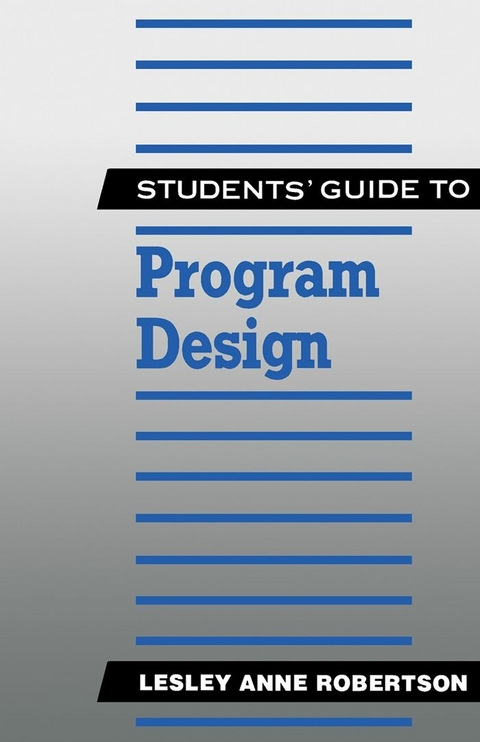
Students' Guide to Program Design (eBook)
188 Seiten
Elsevier Science (Verlag)
978-1-4831-4144-2 (ISBN)
Students' Guide to Program Design is a textbook on program design. This textbook approaches program design by using structures programming techniques and pseudocode to develop a solution algorithm. Divided into 10 chapters, the book begins with a basic explanation of structured programming techniques, top-down development, and modular design. This discussion is followed by detailed concepts of the syntax of pseudocode; methods of defining the problem; the application of basic control structures in the development of the solution algorithm; desk checking techniques; hierarchy charts; and module design considerations. Each step in the development of solution algorithms is covered in this book. These steps are defining the problem; grouping of activities into subtask or functions; creating a hierarchy chart; establishing the logic of the mainline of the algorithm; developing each pseudocode for each successive module in the hierarchy chart; and to desk check the solution algorithm. The development of general pseudocode algorithms as used in common business applications is then studied to help student programmers be familiarized with the concept. In program design, the independence of each module, the ease of maintenance, and the cohesive of the particular module with the other modules in the program are all considered as being important. This textbook will serve as a guide for both beginning and experienced programmers who want to solve common business programming problems.
Front Cover 1
Students' Guide to Program Design 2
Copyright Page 3
Table of Contents 4
Preface 8
Chapter 1. Program design 10
1.1 Steps in program development 11
1.2 Structured programming 13
1.3 An introduction to algorithms and pseudocode 14
1.4 Chapter summary 16
Chapter 2. Pseudocode and Nassi–Schneiderman diagrams 17
2.1 How to write pseudocode 18
2.2 The Structure Theorem 21
2.3 Chapter summary 26
Chapter 3. Developing an algorithm 27
3.1 Defining the problem 28
3.2 Designing a solution algorithm 32
3.3 Checking the solution algorithm 37
3.4 Chapter summary 42
3.5 Programming problems 43
Chapter 4. Selection control structures 44
4.1 The selection control structure 45
4.2 Programming examples using selection 51
4.3 The case structure 59
4.4 Chapter summary 62
4.5 Programming problems 63
Chapter 5. Repetition control structures 65
5.1 Repetition using the DOWHILE structure 66
5.2 Repetition using the REPEAT..UNTIL structure 77
5.3 Counted repetition constructs 82
5.4 Chapter summary 84
5.5 Programming problems 85
Chapter 6. Pseudocode algorithms using sequence, selection and repetition 87
6.1 Eight solution algorithms 88
6.2 Chapter summary 100
6.3 Programming problems 101
Chapter 7. Modularization 103
7.1 Modularization 104
7.2 Hierarchy charts or structure charts 106
7.3 Steps in modularization 108
7.4 Programming examples using modules 108
7.5 Chapter summary 119
7.6 Programming problems 120
Chapter 8. Module design considerations 123
8.1 Module cohesion 124
8.2 Inter-module communication 130
8.3 Using parameters in program design 132
8.4 Module coupling 136
8.5 Chapter summary 142
8.6 Programming problems 142
Chapter 9. General pseudocode algorithms to common business problems 144
9.1 Program structure 145
9.2 Report generation with page break 146
9.3 Single-level control break 148
9.4 Multiple-level control break 153
9.5 Sequential file update 158
9.6 Array processing 166
9.7 Chapter summary 169
9.8 Programming problems 169
Chapter 10. Conclusion 174
10.1 Simple program design 175
10.2 Chapter summary 177
Appendix 178
Glossary 184
| Erscheint lt. Verlag | 15.5.2014 |
|---|---|
| Sprache | englisch |
| Themenwelt | Mathematik / Informatik ► Informatik ► Software Entwicklung |
| Mathematik / Informatik ► Informatik ► Theorie / Studium | |
| ISBN-10 | 1-4831-4144-6 / 1483141446 |
| ISBN-13 | 978-1-4831-4144-2 / 9781483141442 |
| Informationen gemäß Produktsicherheitsverordnung (GPSR) | |
| Haben Sie eine Frage zum Produkt? |
 PDF (Adobe DRM)
Kopierschutz: Adobe-DRM
Adobe-DRM ist ein Kopierschutz, der das eBook vor Mißbrauch schützen soll. Dabei wird das eBook bereits beim Download auf Ihre persönliche Adobe-ID autorisiert. Lesen können Sie das eBook dann nur auf den Geräten, welche ebenfalls auf Ihre Adobe-ID registriert sind.
Details zum Adobe-DRM
Dateiformat: PDF (Portable Document Format)
Mit einem festen Seitenlayout eignet sich die PDF besonders für Fachbücher mit Spalten, Tabellen und Abbildungen. Eine PDF kann auf fast allen Geräten angezeigt werden, ist aber für kleine Displays (Smartphone, eReader) nur eingeschränkt geeignet.
Systemvoraussetzungen:
PC/Mac: Mit einem PC oder Mac können Sie dieses eBook lesen. Sie benötigen eine
eReader: Dieses eBook kann mit (fast) allen eBook-Readern gelesen werden. Mit dem amazon-Kindle ist es aber nicht kompatibel.
Smartphone/Tablet: Egal ob Apple oder Android, dieses eBook können Sie lesen. Sie benötigen eine
Geräteliste und zusätzliche Hinweise
Buying eBooks from abroad
For tax law reasons we can sell eBooks just within Germany and Switzerland. Regrettably we cannot fulfill eBook-orders from other countries.
aus dem Bereich