Chaos Cookbook (eBook)
376 Seiten
Elsevier Science (Verlag)
978-1-4831-0420-1 (ISBN)
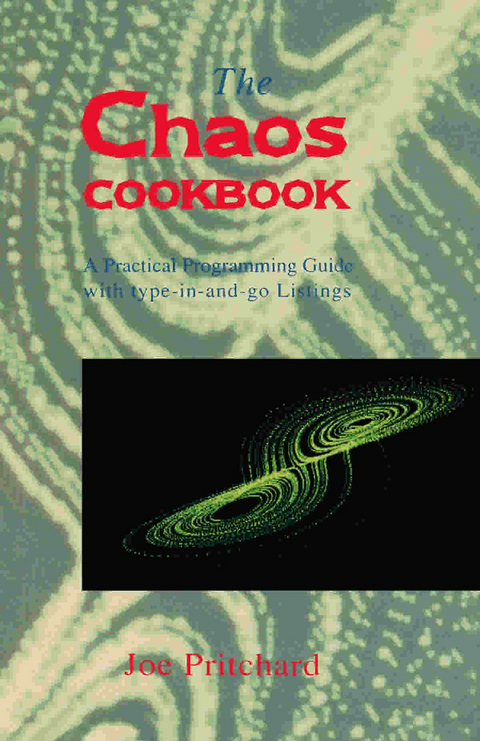
The Chaos Cookbook: A Practical Programming Guide discusses the use of chaos in computer programming. The book is comprised of 11 chapters that tackle various topics relevant to chaos and programming. Chapter 1 reviews the concept of chaos, and Chapter 2 discusses the iterative functions. Chapters 3 and 4 cover differential and Lorenz equations. Chapter 5 talks about strange attractors, while Chapter 6 deals with the fractal link. The book also discusses the Mandelbrot set, and then covers the Julia sets. The other fractal systems and the cellular automata are also explained. The last chapter discusses practical chaos. The book will be of great use to professionals, students, and hobbyist programmers who have an interest with the chaos systems.
Front Cover 1
The Chaos Cookbook: A Practical Programming Guide 4
Copyright Page 5
Table of Contents 6
Preface 10
Introduction 12
The computer 13
Graphics 13
Memory 15
Processing power 15
Disc drives 17
BBC disc systems 17
PC disc systems 18
Hard discs 18
Interfaces 18
Programming languages 19
Interpreted languages 19
Compiled languages 20
Which languages are best? 20
Numerical resolution 21
Numerical accuracy 22
Numerical overflow 22
Types of computer 22
Processing of screen images 23
Saving video memory 23
Getting a hard copy 26
Data export 28
Language versions used in this book 28
Chapter 1. What is chaos? 30
Chapter 2. Iterative functions 40
The square root function 42
The square function 42
The function 2x(x – 1) 43
The logistic equation 43
Other functions 51
Plotting the attractor 51
Iterating two-dimensional functions 52
BBC BASIC listings 56
Turbo Pascal listings 61
Chapter 3. Differential equations 70
Analysis 71
Graphical solution 72
A predator – prey model 76
Nomenclature of phase diagrams 78
The Runge – Kutta method 81
Dependence on starting conditions 82
Stability 82
Forced non-linear oscillators 83
More complicated systems 85
BBC BASIC listings 86
Turbo Pascal listings 90
Chapter 4. The Lorenz equations 102
First investigations 105
Feedback—the common factor 108
The Butterfly Effect 108
Further analysis of the equations 110
Phase portraits of the Lorenz equations 111
The strange attractor 114
BBC BASIC listings 116
Turbo Pascal listings 120
Chapter 5. Strange attractors 130
The Hénon attractor 130
Fractal dimensions and strange attractors 133
Other Hénon attractors 134
Strange attractors from differential equations 136
Other strange attractors 139
Strange attractors from real data 142
How can strange attractors be found? 143
BBC BASIC listings 145
Turbo Pascal listings 148
Chapter 6. The fractal link 154
The Koch curve 155
Recursion 156
Turtle Graphics 158
Fractal Brownian motion 161
Cantor set 162
Peano 164
Dragon and C curves 166
Sierpinski carpet 166
Drawing with the L-language 167
Fractals in the real world 170
Fluid flow 172
Catalysts and enzymes 173
BBC BASIC listings 175
Turbo Pascal listings 182
Chapter 7. The Mandelbrot set 196
Complex numbers 197
The Mandelbrot set 201
Nomenclature 204
Interesting areas 207
Colour selection and aesthetics 208
Time-saving steps 209
Maths coprocessor 209
Calculation types 210
Different starting z values 212
Mandelbroids 213
Three-dimensional representations 215
Periodicity in the Mandelbrot set 215
BBC BASIC listings 218
Turbo Pascal listings 230
Chapter 8. Julia sets 244
Trajectories for the Julia set 246
Plotting the Julia set 246
Iteration number 247
The value of c 248
Periodicity and link to the Mandelbrot set 249
Newton's method 252
Quaternions 255
Inverted Julia sets 256
Some final comments 257
BBC BASIC listings 258
Turbo Pascal listings 264
Chapter 9. Other fractal systems 276
Fractal landscapes 276
Mid-point displacement 277
Fault line modelling 277
Fractal plants and trees 279
Iterated function systems 279
The Collage Theorem 286
BBC BASIC listings 291
Turbo Pascal listings 296
Chapter 10. Cellular automata 304
Dimensions in automata 305
One-dimensional cellular automata 305
The rule set 307
Non-totalistic rule sets 310
Mutation 310
Noise 311
Thermodynamics, reversibility and entropy 311
Simple two-dimensional automata 312
Selection in two-dimensional systems 314
Cell eat cell 315
Time dependent rules 316
The game of Life 316
Dynamic structures 320
Suggestions for further experiments 320
Applications of cellular automata 320
Modelling 321
Pattern design 321
BBC BASIC listings 322
Turbo Pascal listings 332
Chapter 11. Practical chaos 350
The Stock Market 350
Weather 352
The dripping tap 352
Bifurcation plot 355
A chaotic pendulum 355
A driven pendulum 356
Electronic chaos 357
Driven LCR network 357
Plotting phase portraits with an oscilloscope 359
Driven Oscillator 360
Analogue computers 361
Appendix 364
Bibliography 372
Periodicals 373
Other reading 375
Software 375
Index 378
| Erscheint lt. Verlag | 15.5.2014 |
|---|---|
| Sprache | englisch |
| Themenwelt | Mathematik / Informatik ► Informatik ► Software Entwicklung |
| Mathematik / Informatik ► Mathematik ► Angewandte Mathematik | |
| ISBN-10 | 1-4831-0420-6 / 1483104206 |
| ISBN-13 | 978-1-4831-0420-1 / 9781483104201 |
| Informationen gemäß Produktsicherheitsverordnung (GPSR) | |
| Haben Sie eine Frage zum Produkt? |
 PDF (Adobe DRM)
Kopierschutz: Adobe-DRM
Adobe-DRM ist ein Kopierschutz, der das eBook vor Mißbrauch schützen soll. Dabei wird das eBook bereits beim Download auf Ihre persönliche Adobe-ID autorisiert. Lesen können Sie das eBook dann nur auf den Geräten, welche ebenfalls auf Ihre Adobe-ID registriert sind.
Details zum Adobe-DRM
Dateiformat: PDF (Portable Document Format)
Mit einem festen Seitenlayout eignet sich die PDF besonders für Fachbücher mit Spalten, Tabellen und Abbildungen. Eine PDF kann auf fast allen Geräten angezeigt werden, ist aber für kleine Displays (Smartphone, eReader) nur eingeschränkt geeignet.
Systemvoraussetzungen:
PC/Mac: Mit einem PC oder Mac können Sie dieses eBook lesen. Sie benötigen eine
eReader: Dieses eBook kann mit (fast) allen eBook-Readern gelesen werden. Mit dem amazon-Kindle ist es aber nicht kompatibel.
Smartphone/Tablet: Egal ob Apple oder Android, dieses eBook können Sie lesen. Sie benötigen eine
Geräteliste und zusätzliche Hinweise
Buying eBooks from abroad
For tax law reasons we can sell eBooks just within Germany and Switzerland. Regrettably we cannot fulfill eBook-orders from other countries.
aus dem Bereich