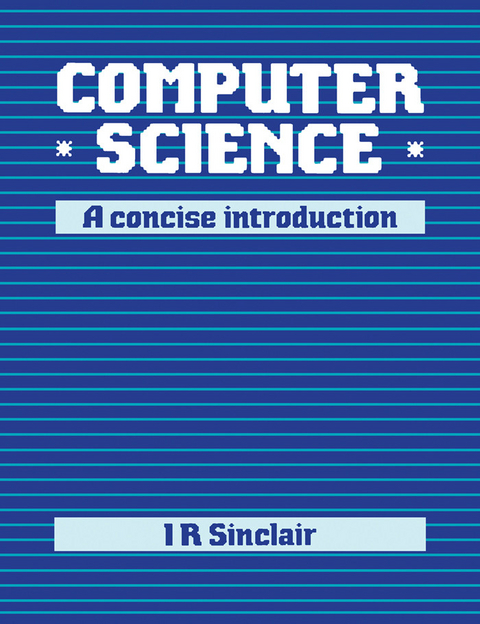
Computer Science (eBook)
186 Seiten
Elsevier Science (Verlag)
978-1-4831-0425-6 (ISBN)
Ian Sinclair was born in 1932 in Tayport, Fife, and graduated from the University of St. Andrews in 1956. In that year, he joined the English Electric Valve Co. in Chelmsford, Essex, to work on the design of specialised cathode-ray tubes, and later on small transmitting valves and TV transmitting tubes. In 1966, he became an assistant lecturer at Hornchurch Technical College, and in 1967 joined the staff of Braintree College of F.E. as a lecturer. His first book, 'Understanding Electronic Components” was published in 1972, and he has been writing ever since, particularly for the novice in Electronics or Computing. The interest in computing arose after seeing a Tandy TRS80 in San Francisco in 1977, and of his 204 published books, about half have been on computing topics, starting with a guide to Microsoft Basic on the TRS80 in 1979. He left teaching in 1984 to concentrate entirely on writing, and has also gained experience in computer typesetting, particularly for mathematical texts. He has recently visited Seattle to see Microsoft at work, and to remind them that he has been using Microsoft products longer than most Microsoft employees can remember. Ian Sinclair is the author of the following Made Simple books: Lotus 1-2-3- (2.4 DOS version) MS-DOS (up to version 6.22) PagePlus for Windows 3.1 Hard drives He is also the author of many other books published under our Newnes imprint.Visit Ian's website at http://website.lineone.net/-ian_sinclair
Computer Science: A Concise Introduction covers the fundamentals of computer science. The book describes micro-, mini-, and mainframe computers and their uses; the ranges and types of computers and peripherals currently available; applications to numerical computation; and commercial data processing and industrial control processes. The functions of data preparation, data control, computer operations, applications programming, systems analysis and design, database administration, and network control are also encompassed. The book then discusses batch, on-line, and real-time systems; the basic concepts of computer architecture; and the characteristics of main memory and backing storage. The main characteristics of common types of input, output, and input/output devices used in commercial computer applications and data transmission system are also considered. The book tackles the organization and accessing of serial, sequential, and indexed sequential file; file processing and management; and the concepts and functions of operating systems. The text describes on-line and off-line programming methods as well. Computer science students will find the book useful.
Front Cover 1
Computer Science: A Concise Introduction 4
Copyright Page 5
Table of Contents 6
Preface 9
Chapter 1. Fundamentals 12
Number codes 12
Other bases 14
Negative numbers 17
Binary arithmetic 18
Coding to binary 20
Suggestions for practical work 22
Multiple-choice test questions 22
Chapter 2. Programs 24
Programming fundamentals 25
Types of program instructions 31
Algorithms 33
Program flow 34
Suggestions for practical work 35
Multiple-choice test questions 37
Chapter 3. Computers and programs 38
Types of tasks 38
Computing work 42
Work classifications 44
Higher-level functions 47
Steps in a program project 50
Suggestions for practical work 51
Multiple-choice test questions 51
Chapter 4. Inside the machine 53
The CPU 54
Managing memory 56
CPU action 57
Interfacing and peripherals 59
Memory types 62
Backing stores 64
Hard disks 67
CD ROM 68
Suggestions for practical work 71
Multiple-choice test questions 71
Chapter 5. Outputs and inputs 73
Printers 73
Plotters 77
Paper handling 78
The keyboard, mouse and graphics pad 80
Scanners and OCRs 83
The VDU 84
Terminals 85
Punch-hole codes 86
Bar-codes 86
Transmitting data 87
The modem 91
Networking 93
Preparation of data 93
Suggestions for practical work 94
Multiple-choice test questions 94
Chapter 6. Introduction to files and filing 96
File labels 98
Serial files 99
Sequential filing 101
Random-access filing 103
File organization and access 105
Other file actions 110
Suggestions for practical work 111
Multiple-choice test questions 112
Chapter 7. File processing and management 113
File addressing 113
Hashing methods 116
Btree methods 120
Sorting and merging 121
External sorting and merging 124
Updating a batch file 127
On-line files 128
File integrity 129
Suggestions for practical work 133
Multiple-choice test questions 133
Chapter 8. Programming introduction 135
Languages and levels 135
Compilers and interpreters 138
Operating systems 141
Advanced OS actions 142
Networks 143
Spooling 145
Timesharing 146
Virtual storage 146
Job control languages 147
Running programs 148
An applications package 149
Suggestions for practical work 151
Multiple-choice test questions 151
Chapter 9. Programming methods 153
Program design and techniques 153
Tools for specification and design 154
Structure 157
Modularity 158
Planning for structuring and modules 160
Specifications 163
Documentation and planning 165
Coding 167
The next version 169
Patching 171
Suggestions for practical work 172
Multiple-choice test questions 172
Appendix 1: Useful texts 174
Appendix 2: ASCII codes in denary and hex 176
Answers to exercises and multiple-choice test questions 179
Index 182
| Erscheint lt. Verlag | 15.5.2014 |
|---|---|
| Sprache | englisch |
| Themenwelt | Mathematik / Informatik ► Informatik ► Theorie / Studium |
| ISBN-10 | 1-4831-0425-7 / 1483104257 |
| ISBN-13 | 978-1-4831-0425-6 / 9781483104256 |
| Informationen gemäß Produktsicherheitsverordnung (GPSR) | |
| Haben Sie eine Frage zum Produkt? |
 PDF (Adobe DRM)
Kopierschutz: Adobe-DRM
Adobe-DRM ist ein Kopierschutz, der das eBook vor Mißbrauch schützen soll. Dabei wird das eBook bereits beim Download auf Ihre persönliche Adobe-ID autorisiert. Lesen können Sie das eBook dann nur auf den Geräten, welche ebenfalls auf Ihre Adobe-ID registriert sind.
Details zum Adobe-DRM
Dateiformat: PDF (Portable Document Format)
Mit einem festen Seitenlayout eignet sich die PDF besonders für Fachbücher mit Spalten, Tabellen und Abbildungen. Eine PDF kann auf fast allen Geräten angezeigt werden, ist aber für kleine Displays (Smartphone, eReader) nur eingeschränkt geeignet.
Systemvoraussetzungen:
PC/Mac: Mit einem PC oder Mac können Sie dieses eBook lesen. Sie benötigen eine
eReader: Dieses eBook kann mit (fast) allen eBook-Readern gelesen werden. Mit dem amazon-Kindle ist es aber nicht kompatibel.
Smartphone/Tablet: Egal ob Apple oder Android, dieses eBook können Sie lesen. Sie benötigen eine
Geräteliste und zusätzliche Hinweise
Buying eBooks from abroad
For tax law reasons we can sell eBooks just within Germany and Switzerland. Regrettably we cannot fulfill eBook-orders from other countries.
aus dem Bereich