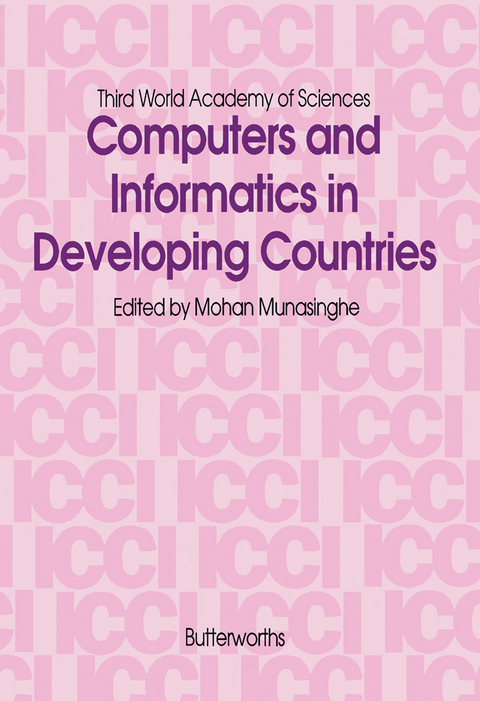
Computers and Informatics in Developing Countries (eBook)
142 Seiten
Elsevier Science (Verlag)
978-1-4831-0110-1 (ISBN)
Computers and Informatics in Developing Countries is a collection of papers documenting the conference of the Expert Group on Computers and Informatics for Development which investigates how the international scientific and development community can assist developing countries in using computer and informatics technology to promote progress and growth. The papers address the need for developing countries to formulate and apply computer and informatics policies for development, as well as the role of an International Centre for Computers and Informatics (ICCI) should play in the development process. The ICCI should be based on the network principle that links other regional and national computer centers. The advantages of the network principle are lower startup costs, avoidance of setting up a large organization, and localized services of needs. An international organization similar to ICCI can accelerate Third World developmental efforts following the identification of needs of developing countries as regards computer and informatics, setting of clear objectives of ICCI, and meeting with potential donors. The collection is suitable for heads of both non-government agencies and government departments involved in international aid, education, or development, and also to administrators of educational institutions and philanthropic organizations.
Front Cover 1
Computers and Informatics in Developing Countries 4
Copyright Page 5
Table of Contents 6
The Third World Academy of Sciences (TWAS) 8
Foreword 10
Acknowledgements 12
Contributors 14
Chapter 1. Introduction 16
Computer and Informatics Issues in Developing Countries 17
Role of an International Centre for Computers and Informatics (ICCI) to Accelerate Third World Development 18
Basic Considerations Concerning the Organization of ICCI 19
Recommendations for Action 21
Chapter 2. Computer and Informatics Policy and Issues for Third World Development 23
Why Developing Countries Should Be Concerned About Computers and Information Technology 26
Sri Lanka: A Case Study of Computer Policy Development 42
Framework for International Collaboration in Computers and Informatics 49
References 53
Chapter 3. Scope for South-North Collaboration in the Area of Computers and Informatics 56
Chapter 4. Review of Selected Donor Agency Policies on Computers and Informatics in Third World Countries 60
Donor Agency Perceptions 61
The World Bank 64
The United Nations Agencies 64
The UN Development Programme (UNDP) 65
The Intergovernmental Bureau for Informatics (IBI) 66
UN Centre for Science and Technology for Development (UNCSTD) 68
The World Health Organization (WHO) 69
The International Labour Office (ILO) 69
The UN Industrial Development Organization (UNIDO) 70
Other non-governmental donor agencies 73
General Conclusions 75
References 78
Chapter 5. Application of Information Technology to Development 79
Technology Trends 79
Application 80
Unique Requirements and Related Issues 82
Managing Technology Development 83
An Example 84
A Plan of Action 84
Concluding Remarks 85
Chapter 6. Educational Computing Technology Transfer: What ICCI Should Do 86
The International Centre for Computers and Informatics 87
Educational Computing and Technology Transfer 88
Exploring the Impact of Computing in Education 88
Continuing and Specialized Education On Computing 89
Computing and Education 91
Computer Education 92
Computing Tools for the Teacher and the Learner 93
Computer-based Learning Environments 94
Towards a Non-Magical Technology Transfer of Educational Computing 97
ICCI as a Means for Fostering a Non-Magical Transference of Informatics and Computing Technology 99
References 100
Chapter 7. Networking and Development 102
EARN - A First Step 102
Objectives and Applications 104
Organization and Technology 105
Regional Information Centre - A Model for the Developing Countries 106
The Next Decade 107
Chapter 8. International Data Communication and Third World Applications: The IDRC Experience 109
Data Communications for Development: Techniques and Experiences 110
An IDRC workshop on computer-based conferencing 112
The computer conference on the bioconversion of lignocellulosics 113
CGNET: communications for agricultural research 115
PACSAT: packet satellite communications 118
Other IDRC activities in telematics 120
Selected IDRC Activities Involving Other Information Technologies 122
Conclusions 126
References 128
Chapter 9. Computers and Informatics in Indonesia: Present and Future Prospects 129
The Role of Computers and Informatics 130
The Prospects 133
Conclusions and Suggestions 136
References 137
Annex 1: Roundtable Conference on an International Centre for Computers and Informatics to Promote Third World Development 138
Annex 2: Roundtable Conference on an International Centre for Computers and Informatics to Promote Third World Development 140
| Erscheint lt. Verlag | 20.5.2014 |
|---|---|
| Sprache | englisch |
| Themenwelt | Mathematik / Informatik ► Informatik ► Theorie / Studium |
| Informatik ► Weitere Themen ► Hardware | |
| ISBN-10 | 1-4831-0110-X / 148310110X |
| ISBN-13 | 978-1-4831-0110-1 / 9781483101101 |
| Informationen gemäß Produktsicherheitsverordnung (GPSR) | |
| Haben Sie eine Frage zum Produkt? |
 PDF (Adobe DRM)
Kopierschutz: Adobe-DRM
Adobe-DRM ist ein Kopierschutz, der das eBook vor Mißbrauch schützen soll. Dabei wird das eBook bereits beim Download auf Ihre persönliche Adobe-ID autorisiert. Lesen können Sie das eBook dann nur auf den Geräten, welche ebenfalls auf Ihre Adobe-ID registriert sind.
Details zum Adobe-DRM
Dateiformat: PDF (Portable Document Format)
Mit einem festen Seitenlayout eignet sich die PDF besonders für Fachbücher mit Spalten, Tabellen und Abbildungen. Eine PDF kann auf fast allen Geräten angezeigt werden, ist aber für kleine Displays (Smartphone, eReader) nur eingeschränkt geeignet.
Systemvoraussetzungen:
PC/Mac: Mit einem PC oder Mac können Sie dieses eBook lesen. Sie benötigen eine
eReader: Dieses eBook kann mit (fast) allen eBook-Readern gelesen werden. Mit dem amazon-Kindle ist es aber nicht kompatibel.
Smartphone/Tablet: Egal ob Apple oder Android, dieses eBook können Sie lesen. Sie benötigen eine
Geräteliste und zusätzliche Hinweise
Buying eBooks from abroad
For tax law reasons we can sell eBooks just within Germany and Switzerland. Regrettably we cannot fulfill eBook-orders from other countries.
aus dem Bereich