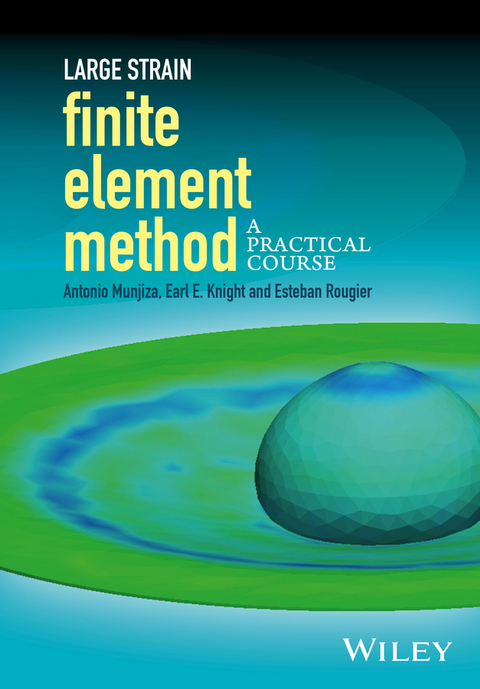
Large Strain Finite Element Method (eBook)
488 Seiten
Wiley (Verlag)
978-1-118-53580-6 (ISBN)

An introductory approach to the subject of large strains and large displacements in finite elements.
Large Strain Finite Element Method: A Practical Course, takes an introductory approach to the subject of large strains and large displacements in finite elements and starts from the basic concepts of finite strain deformability, including finite rotations and finite displacements. The necessary elements of vector analysis and tensorial calculus on the lines of modern understanding of the concept of tensor will also be introduced.
This book explains how tensors and vectors can be described using matrices and also introduces different stress and strain tensors. Building on these, step by step finite element techniques for both hyper and hypo-elastic approach will be considered.
Material models including isotropic, unisotropic, plastic and viscoplastic materials will be independently discussed to facilitate clarity and ease of learning. Elements of transient dynamics will also be covered and key explicit and iterative solvers including the direct numerical integration, relaxation techniques and conjugate gradient method will also be explored.
This book contains a large number of easy to follow illustrations, examples and source code details that facilitate both reading and understanding.
- Takes an introductory approach to the subject of large strains and large displacements in finite elements. No prior knowledge of the subject is required.
- Discusses computational methods and algorithms to tackle large strains and teaches the basic knowledge required to be able to critically gauge the results of computational models.
- Contains a large number of easy to follow illustrations, examples and source code details.
- Accompanied by a website hosting code examples.
Antonio A. Munjiza, Queen Mary College, London, UK Antonio Munjiza is a professor of computational mechanics in the Department of Computational Mechanics at Queen Mary College, London. His research interests include finite element methods, discrete element methods, molecular dynamics, structures and solids, structural dynamics, software engineering, blasts, impacts, and nanomaterials. He has authored two books, The Combined Finite-Discrete Element Method (Wiley 2004) and Computational Mechanics of Discontinua (Wiley 2011) and over 110 refereed journal papers. In addition, he is on the editorial board of seven international journals. Dr Munjiza is also an accomplished software engineer with three research codes behind him and one commercial code all based on his technology. Earl E. Knight, Esteban Rougier and Ted Carney, Los Alamos National Laboratories, USA Earl Knight is a Team Leader in the Geodynamics Team at Los Alamos National Laboratory. His research interests include geodynamic modeling, rock mechanical modeling for deep water oil reservoirs and ground based nuclear explosion monitoring. Esteban Rougier is a Post Doctoral Research Associate at LANL. He has received his Ph.D. from Queen Mary, University of London in 2008` on Computational Mechanics of Discontinuum and its Application to the Simulation of Micro-Flows.
1
Introduction
1.1 Assumption of Small Displacements
University courses often introduce the small displacement assumption in an implicit way, without explaining to the students that it is applicable only in special cases. Take, for example, the structural system shown in Figure 1.1. Point P is attached to the ground using two straight rods that are pin-connected both to the ground and to each other. In a first-year stress analysis course this problem would be solved using the solution procedure shown in Figure 1.2, thus yielding
Figure 1.1 A two member truss
Figure 1.2 Equilibrium of forces at point P
Note that in Equation (1.1) force f1 is a function of angle , where is 45°. However, with this approach, one has ignored the fact that the rods can deform (shorten) under load, thus resulting in a downward displacement of point P. This deformation, in turn changes the initial angle into , Figure 1.3.
Figure 1.3 The initial (dashed lines) and the current (solid lines) geometries
In real life, the actual equilibrium of forces occurs not on the initial geometry, but on the deformed geometry. The internal forces (forces between atoms) move with the geometry (changed position of atoms) – the internal forces f1 and f2 rotate with the corresponding rods and are always parallel to their corresponding rods. The load f also moves with point P. Finally the state of equilibrium shown in Figure 1.4 is reached, when
Figure 1.4 Equilibrium of the deformed system
In other words, the internal forces obtained using Equation (1.1) are wrong and the correct internal forces are obtained using Equation (1.2). The problem with Equation (1.2) is that the geometry of the system is a function of the internal forces, which in turn are a function of the geometry. This yields an implicit equilibrium formulation
The formulation shown in Equation (1.3) is obviously nonlinear. As such, it can be difficult to resolve. For this reason, the formulation given by Equation (1.1) is often used instead, which is fine only when:
- the initial and the deformed geometry are nearly identical – this case occurs only when the displacements are infinitesimally small or tolerably small in practical applications.
- the displacements do not change progressively with the applied load – infinitesimally small perturbations (inaccuracies) in the geometry will not lead to disproportionally large changes in the internal forces, Figure 1.5.
Figure 1.5 Instability of the equilibrium (buckling of struts)
The situation shown in Figure 1.5 is called instability of the equilibrium. Buckling of struts is only one example of an unstable equilibrium. There exists an entire field of applied science dedicated to the analysis of structural stability. It is often formulated in terms of modal analysis, which students usually find difficult to understand, although the concept is relatively simple:
For a given load, there may exist a particular deformed shape in which the structure has in a sense “escaped” from under the load: for example, in Figure 1.5the load has stayed vertical, but the strut has moved (escaped) sideways and, as such, it does not support the load any longer.
In order to solve the above problems, the second order formulation was developed. It is not a general formulation, but rather a patchwork of application-specific formulations that address either the problem of large displacements or structural stability. Some classical examples are the deformation of a rope, the deformation of membranes, and the deformation of slender structures used in civil engineering, aerospace engineering and naval architecture.
As an alternative, the theoretically exact generalized large displacements approach was introduced in the late 1990s and early years of the 21st century and it has gained significant popularity. The idea is relatively simple:
Always consider equilibriumusing the deformed geometry of the solid.
The resulting formulation is called the large displacement formulation, for it represents the exact equilibrium of internal and external forces regardless of the size of the displacements. As such, it captures: (a) equilibrium of systems with small displacements, (b) any instability of equilibrium, and (c) equilibrium of systems with large displacements. In contrast to the 2nd order theory, this is the exact theoretical formulation. It is, by default, nonlinear.
1.2 Assumption of Small Strains
In order to simplify how one solves solid deformation problems, the assumption of small strains through the engineering strain is often introduced. Many times this approach is utilized without any thought of explaining that it is only valid if the strains are infinitesimally small. For this purpose, the strain is often defined as engineering strain
where ΔL is the elongation of a rod of initial length and deformed length . The assumption of small strains is only valid in exceptional circumstances such as deformation of glass at room temperature and similar materials.
When it comes to plastics, rubber, metals, clay, gels, granular materials, glass fibers, carbon fibers, biological tissues, mechanics of cells (such as red blood cells), bitumen, kerogen, and many other materials of modern technology, modern industry, modern science and modern engineering, the assumption of small strains is simply not valid.
In order to rectify the problem for specific applications, various second order formulations have been developed. These parallel the second order formulations for large displacements and are in general applicable only to a specific narrowly defined problem.
In contrast, in this book the theoretically exact generalized large strain formulation is explained.
1.3 Geometric Nonlinearity
The large strain formulation combines naturally with the large displacement formulation. The result is a formulation that reproduces a theoretically exact solution (as opposed to the second order formulation) for both large displacements and large strains.
As such, it addresses (in an exact manner) geometric nonlinearity. Geometric nonlinearity by definition includes nonlinear aspects of deformation that arise from large displacements and/or large strains.
The theoretically exact formulation is based on the multiplicative decomposition of deformation. The concept is relatively simple:
Write the current coordinates of the material points of the solid as
where (ξ, η, ζ) somehow uniquely define a given material point and as such do not change with deformation. Now, Equation (1.5) can be written as
where represents the material points’ translation. It is followed by the rotation and the stretch . In other words, the function is a composition of three functions
where stretches the solid, rotates the solid and translates the solid. It is like one person first comes and translates material point P. The second person comes and rotates the solid. Finally the third person stretches the solid. Only the third stage causes internal forces in the material and can, for example, break the material.
The function describes the deformation of the solid body and is therefore called the deformation function or simply, deformation. The deformation is made from the composition of translation, rotation and stretch in any order. Translation and rotation move the solid as though it was rigid. As such, they do not stretch the solid. In contrast, stretch changes the shape (the geometry) of the solid. In an infinitesimally close vicinity of a given material point P, all these functions are de-facto linear functions of coordinates x, y and z, as shown in Figure 1.6.
Figure 1.6 Linearity of deformation in the infinitesimal vicinity of a given point P: Note that for infinitesimally small dx any function f(x) reduces to f(x) = fP + αx
This leads to the multiplicative decomposition of rotation and stretch. First, the translation is removed from the deformation and what is left is decomposed into a product of stretch and rotation. In addition, stretch is expressed as a product of different types of stretches, such as volumetric stretch, shear stretch, elastic stretch, plastic stretch, etc.
1.4 Stretches
In large strain large displacements deformation, it is convenient to formulate the problem not in terms of strains, but in terms of stretches. The reasons for this are as follows:
- Stretch is well represented by a second order tensor.
- Stretch is easily calculated from the deformation function.
- Stretch is easily separated from rotation.
- Stretch can be further decomposed into an elastic part, a plastic part, a volumetric part, etc.
- Multiplicative decomposition of stretches comes naturally.
- Any type of strains (strain measures) can be calculated from the stretches.
- Stretches are applicable to nonlinear material formulations including nonlinear anisotropic...
| Erscheint lt. Verlag | 19.11.2014 |
|---|---|
| Sprache | englisch |
| Themenwelt | Mathematik / Informatik ► Informatik ► Theorie / Studium |
| Mathematik / Informatik ► Mathematik ► Angewandte Mathematik | |
| Technik ► Maschinenbau | |
| Schlagworte | Calculus • Civil Engineering • Code • Computational / Numerical Methods • conjugate • Course • deformability • displacements • Dynamics • Electrical & Electronics Engineering • Elektrotechnik u. Elektronik • Engineering • Example • FEM • Finite Element Method • Finite-Element-Methode • finite elements • Finite strain • Gradient • hyper-elastic • hypo-elastic • Integration • Introduction • Isotropic • iterative • large displacements • large strain • large strains • Maschinenbau • Materials • matrices • mechanical engineering • Method • Models • Numerical • Numerical Methods & Algorithms • Numerische Methoden u. Algorithmen • Plastic • Practical • Rechnergestützte / Numerische Verfahren im Maschinenbau • Rechnergestützte / Numerische Verfahren im Maschinenbau • Relaxation • Rotations • source code • stress strain • Structural engineering • techniques • Tensor • Transient • unisotropic • Vector analysis • Viscoplastic |
| ISBN-10 | 1-118-53580-4 / 1118535804 |
| ISBN-13 | 978-1-118-53580-6 / 9781118535806 |
| Informationen gemäß Produktsicherheitsverordnung (GPSR) | |
| Haben Sie eine Frage zum Produkt? |
 EPUB (Adobe DRM)
Kopierschutz: Adobe-DRM
Adobe-DRM ist ein Kopierschutz, der das eBook vor Mißbrauch schützen soll. Dabei wird das eBook bereits beim Download auf Ihre persönliche Adobe-ID autorisiert. Lesen können Sie das eBook dann nur auf den Geräten, welche ebenfalls auf Ihre Adobe-ID registriert sind.
Details zum Adobe-DRM
Dateiformat: EPUB (Electronic Publication)
EPUB ist ein offener Standard für eBooks und eignet sich besonders zur Darstellung von Belletristik und Sachbüchern. Der Fließtext wird dynamisch an die Display- und Schriftgröße angepasst. Auch für mobile Lesegeräte ist EPUB daher gut geeignet.
Systemvoraussetzungen:
PC/Mac: Mit einem PC oder Mac können Sie dieses eBook lesen. Sie benötigen eine
eReader: Dieses eBook kann mit (fast) allen eBook-Readern gelesen werden. Mit dem amazon-Kindle ist es aber nicht kompatibel.
Smartphone/Tablet: Egal ob Apple oder Android, dieses eBook können Sie lesen. Sie benötigen eine
Geräteliste und zusätzliche Hinweise
Buying eBooks from abroad
For tax law reasons we can sell eBooks just within Germany and Switzerland. Regrettably we cannot fulfill eBook-orders from other countries.
aus dem Bereich