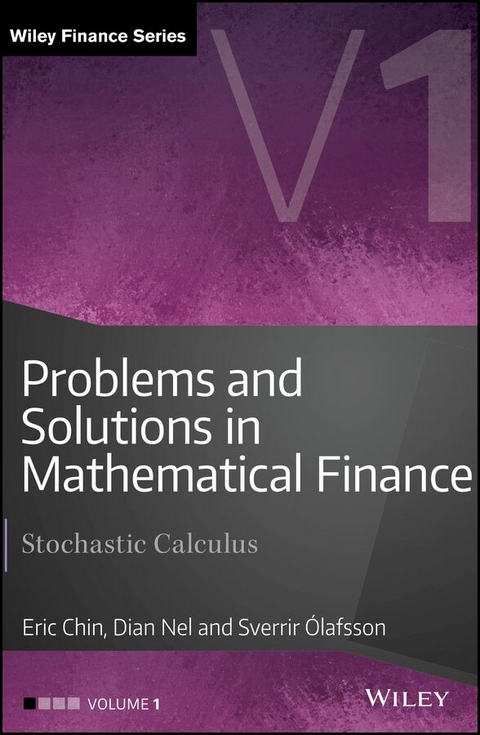
Problems and Solutions in Mathematical Finance, Volume 1 (eBook)
John Wiley & Sons (Verlag)
978-1-119-96608-1 (ISBN)
Mathematical finance requires the use of advanced mathematical techniques drawn from the theory of probability, stochastic processes and stochastic differential equations. These areas are generally introduced and developed at an abstract level, making it problematic when applying these techniques to practical issues in finance.
Problems and Solutions in Mathematical Finance Volume I: Stochastic Calculus is the first of a four-volume set of books focusing on problems and solutions in mathematical finance.
This volume introduces the reader to the basic stochastic calculus concepts required for the study of this important subject, providing a large number of worked examples which enable the reader to build the necessary foundation for more practical orientated problems in the later volumes. Through this application and by working through the numerous examples, the reader will properly understand and appreciate the fundamentals that underpin mathematical finance.
Written mainly for students, industry practitioners and those involved in teaching in this field of study, Stochastic Calculus provides a valuable reference book to complement one’s further understanding of mathematical finance.
Eric Chin is a quantitative analyst at an investment bank in the City of London where he is involved in providing guidance on price testing methodologies and their implementation, formulating model calibration and model appropriateness on commodity and credit products. Prior to joining the banking industry he worked as a senior researcher at British Telecom investigating radio spectrum trading and risk management within the telecommunications sector. Eric Chin holds an MSc in Applied Statistics and an MSc in Mathematical Finance both from University of Oxford. He also holds a PhD in Mathematics from University of Dundee.
Dian Nel has more than 10 years of experience in the commodities sector. He currently works in the City of London where he specialises in oil and gas markets. He holds a BEng in Electrical and Electronic Engineering from StellenboschUniversity and an MSc in Mathematical Finance from ChristChurch, OxfordUniversity. He is a Chartered Engineer registered with the Engineering Council UK.
Sverrir Olafsson is Professor of Financial Mathematics at Reykjavik University; a Visiting Professor at QueenMaryUniversity, London and a director of Riskcon Ltd, a UK based risk management consultancy. Previously he was a Chief Researcher at BT Research and held academic positions at The Mathematical Departments of Kings College, London; UMIST Manchester and The University of Southampton. Dr Olafsson is the author of over 95 refereed academic papers and has been a key note speaker at numerous international conferences and seminars. He is on the editorial board of three international journals. He has provided an extensive consultancy on financial risk management and given numerous specialist seminars to finance specialists. In the last five years his main teaching has been MSc courses on Risk Management, Fixed Income, and Mathematical Finance.
Dr Olafsson has an MSc and PhD in mathematical physics from the Universities of Tübingen and Karlsruhe respectively.
Mathematical finance requires the use of advanced mathematical techniques drawn from the theory of probability, stochastic processes and stochastic differential equations. These areas are generally introduced and developed at an abstract level, making it problematic when applying these techniques to practical issues in finance. Problems and Solutions in Mathematical Finance Volume I: Stochastic Calculus is the first of a four-volume set of books focusing on problems and solutions in mathematical finance. This volume introduces the reader to the basic stochastic calculus concepts required for the study of this important subject, providing a large number of worked examples which enable the reader to build the necessary foundation for more practical orientated problems in the later volumes. Through this application and by working through the numerous examples, the reader will properly understand and appreciate the fundamentals that underpin mathematical finance. Written mainly for students, industry practitioners and those involved in teaching in this field of study, Stochastic Calculus provides a valuable reference book to complement one s further understanding of mathematical finance.
Eric Chin is a quantitative analyst at an investment bank in the City of London where he is involved in providing guidance on price testing methodologies and their implementation, formulating model calibration and model appropriateness on commodity and credit products. Prior to joining the banking industry he worked as a senior researcher at British Telecom investigating radio spectrum trading and risk management within the telecommunications sector. Eric Chin holds an MSc in Applied Statistics and an MSc in Mathematical Finance both from University of Oxford. He also holds a PhD in Mathematics from University of Dundee. Dian Nel has more than 10 years of experience in the commodities sector. He currently works in the City of London where he specialises in oil and gas markets. He holds a BEng in Electrical and Electronic Engineering from StellenboschUniversity and an MSc in Mathematical Finance from ChristChurch, OxfordUniversity. He is a Chartered Engineer registered with the Engineering Council UK. Sverrir Olafsson is Professor of Financial Mathematics at Reykjavik University; a Visiting Professor at QueenMaryUniversity, London and a director of Riskcon Ltd, a UK based risk management consultancy. Previously he was a Chief Researcher at BT Research and held academic positions at The Mathematical Departments of Kings College, London; UMIST Manchester and The University of Southampton. Dr Olafsson is the author of over 95 refereed academic papers and has been a key note speaker at numerous international conferences and seminars. He is on the editorial board of three international journals. He has provided an extensive consultancy on financial risk management and given numerous specialist seminars to finance specialists. In the last five years his main teaching has been MSc courses on Risk Management, Fixed Income, and Mathematical Finance. Dr Olafsson has an MSc and PhD in mathematical physics from the Universities of Tübingen and Karlsruhe respectively.
Preface ix
Prologue xi
About the Authors xv
1 General Probability Theory 1
1.1 Introduction 1
1.2 Problems and Solutions 4
1.2.1 Probability Spaces 4
1.2.2 Discrete and Continuous Random Variables 11
1.2.3 Properties of Expectations 41
2 Wiener Process 51
2.1 Introduction 51
2.2 Problems and Solutions 55
2.2.1 Basic Properties 55
2.2.2 Markov Property 68
2.2.3 Martingale Property 71
2.2.4 First Passage Time 76
2.2.5 Reflection Principle 84
2.2.6 Quadratic Variation 89
3 Stochastic Differential Equations 95
3.1 Introduction 95
3.2 Problems and Solutions 102
3.2.1 Ito Calculus 102
3.2.2 One-Dimensional Diffusion Process 123
3.2.3 Multi-Dimensional Diffusion Process 155
4 Change of Measure 185
4.1 Introduction 185
4.2 Problems and Solutions 192
4.2.1 Martingale Representation Theorem 192
4.2.2 Girsanov's Theorem 194
4.2.3 Risk-Neutral Measure 221
5 Poisson Process 243
5.1 Introduction 243
5.2 Problems and Solutions 251
5.2.1 Properties of Poisson Process 251
5.2.2 Jump Diffusion Process 281
5.2.3 Girsanov's Theorem for Jump Processes 298
5.2.4 Risk-Neutral Measure for Jump Processes 322
Appendix A Mathematics Formulae 331
Appendix B Probability Theory Formulae 341
Appendix C Differential Equations Formulae 357
Bibliography 365
Notation 369
Index 373
Chapter 1
General Probability Theory
Probability theory is a branch of mathematics that deals with mathematical models of trials whose outcomes depend on chance. Within the context of mathematical finance, we will review some basic concepts of probability theory that are needed to begin solving stochastic calculus problems. The topics covered in this chapter are by no means exhaustive but are sufficient to be utilised in the following chapters and in later volumes. However, in order to fully grasp the concepts, an undergraduate level of mathematics and probability theory is generally required from the reader (see Appendices A and B for a quick review of some basic mathematics and probability theory). In addition, the reader is also advised to refer to the notation section (pages 369–372) on set theory, mathematical and probability symbols used in this book.
1.1 Introduction
We consider an experiment or a trial whose result (outcome) is not predictable with certainty. The set of all possible outcomes of an experiment is called the sample space and we denote it by . Any subset of the sample space is known as an event, where an event is a set consisting of possible outcomes of the experiment.
The collection of events can be defined as a subcollection of the set of all subsets of and we define any collection of subsets of as a field if it satisfies the following.
Definition 1.1
The sample space is the set of all possible outcomes of an experiment or random trial. A field is a collection (or family) of subsets of with the following conditions:
- where is the empty set;
- if then where is the complement of in ;
- if , then —that is to say, is closed under finite unions.
It should be noted in the definition of a field that is closed under finite unions (as well as under finite intersections). As for the case of a collection of events closed under countable unions (as well as under countable intersections), any collection of subsets of with such properties is called a -algebra.
Definition 1.2
If is a given sample space, then a -algebra (or -field) on is a family (or collection) of subsets of with the following properties:
- ;
- if then where is the complement of in ;
- if then —that is to say, is closed under countable unions.
We next outline an approach to probability which is a branch of measure theory. The reason for taking a measure-theoretic path is that it leads to a unified treatment of both discrete and continuous random variables, as well as a general definition of conditional expectation.
Definition 1.3
The pair is called a measurable space. A probability measure on a measurable space is a function such that:
- ;
- ;
- if and is disjoint such that , then .
The triple is called a probability space. It is called a complete probability space if also contains subsets of with -outer measure zero, that is .
By treating -algebras as a record of information, we have the following definition of a filtration.
Definition 1.4
Let be a non-empty sample space and let be a fixed positive number, and assume for each there is a -algebra . In addition, we assume that if , then every set in is also in . We call the collection of -algebras , , a filtration.
Below we look into the definition of a real-valued random variable, which is a function that maps a probability space to a measurable space .
Definition 1.5
Let be a non-empty sample space and let be a -algebra of subsets of . A real-valued random variable is a function such that for each and we say is measurable.
In the study of stochastic processes, an adapted stochastic process is one that cannot “see into the future” and in mathematical finance we assume that asset prices and portfolio positions taken at time are all adapted to a filtration , which we regard as the flow of information up to time . Therefore, these values must be measurable (i.e., depend only on information available to investors at time ). The following is the precise definition of an adapted stochastic process.
Definition 1.6
Let be a non-empty sample space with a filtration , and let be a collection of random variables indexed by . We therefore say that this collection of random variables is an adapted stochastic process if, for each , the random variable is measurable.
Finally, we consider the concept of conditional expectation, which is extremely important in probability theory and also for its wide application in mathematical finance such as pricing options and other derivative products. Conceptually, we consider a random variable defined on the probability space and a sub--algebra of (i.e., sets in are also in ). Here can represent a quantity we want to estimate, say the price of a stock in the future, while contains limited information about such as the stock price up to and including the current time. Thus, constitutes the best estimation we can make about given the limited knowledge . The following is a formal definition of a conditional expectation.
Definition 1.7 (Conditional Expectation)
Let be a probability space and let be a sub--algebra of (i.e., sets in are also in ). Let be an integrable (i.e., ) and non-negative random variable. Then the conditional expectation of given , denoted , is any random variable that satisfies:
- is measurable;
- for every set , we have the partial averaging property
From the above definition, we can list the following properties of conditional expectation. Here is a probability space, is a sub--algebra of and is an integrable random variable.
- Conditional probability. If is an indicator random variable for an event then
- Linearity. If , , , are integrable random variables and , , , are constants then
- Positivity. If almost surely then almost surely.
- Monotonicity. If and are integrable random variables and almost surely then
- Computing expectations by conditioning. .
- Taking out what is known. If and are integrable random variables and is measurable then
- Tower property. If is a sub--algebra of then
- Measurability. If is measurable then .
- Independence. If is independent of then .
- Conditional Jensen's inequality. If is a convex function then
1.2 Problems and Solutions
1.2.1 Probability Spaces
- 1. De Morgan's Law. Let , where is some, possibly uncountable, indexing set. Show that
- .
- .
Solution
- Let which implies , so that for all . Therefore,
On the contrary, if we let then for all or and hence
Therefore, .
- From (a), we can write
Taking complements on both sides gives
- 2. Let be a -algebra of subsets of the sample space . Show that if then .
Solution
Given that is a -algebra then and . Furthermore, the complement of is .
Thus, from De Morgan's law (see Problem 1.2.1.1, page 4) we have .
- 3. Show that if is a -algebra of subsets of then .
Solution
is a -algebra of subsets of , hence if then .
Since then . Thus, .
- 4. Show that if then is a -algebra of subsets of .
Solution
is a -algebra of subsets of since
- .
- For then . For then . In addition, for then . Finally, for then .
- , , , , , , and .
- 5. Let , be a family of -algebras of subsets of the sample space . Show that is also a -algebra of subsets of .
Solution
is a -algebra by taking note that
- Since , therefore as well.
- If for all then , . Therefore, and hence .
- If for all then , and hence and .
From the results of (a)–(c) we have shown is a -algebra of .
- 6. Let and let
Show that and are -algebras of subsets of .
Is also a -algebra of subsets of ?
Solution
Following the steps given in Problem 1.2.1.4 (page 5) we can easily show and are -algebras of subsets of .
By setting , and since and , but , then is not a -algebra of subsets of .
- 7. Let be a -algebra of subsets of and suppose so that . Show that .
Solution
Given that and are mutually exclusive we therefore have
Thus, we can express
Since and therefore .
- 8. Let be a probability space and let be defined by where such that . Show that is also a probability space.
Solution
To show that is a probability space we note that
- .
- .
- Let be disjoint members of and hence we can imply , are also disjoint members of . Therefore,
Based on the results of (a)–(c), we have shown that is also a probability space.
- 9. Boole's Inequality. Suppose is a countable collection of events. Show that
Solution
Without loss of generality we assume that and define , , such that are pairwise disjoint and
Because , , we have
- 10. Bonferroni's Inequality. Suppose is a countable collection of events....
| Erscheint lt. Verlag | 20.11.2014 |
|---|---|
| Reihe/Serie | The Wiley Finance Series |
| Wiley Finance Series | Wiley Finance Series |
| Sprache | englisch |
| Themenwelt | Mathematik / Informatik ► Mathematik ► Angewandte Mathematik |
| Recht / Steuern ► Wirtschaftsrecht | |
| Wirtschaft ► Betriebswirtschaft / Management ► Finanzierung | |
| Schlagworte | common problems in quantitative finance • Computational Finance • derivatives pricing modeling • derivatives pricing models • Finance & Investments • financial mathematical modeling • Financial products • financial risk management and probability • Finanzprodukte • Finanz- u. Anlagewesen • investment risk management and probability • mathematical finance • Mathematical modeling in finance • probability and risk management • probability in finance • Quantitative Finance • quantitative finance problems • quantitative finance problems and solutions • statistical methods in finance • statistical modeling in finance • Statistics in Finance • stochastic calculus finance problems and solutions • stochastic calculus for finance • stochastic calculus in derivatives pricing • stochastic calculus problems in finance • trading risk management and probability |
| ISBN-10 | 1-119-96608-6 / 1119966086 |
| ISBN-13 | 978-1-119-96608-1 / 9781119966081 |
| Informationen gemäß Produktsicherheitsverordnung (GPSR) | |
| Haben Sie eine Frage zum Produkt? |
 EPUB (Adobe DRM)
Kopierschutz: Adobe-DRM
Adobe-DRM ist ein Kopierschutz, der das eBook vor Mißbrauch schützen soll. Dabei wird das eBook bereits beim Download auf Ihre persönliche Adobe-ID autorisiert. Lesen können Sie das eBook dann nur auf den Geräten, welche ebenfalls auf Ihre Adobe-ID registriert sind.
Details zum Adobe-DRM
Dateiformat: EPUB (Electronic Publication)
EPUB ist ein offener Standard für eBooks und eignet sich besonders zur Darstellung von Belletristik und Sachbüchern. Der Fließtext wird dynamisch an die Display- und Schriftgröße angepasst. Auch für mobile Lesegeräte ist EPUB daher gut geeignet.
Systemvoraussetzungen:
PC/Mac: Mit einem PC oder Mac können Sie dieses eBook lesen. Sie benötigen eine
eReader: Dieses eBook kann mit (fast) allen eBook-Readern gelesen werden. Mit dem amazon-Kindle ist es aber nicht kompatibel.
Smartphone/Tablet: Egal ob Apple oder Android, dieses eBook können Sie lesen. Sie benötigen eine
Geräteliste und zusätzliche Hinweise
Buying eBooks from abroad
For tax law reasons we can sell eBooks just within Germany and Switzerland. Regrettably we cannot fulfill eBook-orders from other countries.
aus dem Bereich