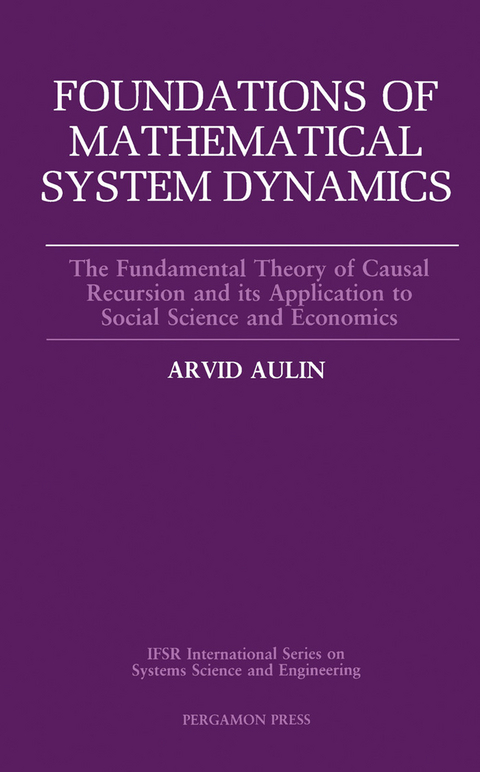
Foundations of Mathematical System Dynamics (eBook)
343 Seiten
Elsevier Science (Verlag)
978-1-4832-8697-6 (ISBN)
This book is a foundational study of causality as conceived in the mathematical sciences. It is shown that modern mathematical dynamics involves a formulation of the fundamental concept of causality, and an exhaustive classification of causal systems. Among them are the 'self-steering' and 'self-regulating' systems, which together form the class of purposive systems, on whose specific properties the book then focuses. These properties are the mathematical-dynamical foundations of the behavioural and social sciences. This is the definitive book on causality and purposive processes by the originator of the mathematical concept of self-steering.
Front Cover 1
Foundations of Mathematical System Dynamics: The Fundamental Theory of Causal
4
Copyright Page 5
Table of Contents 6
Preface 12
Part 1: Fundamental Dynamics: The General Theory of Causal Recursion 14
CHAPTER 1. Causal Recursion in Theoretical Physics 16
1.1 Causal Relation, Causal Law, and Causal Recursion 16
1.2. Causal Recursion in Classical Physics: the Hamiltonian Formalism 17
1.3 Causal Recursion in Quantum Physics: the Unitary Timetranslations in a Hubert Space of States 20
1.4 The Molecular State-description: a Third Level of Causal Recursion 21
1.5 Conservative and Dissipative Systems 23
CHAPTER 2. Causal Recursion in Mathematical Dynamics 26
2.1. Causal Recursion in Dynamical Systems Generally 26
2.2 Dynamical Systems With Nilpotent Causal Recursion 31
2.3. Dynamical Systems with Full Causal Recursion 35
2.4. Self-organization vs Rigid-structured Dynamical Systems 37
2.5 Causality, Determinism, and Indeterminism 40
CHAPTER 3. The Systematics of Goal-directed Systems 42
3.1. General properties of the goals of self-regulating systems 42
3.2. Self-regulating equilibrium systems 43
3.3. Periodically pulsating self-regulating systems 46
3.4. Almost periodically pulsating self-regulating systems 48
3.5. Irregularly ('chaotically') pulsating self-regulating systems 49
3.6. Self-steering systems 51
3.7. The Ashby-Lange effect 54
3.8. Systems that are steerable from outside 55
3.9. Finite systems and Turing machines 59
CHAPTER 4. The Modes of Asymptotic Approach of Goals 63
4.1. Causal Suction: The Ideal Type 63
4.2. The Generalization of Causal Suction to ç Dimensions and to Nonlinear Causal Recursions in an Equilibrium System 65
4.3. The Generalization of Causal Suction t o Nonequilibrium Goals 71
4.4. Causal Torsion 72
4.5. Causal Vortex 76
4.6. The Approach of a Goal Through Rapid Vibrations 79
4.7. The Degeneracies of Causal Suction, Torsion, and Vortex, and of Rapid Vibrations, into Satellites and Comets 84
4.8. The General Connection Between Linear Difference and Differential Equations 91
CHAPTER 5. The Variety of Dynamical Systems Generated by a Single Nonlinear Map (An Example) 95
5.1. The Séparatrices and Regions 96
5.2. The Special Points 100
5.3. Structural Stability and Instability 102
5.4. Hopf Bifurcation: an Algorithm for the Detection of its Existence 104
Part 2: Simple Applications: Causal Recursion in Population Dynamics and Economic Growth Theory 108
CHAPTER 6. Verhulstian Ecosystems and the Feigenbaum Bifurcations of their Equilibrium States 110
6.1. The Verhulst Axioms 110
6.2. The Preliminary (Local) Stability Analysis 111
6.3. Verhulstian Ecosystems as Self-regulating Equilibrium Systems: a Small or Medium Total Biomass 114
6.4 Verhulstian Ecosystems as Periodically Pulsating Self-regulating Systems of Period 2: a Large Total Biomass but a Small Death Rate 123
6.5. The Feigenbaum Bifurcations and their Interruptions in Verhulstian Ecosystems in the General Case: a Large Death Rate and Total Biomass 127
CHAPTER 7. The Role of Self-regulation in Biological Evolution and in Different Ecologies 132
7.1. The Survival of the Fittest 132
7.2. The Coexistence of Different Species 133
7.3. General Remarks on Self-regulation in Competitive Ecology 136
7.4. On Self-regulation in Predator-Prey Ecology 139
CHAPTER 8. The Conditions of Self-steering of Economic Development 142
8.1. A Heuristic Model of Self-steering and Selforganization of Economic Development in the Very Long Run: the Generalized Steinmann-Komlos Model 142
8.2. A Down-to-earth Approach to Economic Growth: the Dynamic Input-Output Model 151
8.3. The Condition of Self-steering to the Golden Age Path in the Solow-Swan and Related Mainstream Models 162
8.4. Criticism of Neoclassical Growth Theory from the Point of V i ew of Mathematical Dynamics 168
Part 3: Complex Applications: The Self-steering and Selfregulation of Human Societies as Wholes 176
CHAPTER 9. The Concept of a Self-steering Actor 178
9.1. Human Acts as Tools of Interaction between Consciousness and the World of Objects 178
9.2. Mathematical Representation of Acts 180
9.3. The Theorem on Dual Causality 183
9.4. Self-steering Actors 186
CHAPTER 10. Self-regulating Actors and Actorhierarchies 190
10.1 Subjective and Objective Complexity 190
10.2. Survival through Self-regulation: Ashby's Law 191
10.3. The Improvement of Self-regulation by Actor- Hierarchies 195
CHAPTER 11. The Law of Requisite Hierarchy 198
11.1. Human Society as a Complex Self-regulating and Self-organizing Actor-Hierarchy 198
11.2. The Law of Requisite Hierarchy for Undeveloped Economic Systems 200
11.3. The Law of Requisite Hierarchy for Developing Economic Systems 202
CHAPTER 12. The Cybernetic Concepts of Social Development and U nderdevelopment 204
12.1. Human Society as a Collective of Self-steering Actors 204
12.2. The Limits of Toleration of Self-Steering in Human Society 205
12.3. The Concept of Underdevelopment 208
12.4. The Concept of Social Development 210
CHAPTER 13. The Governability of Human Society 212
13.1. The Crises of Governability as Crises of Selfsteering 212
13.2. The Freedom of Action of Two Opposite Political Forces as the Condition of Governability of Developing Society 217
13.3. Full-scale Social Revolution as a Loss of Governability of Society 219
Part 4: Historical Illustrations of Se/fsteering in Different Types of Human Societies 224
CHAPTER 14. The Birth of the Western-style Society of Relaxed Hierarchy 226
14.1. The Origin of East-West Differences: Economic Development in Western and Eastern Europe since the Twelfth Century 226
14.2. Western-European Feudalism and its Relaxed Hierarchy of Power 228
14.3. The Germ of Western Democracy: the Local Power of the Middle Class in Medieval England 233
CHAPTER 15. Underdevelopment as Illustrated by Russian Social History from the Ninth to the Nineteenth Centuries 240
15.1. The Backwardness of the Russian Economy and the Defeat of the Norman Power 240
15.2. The Continual Growth of Centralized Power in Russia 242
15.3. The Development from Absolute towards Totalitarian Power 246
CHAPTER 16. The Gradual Breakthrough of Modern Western Society in England from the Fourteenth to the Nineteenth Centuries 253
16.1. The End of English Feudalism and the Rise of Independent Farmers and City Bourgeoisie 253
16.2. The Short-lived Threat of Full Revolution: Cromwell's Time and a Temporary Drop of Selfsteering (Human Freedom) in English Society 256
16.3. The Rapid Increase of Self-steering: The Emergence of Two-party Parliamentarism, Industrial Revolution, and the Anglo-Saxon Freedom of Speech 259
CHAPTER 17. The Full-scale Social Revolutions and Their After-effects on the European Continent 264
17.1. Delayed Social Development in France and the Instability Following the Great Revolution 264
17.2. Revolution Passes Eastward 267
17.3. The Dominating Developmental Trends in the Contemporary World and the Birth of the European 'Grey Zone' 270
Part 5: The Problem of the Origin: The Self-steering and Steered - from-outside Layers of Consciousness? 274
CHAPTER 18. The Self-steering and Steeringfrom- outside of Man 276
18.1. The Mathematical Concepts of a priori and a posteriori Subjective Probability 276
18.2. The Filter Theorem 281
18.3. A Discussion of the First Condition of the Filter Theorem: Empirical and Inductive Knowledge 283
18.4. A Discussion of the Second Condition of the Filter Theorem: The Filter in Human Consciousness 286
18.5. On the Mechanisms of the Formation of a priori Knowledge 287
18.6. The Anthropological Evidence for the Two-layer Theory and the Conditioning Hypothesis: A Survey of the Main Points 291
CHAPTER 19. The Primitive Mind: Anthropological Evidence for the Two-layer Theory and the Conditioning Hypothesis Scrutinized* 295
19.1. The Two Layers of the Primitive Mind: The Sacred and the Profane 295
19.2. The Nature of Magic and the Conditioning of Myths 297
19.3. The Crucial Test of the Collective Conditioning of a priori Truths 304
Scientific References 317
APPENDIX: Why Mathematical Foundations Are Important in Science 321
1. Introduction 321
2. The Inflation of Various Models and Paradigms 321
3. The Testimony of the Accumulation of Fundamental Scientific Knowledge: Reality is Mathematical 324
4. Where and how Ultra-empiricism got it Wrong 328
5. Repercussions of Ultra-empiricism in Philosophy and in the 'Soft' Sciences 334
6. Conclusions 340
Index 342
| Erscheint lt. Verlag | 25.5.2017 |
|---|---|
| Sprache | englisch |
| Themenwelt | Mathematik / Informatik ► Mathematik ► Analysis |
| Technik | |
| ISBN-10 | 1-4832-8697-5 / 1483286975 |
| ISBN-13 | 978-1-4832-8697-6 / 9781483286976 |
| Informationen gemäß Produktsicherheitsverordnung (GPSR) | |
| Haben Sie eine Frage zum Produkt? |
 PDF (Adobe DRM)
Kopierschutz: Adobe-DRM
Adobe-DRM ist ein Kopierschutz, der das eBook vor Mißbrauch schützen soll. Dabei wird das eBook bereits beim Download auf Ihre persönliche Adobe-ID autorisiert. Lesen können Sie das eBook dann nur auf den Geräten, welche ebenfalls auf Ihre Adobe-ID registriert sind.
Details zum Adobe-DRM
Dateiformat: PDF (Portable Document Format)
Mit einem festen Seitenlayout eignet sich die PDF besonders für Fachbücher mit Spalten, Tabellen und Abbildungen. Eine PDF kann auf fast allen Geräten angezeigt werden, ist aber für kleine Displays (Smartphone, eReader) nur eingeschränkt geeignet.
Systemvoraussetzungen:
PC/Mac: Mit einem PC oder Mac können Sie dieses eBook lesen. Sie benötigen eine
eReader: Dieses eBook kann mit (fast) allen eBook-Readern gelesen werden. Mit dem amazon-Kindle ist es aber nicht kompatibel.
Smartphone/Tablet: Egal ob Apple oder Android, dieses eBook können Sie lesen. Sie benötigen eine
Geräteliste und zusätzliche Hinweise
Buying eBooks from abroad
For tax law reasons we can sell eBooks just within Germany and Switzerland. Regrettably we cannot fulfill eBook-orders from other countries.
aus dem Bereich