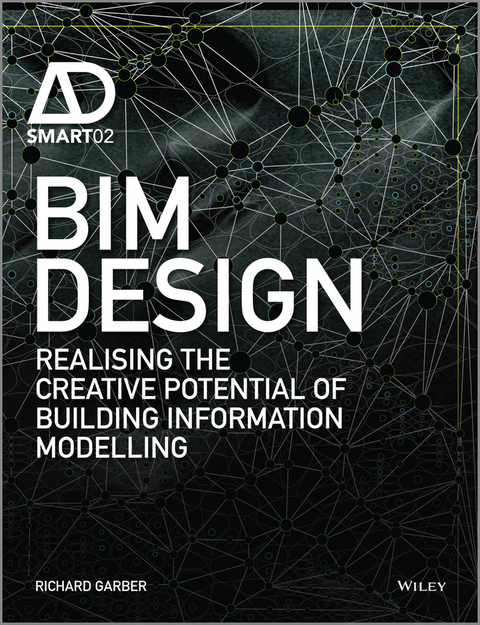
BIM Design (eBook)
John Wiley & Sons (Verlag)
978-1-118-71979-4 (ISBN)
Throughout the projects are used to effectively illustrate the creative application of BIM at a variety of scales. These buildings showcase work by firms executing projects all over the world including: SHoP Architects and Construction (New York), Morphosis (Los Angeles), Populous (London), GRO Architects (New York), Resier + Umemoto (New York), Gensler (Shanghai) and UN Studio (Amsterdam).
Richard Garber, AIA, is an Associate Professor at the College of Architecture and Design of the New Jersey Institute of Technology and partner in the New York City-based fi rm GRO Architects. His teaching and professional work uses computer simulation and computer numerically controlled (CNC) hardware to generate innovative design, construction and assembly solutions. Current work includes a series of modular housing projects in Jersey City, New Jersey and Baltimore, Maryland; and a community plan for the Zhangdu Lake region of Wuhan, China. He was previously a project manager at SHoP Architects and at Greg Lynn FORM. He holds architecture degrees from Rensselaer Polytechnic Institute and Columbia University.
FOREWORD Mario Carpo 8
CHAPTER 1 Information Modelling Today 14
CHAPTER 2 The Master Builder and Information Modelling 28
SHoP Architects, Control and Construction 44
CHAPTER 3 The C(reative)onstruction Process, Then and Now 58
MORPHOSIS Design Intent and Digital Iteration 70
CHAPTER 4 New Methods: New Tools 88
POPULOUS Curvilinear Workflows 102
CHAPTER 5 The Digital States and Information Modelling 122
GRO ARCHITECTS Dense Agendas 132
CHAPTER 6 Strategies for Component Generation 146
REISER + UMEMOTO Architecture by (Semi) Remote Control 160
CHAPTER 7 Assemblies and their Simulation 178
GENSLER Simulation Takes Control 196
CHAPTER 8 Conclusions: Authorship and Lines of Development 214
UNStudio Knowledge Architecture for a Life (Cycle) 224
Select Bibliography 242
Index 244
FOREWORD
MARIO CARPO
When I started my architectural studies in Italy, in the late 1970s, one of the first assignments I was given was to make a model of a circus tent. The mimeographed instructions specified that the model had to include poles, either vertical or slanted, suspended ropes or wires with load-bearing functions, and a canopy; the scale of the model and the choice of materials were up to the students. I vividly remember being perplexed from the start; my frustration then grew along with my evident inability to make that bizarre contrivance stand up – in any configuration. I did not know how to saw wood, cut canvas or tie ropes. I had no experience as a bricoleur, no skill as a handyman, nor any desire to become one; and I stood up and said exactly that the second or third time the class met. The professor, a stern melancholy man of solid Tuscan stock, severely reprimanded me, accusing me of being an elitist, an urban intellectual, or worse. By contrast, he praised his own rural upbringing in a family of farmers and woodworkers, hence his spiritual understanding of the nature of the materials of which architecture is made and their inner workings – or something like that. I was not persuaded and, back home, I fine-tuned my arguments in preparation for another round. I do not remember what those arguments were, as no further debate ensued.
The week after that memorable confrontation, the Department of Architecture, together with most of the university, was occupied by Communist guerrillas. When the same professor tried to go to his office, the Proletarian Avant-Garde of the Irascible Non-Tenured Lecturers (an approximate translation from the original Italian) smashed him over the head with a heavy wooden chair. His ancestral familiarity with timber, however, did not save his skull; he was taken to hospital and kept there for almost as long as the school’s occupation. When courses restarted, months later, all assignments were due the same week. I teamed up with other students, better bricoleurs than me, the model was produced collectively and my task in the group was to write the presentation text.
For the remainder of my studies in architecture I was never asked to produce another physical object – other than drawings, of course – and so never had the opportunity to revisit and further investigate the causes of that altercation and the nature of my objections. Had I been more perspicacious, or more conversant with the history of architecture – which I wasn’t at the age of 18 and after barely a month of classes – my retort to that blundering craftsman-turned-architectural-educator should have been: architecture as an art of design was invented by Leon Battista Alberti, and a few others, during the Renaissance. Alberti and his humanist friends thought that architects should not make physical buildings, but concentrate only on drawing them. For the humanists, the complete separation between designers and makers, both ideological and practical, allowed no exceptions: designers should do the drawings and send them to the builders for execution; designers should not make objects and makers should not design them. Thus, architects are not craftsmen but thinkers, which is why, unlike plumbers or bakers, they prepare for their profession by studying at university, instead of training in a shop or on site.
This ‘Albertian paradigm’ is the foundation of modern architecture as an art of design, and when the humanists invented it, it was a revolution against the medieval and traditional way of building as a mechanical craft. When I enrolled in the Department of Architecture of an Italian university to become an architect, I was the product of five centuries of Albertian humanism in the arts of design: I wanted to become a maker of notations, expressed through words, numbers and drawings. I had no interest whatsoever in making buildings with my own hands, and I was even less interested in learning from, or even simply dealing with, the scores of builders and makers and craftsmen and contractors that at some point would, somehow, translate my drawings into physical objects. Alberti would have said that if I had felt so inclined, I should have gone back to live in the Middle Ages (not the exact words he used) to train as an apprentice in the guild of the stonecutters. There I would have found dust and dirt, blood, sweat and tears and much gnashing of teeth. Instead, in the modern, Albertian way, the tools of my trade had to be strictly limited to sound ideas and clear lines (‘fidum consilium’ and ‘castigataque lineamenta’).
Approximately two decades after the rise of computer-based design, we now fully appreciate that digital design and fabrication do not work that way. The technical logic of digital tools runs counter to, and indeed negates, the Albertian principle of separation between design and making. Computers can notate any three-dimensional physical object using as many X-Y-Z coordinates as necessary (or using mathematical functions to generate them). These digital notations, when sent to a computer screen, create 2-D images, and when sent to a 3-D printer, create 3-D objects. When the architectural avant-garde of the early and mid 1990s began to use digital design and fabrication tools, this process was called ‘file-to-factory’, implying that the fabrication of the real object, in real size, is just one of the many instantiations of the same digital file, and can be managed by the same person. This person used to be called a designer, but in this seamless digital process the designer is also the maker, and this digital designer-and-maker is de facto a digitally empowered craftsman, who using the same digital tools can design and make at the same time.
Today, a 3-D printer can fabricate almost any one-piece object that a computer screen can represent with images. Designers can then manipulate the physical object and send the changes back to the digital file, if necessary, by scanning it in 3-D, and so on ad libitum. The digital avant-garde was quick to grasp the creative potential of the ‘file-to-factory’ model, and a comprehensive new theory of digital design and making, or digital craftsmanship, was formulated in the course of the 1990s, despite the limited technical possibilities that 3-D printers of the time (mostly CNC milling machines) could offer. Experimental product design also blossomed at the time, mostly in small sizes, small batches and at the small scale of prototyping, which early digital fabrication technologies could more easily support. A bigger scale and bigger objects, it was then thought, would come in time, with bigger and more powerful machines.
1 Gehry Technologies, Edmonton International Airport, Edmonton, Alberta 2013
An important role of so-called BIM consultants is to conceptualise the whole process of information flow across an entire project.
This did not happen. Using any cheap 3-D printer today, anyone could – if so inclined – design and print a teapot, for example, on his or her desk. But no machine can 3-D print a real building in one big piece (even though, using a technology called ‘contour crafting’, some are still trying). In the summer of 2012 a group of 13 Yale students used state-of-the-art digital technologies to design and build an elegant pavilion made of laser-cut metal parts, which they assembled with their own hands on the New Haven Green, Connecticut. But the success of this experiment does not mean that a hundred students could conceive and make a housing project, nor that a thousand students could conceive and make a skyscraper. Today’s building and construction industry does not yet work that way, and chances are it never will, as buildings are not big teapots, nor the assembly of many smaller ones – no matter how customisable. A building is in most cases made from many very different parts, which in turn are made of different materials, provided by different industries or crafted by different contractors, following the rules of different trades, and frequently redesigned and fine-tuned all along this process in ways that may in the end match, somehow, the intentions of the original designer – but often don’t.
This is one reason why, to ‘close the gap’ between design intentions and project delivery, the building and construction industry has looked for other ways to reunite design and making, based not on single-actor, or single-piece, fabrication, but on a different strategy of information sharing. This followed from the assumption that the many and diverse actors participating in a complex design process would remain separate but use the same digital models from the start, and that these models should make all technical and financial information accessible to all at all times. In more recent times, this managerial approach has merged with the avant-garde experiments of a new generation of digitally intelligent designers under the generic name of Building Information Modelling (BIM). The spirit of BIM posits that designers, builders and theoretically other agents as well, such as customers or clients or users, should participate in the collaborative making of the digital model of a future building, and that contractors in particular – thanks to this new, interactive digital platform – may enter the design process from the very start. Given the unprecedented power of digital simulations, one may surmise that at some point virtual models may become perfect duplicates of, and substitutes for, the buildings they represent – embodying and enacting all and every aspect of them. Designers could then...
| Erscheint lt. Verlag | 29.10.2014 |
|---|---|
| Reihe/Serie | AD Smart |
| AD Smart | AD Smart |
| Sprache | englisch |
| Themenwelt | Informatik ► Grafik / Design ► Digitale Bildverarbeitung |
| Mathematik / Informatik ► Informatik ► Theorie / Studium | |
| Technik ► Architektur | |
| Schlagworte | Architects • Architecture • Architektur • Bauentwurf • BIM • book demonstrates • Building • Building Design • Computer-Ratgeber • Construction • Creativity • Design • End-User Computing • firms • Graphics & Design software (Non-Microsoft) • Graphik- u. Designsoftware (auÃer Microsoft) • Graphik- u. Designsoftware (außer Microsoft) • Information Modelling • Innovative • Potential • Problems • Process • revolutionising • Risk • Role • significant • Technologies • utilitarian |
| ISBN-10 | 1-118-71979-4 / 1118719794 |
| ISBN-13 | 978-1-118-71979-4 / 9781118719794 |
| Informationen gemäß Produktsicherheitsverordnung (GPSR) | |
| Haben Sie eine Frage zum Produkt? |
 EPUB (Adobe DRM)
Kopierschutz: Adobe-DRM
Adobe-DRM ist ein Kopierschutz, der das eBook vor Mißbrauch schützen soll. Dabei wird das eBook bereits beim Download auf Ihre persönliche Adobe-ID autorisiert. Lesen können Sie das eBook dann nur auf den Geräten, welche ebenfalls auf Ihre Adobe-ID registriert sind.
Details zum Adobe-DRM
Dateiformat: EPUB (Electronic Publication)
EPUB ist ein offener Standard für eBooks und eignet sich besonders zur Darstellung von Belletristik und Sachbüchern. Der Fließtext wird dynamisch an die Display- und Schriftgröße angepasst. Auch für mobile Lesegeräte ist EPUB daher gut geeignet.
Systemvoraussetzungen:
PC/Mac: Mit einem PC oder Mac können Sie dieses eBook lesen. Sie benötigen eine
eReader: Dieses eBook kann mit (fast) allen eBook-Readern gelesen werden. Mit dem amazon-Kindle ist es aber nicht kompatibel.
Smartphone/Tablet: Egal ob Apple oder Android, dieses eBook können Sie lesen. Sie benötigen eine
Geräteliste und zusätzliche Hinweise
Buying eBooks from abroad
For tax law reasons we can sell eBooks just within Germany and Switzerland. Regrettably we cannot fulfill eBook-orders from other countries.
aus dem Bereich