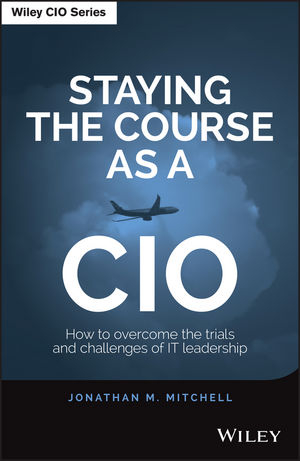
Staying the Course as a CIO (eBook)
John Wiley & Sons (Verlag)
978-1-118-96884-0 (ISBN)
STAYING THE COURSE AS A CIO: HOW TO OVERCOME THE TRIALS AND CHALLENGES OF IT LEADERSHIP
The shelf-life of a Chief Information Officer can be shockingly short. Few survive in post for more than a few years. More often each falls prey to insurmountable problems and their careers come to a sharp and ignominious end. In this book, a global CIO with over thirty years of experience in major corporations examines the main reasons why this happens. Readers will understand which types of issue can cause problems for an IT Leader and more importantly, they will learn strategies of how these problems can be minimized or even avoided.
IT is often seen a technical backwater, but it is a discipline which has the capability to add massive value to an organisation whether it is in the private or the public sector – provided of course it has the right leadership doing the right things.
Aspiring IT Leaders will need to deal with a common set of recurring trials and challenges. These include:
· Overcoming the challenge of managing diverse and conflicting stakeholders
· How to deal with large and complex projects
· Making sense of software and how to handle the rapidly changing technology landscape
· Knowing when to outsource and how to get the best out of an outsourcing partner
· Harnessing the intellectual power of consultants to help you meet your goals
· And last but not least, how to develop a set of strategies that are aligned with your corporate goals and then make sure your resources are properly targetted so that the IT function generates maximum positive impact for the enterprise.
For IT professionals looking to fully integrate their function into the enterprise, 'Staying the Course as a CIO’ is a valuable source of practical advice, all based on real experience.
STAYING THE COURSE AS A CIO: HOW TO OVERCOME THE TRIALS AND CHALLENGES OF IT LEADERSHIP The shelf-life of a Chief Information Officer can be shockingly short. Few survive in post for more than a few years. More often each falls prey to insurmountable problems and their careers come to a sharp and ignominious end. In this book, a global CIO with over thirty years of experience in major corporations examines the main reasons why this happens. Readers will understand which types of issue can cause problems for an IT Leader and more importantly, they will learn strategies of how these problems can be minimized or even avoided. IT is often seen a technical backwater, but it is a discipline which has the capability to add massive value to an organisation whether it is in the private or the public sector provided of course it has the right leadership doing the right things. Aspiring IT Leaders will need to deal with a common set of recurring trials and challenges. These include: Overcoming the challenge of managing diverse and conflicting stakeholders How to deal with large and complex projects Making sense of software and how to handle the rapidly changing technology landscape Knowing when to outsource and how to get the best out of an outsourcing partner Harnessing the intellectual power of consultants to help you meet your goals And last but not least, how to develop a set of strategies that are aligned with your corporate goals and then make sure your resources are properly targetted so that the IT function generates maximum positive impact for the enterprise. For IT professionals looking to fully integrate their function into the enterprise, 'Staying the Course as a CIO is a valuable source of practical advice, all based on real experience.
DR JONATHAN M. MITCHELL is an IT executive with over 30 years of experience in global blue-chip companies. For nearly a decade he was the Chief Information Officer, Business Process Improvement Director and Corporate Development Director at Rolls-Royce. Prior to that he built a successful IT career at BP and GlaxoSmithKline, where he rose to become a Vice President. In recent years he has appeared in lists of the most influential Global CIOs in Information Week, CIO Magazine and Computer Weekly. Jonathan is a founder of CIO Strategic Advisors Ltd, a company which provides strategic consultancy and development for Executive teams using a network of respected former-CIOs. In 2014, he became the Non-Executive Chairman of the Global CIO Practice at Harvey Nash, one of the largest IT recruitment companies in the world. He has also been working as an independent industry expert with the UK Shadow Cabinet to develop a rescue plan for a major welfare IT project. Jonathan is a member of the Advisor Board for the Centre for Information Leadership at City University and collaborates with the CASS Business School's Executive Education unit. He is a Fellow of the British Computer Society, a Chartered IT Professional and a past Chairman of the UK Corporate IT Forum. www.ciostrategicadvisors.com
"If you are a CIO or thinking about taking on the position, this book should be on your list of essential reading....it is an excellent book" (BCS, February 2015)
"The distillation of 30 years of experience from a CIO who knows a thing or two about an extended shelf life" (i-cio.com, February 2015)
"Michell gives useful advice on how to work through the toughest projects and solve some of the most pressing issues CIOs deal with today" (World Economic Forum, May 2015)
"For IT professionals looking to fully integrate their function into the enterprise, 'Staying the Course as a CIO' is a valuable source of practical advice, all based on real experience." (Good Reads, June 2015)
CHAPTER 1
Dislocated Stakeholders
“Where is the ‘any’ key?”
(Homer Simpson, in response to the message, “Press any key”)
Stakeholders, as one of my colleagues once said to me, “should be tied to one”. He was definitely in the “Joan of Arc” school of stakeholder management. “It's all very good when they are feisty and swashbuckling,” he continued, “but when they start to get irritating, you should tie ’em to a pole and light a bonfire.” This approach has obvious attractions, but there are few people who can avoid the scourge of the irritating stakeholder whose mission in life is to make your life a misery. King Henry VIII, the sixteenth-century King of England, was one of the few heroes of history who was able to buck the trend. As most British schoolchildren will know, Old Henry had a penchant for doing his own thing. It was never a good idea to be his wife when he got bored (which happened at least five times it seems). Kings in olden days generally didn't have that many stakeholders to worry about especially if they had bags of charisma and a large, loyal army at their disposal. Henry therefore pushed the boundaries of his not inconsiderable power to the limits. During his reign he worked his way through six wives, as well as starting a war with France (which is something every good British monarch feels they have to do). He also created the Royal Navy (Loades, 2009) and is even thought by some to have written the quintessential English song Greensleeves (Trow, 2010). Henry was certainly a colourful and decisive monarch and he knew how to please a crowd. When he became King at the tender age of 17, one of the very first things he did was to order the execution of the two men his father had employed to collect heavy taxes from the fair folk of England. All but two people in the land thought that this was a great idea. He was also fond of hunting, gambling and dancing. It is said that he only spent an hour a day on government business (Spartacus Educational, 2013).
Perhaps Henry's biggest moment in history came when he decided to divorce his first wife, Catherine of Aragon. Popular culture suggests that Henry grew bored of Catherine. Knowing the response he'd get from Pope Clement (who wasn't much of a fan of divorces, especially when they involved Catholic Queens), he apparently decided that he would stick his fingers up at the Catholic Church and invent a whole new religion. This we now know today as protestant Anglicanism. While it is true that Henry was eventually excommunicated by the Pope, the divorce from Catherine was probably only one symptom of Henry's problems with his stakeholders (Weir, 2002). Henry was a fiercely independent chap by all accounts and his motives and methods were devious—at least when it came to finding ways that allowed him to operate in a completely unconstrained fashion. He was also thought to be a good Catholic, but Henry just couldn't live with the concept of an old guy with a beard in far-off Italy telling him what to do. Between 1532 and 1537, he instituted a number of statutes that dealt with the relationship between himself and the pope. For example, in 1534 he mandated that the clergy could only elect bishops nominated by him. For an encore he then declared that the King was the only “Supreme Head on Earth of the Church of England”. So there! All in all, Henry must have been a very fine megalomaniac even if he did over-eat a bit as he grew older.
We, unfortunately, do not have the freedom of action enjoyed by people such as good King Henry, or any other historical giants for that matter. We therefore need to understand the identity and motivations of the stakeholders who hold influence over all that we do (at least in the work place context). Tudor-style, summary execution is frowned upon today. This means that it is a relatively unlikely outcome if you do somehow become detached from your stakeholders. But be warned, there are plenty of other nefarious and deeply unpleasant methods of punishment available to people in corporate life today. Dislocation is painful and if you do not rapidly connect things back together properly, then they will become detached forever and it won't be long before someone decides to put the pieces in the air-lock so that they can be blasted out into space.
So who are our stakeholders and what do they want?
Wooden Poles with Holder
In its simplest sense, a stakeholder is a person, group or organisation that has interest or concern in an organisation (Business Dictionary, 2013). The days when people felt they needed to carry wooden poles around with them disappeared with the wizards of Middle Earth. Stakeholders also have nothing to do with vampires, though if you do unhappily have a vampire infestation on your hands, driving wooden sticks through the hearts of the un-dead while they sleep in their coffins is widely considered an effective pest control measure. These days life is much easier. Modern vampires tend to be good-looking teenagers with a conscience. It was never like that in Bela Lugosi's day.
“We don't vanquish vampires so don't call us stakeholders!”
Jackie Sadek
So while a few of our stakeholders may be brandishing wooden sticks, more often their weapon of choice is the pointed word. And you will find plenty of those out there—both words and people. There are of course, a wide range of different stakeholders who are affected by IT. In fact, pretty much everyone in the company, together with all your suppliers and customers, receive the delicate ministrations of your organisation in some form or other. Figure 1.1 shows some of the major stakeholders you will encounter. The strong arrows show the strong connections while the dotted arrows represent a looser stakeholder engagement. There may be some corporate outward-looking IT functions which have very intimate relations with customers and suppliers but for most of us, it is the Board of Directors and the leadership of the company, our beloved middle managers and the common or garden users who will demand most of the management time of an IT leader. We should look at each in turn.
Figure 1.1 The CIO's Major Stakeholders
Because They're Worth It?
Let us look first at our user community, or to use a better term—the workers. They are the most voluminous group of your stakeholders and they are comprised of real people doing real jobs. Workers are really cool people. They actually get to do stuff other than emails and meetings. On occasions, what they do get up to can even be useful to the company. It doesn't matter whether they are on the floor of a factory bending metal, or in an office creating what I believe is known these days as “intellectual property”; these people are precious and you have to look after them as best as you can. However, as far as a voice in IT is concerned, most of these folks will strictly be in the silent majority category.
“Every day I get up and look through the Forbes list of the richest people in America. If I'm not there, I go to work.”
Robert Orben
That said, the needs of the many are simple and straightforward—at least from their perspective. When I've spoken to computer users over the years about their requirements, the answers they give me are fairly consistent. I'm sure it will be the same for you. These good folk will want the latest models of phones and tablet computers and they will want to change them as frequently as they change their socks. They believe they cannot live without the most powerful laptops and personal computers known to man. They will also want to store infinite amounts of email in their inboxes and send and receive massive PowerPoint files that run into terrorbytes. They will demand full and unfettered access to the Internet, so that they can use whatever social media, home banking or any other e-commerce sites take their fancy. Some will want you to fund small pet projects because they naively believe that technology will make their working lives easier. Finally, everyone wants a helpdesk that is instantly answered by a beautiful, courteous person who has bucket loads of empathy to hand. Some may even want these people to solve their problems.
While such requests are easy to understand, responding to them sensitively can be tricky. Many IT leaders faced with the enormity of the task just throw up their hands and subscribe to the pleasing mantra “The only good user is a dead user”. The security needs of your network will of course, horribly constrain the things that you can do for them, but it is pointless explaining this to anyone. They won't understand and they won't care. Why should they? Your users will just see a computer that's much the same as the one they have at home, except that this machine is probably older and of course they can't change their wallpaper or replace the arrow cursor with a banana that peels itself. When people come to work, they will demand and expect all the freedoms they enjoy on their virus-laden, spyware-riddled, zombie-bot, home computers, smartphones and tablets. However, despite all the corporate problems, allowing “reasonable personal use” on company computers is a policy you should strongly...
| Erscheint lt. Verlag | 22.10.2014 |
|---|---|
| Sprache | englisch |
| Themenwelt | Informatik ► Office Programme ► Outlook |
| Wirtschaft ► Betriebswirtschaft / Management ► Unternehmensführung / Management | |
| Schlagworte | Business & Management • Business & Management Special Topics • business of IT • CIO function • CIO innovation • CIO integration • CIO methods • CIO perception • CIO skills • CIO strategy • Harvey Nash • IT and corporate strategy • IT business innovation • IT Integration • IT leadership • IT leadership challenges • IT leadership problems • IT leadership skills • IT leadership solutions • IT leadership strategy • It Management • IT management issues • IT perception • IT soft skills • IT Strategy • Jonathan Mitchell • Management • Spezialthemen Wirtschaft u. Management • Staying the Course as a CIO: How to Overcome the Trials and Challenges of IT Leadership • Wirtschaft u. Management |
| ISBN-10 | 1-118-96884-0 / 1118968840 |
| ISBN-13 | 978-1-118-96884-0 / 9781118968840 |
| Informationen gemäß Produktsicherheitsverordnung (GPSR) | |
| Haben Sie eine Frage zum Produkt? |
 EPUB (Adobe DRM)
Kopierschutz: Adobe-DRM
Adobe-DRM ist ein Kopierschutz, der das eBook vor Mißbrauch schützen soll. Dabei wird das eBook bereits beim Download auf Ihre persönliche Adobe-ID autorisiert. Lesen können Sie das eBook dann nur auf den Geräten, welche ebenfalls auf Ihre Adobe-ID registriert sind.
Details zum Adobe-DRM
Dateiformat: EPUB (Electronic Publication)
EPUB ist ein offener Standard für eBooks und eignet sich besonders zur Darstellung von Belletristik und Sachbüchern. Der Fließtext wird dynamisch an die Display- und Schriftgröße angepasst. Auch für mobile Lesegeräte ist EPUB daher gut geeignet.
Systemvoraussetzungen:
PC/Mac: Mit einem PC oder Mac können Sie dieses eBook lesen. Sie benötigen eine
eReader: Dieses eBook kann mit (fast) allen eBook-Readern gelesen werden. Mit dem amazon-Kindle ist es aber nicht kompatibel.
Smartphone/Tablet: Egal ob Apple oder Android, dieses eBook können Sie lesen. Sie benötigen eine
Geräteliste und zusätzliche Hinweise
Buying eBooks from abroad
For tax law reasons we can sell eBooks just within Germany and Switzerland. Regrettably we cannot fulfill eBook-orders from other countries.
aus dem Bereich