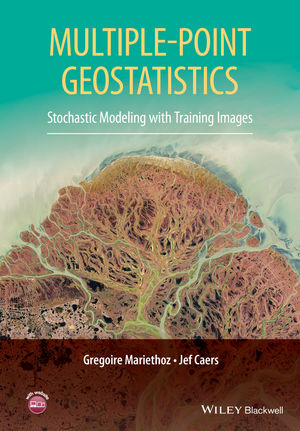
Multiple-point Geostatistics (eBook)
John Wiley & Sons (Verlag)
978-1-118-66293-9 (ISBN)
Gregoire Mariethoz is Professor Assistant at the Faculty of Geosciences and Environment of the University of Lausanne, Switzerland, and Adjunct Senior Lecturer in Water Resources Engineering at the University of New South Wales, Australia.
Jef Caers is Professor of Energy Resources Engineering at Stanford University, USA and Director of the Stanford Center for Reservoir Forecasting. His previous book publications include Petroleum Geostatistics (SPE) and Modeling Uncertainty in the Earth Sciences (Wiley-Blackwell).
Gregoire Mariethoz is Professor Assistant at the Faculty of Geosciences and Environment of the University of Lausanne, Switzerland, and Adjunct Senior Lecturer in Water Resources Engineering at the University of New South Wales, Australia. Jef Caers is Professor of Energy Resources Engineering at Stanford University, USA and Director of the Stanford Center for Reservoir Forecasting. His previous book publications include Petroleum Geostatistics (SPE) and Modeling Uncertainty in the Earth Sciences (Wiley-Blackwell).
Preface, vii
Acknowledgments, xi
Part I Concepts
I.1 Hiking in the Sierra Nevada, 3
I.2 Spatial estimation based on random function theory, 7
I.3 Universal kriging with training images, 29
I.4 Stochastic simulations based on random function theory,
49
I.5 Stochastic simulation without random function theory, 59
I.6 Returning to the Sierra Nevada, 75
Part II Methods
II.1 Introduction, 87
II.2 The algorithmic building blocks, 91
II.3 Multiple-point geostatistics algorithms, 155
II.4 Markov random fields, 173
II.5 Nonstationary modeling with training images, 183
II.6 Multivariate modeling with training images, 199
II.7 Training image construction, 221
II.8 Validation and quality control, 239
II.9 Inverse modeling with training images, 259
II.10 Parallelization, 295
Part III Applications
III.1 Reservoir forecasting - the West Coast of Africa
(WCA) reservoir, 303
III.2 Geological resources modeling in mining, 329
Coauthored by Cristian P´erez, Julian M. Ortiz, &
Alexandre Boucher
III.3 Climate modeling application - the case of the
Murray-Darling
Basin, 345
Index, 361
"I benefited from this book and plan to keep it as a resource on my bookshelf. I recommend Multiple-point Geostatistics: Stochastic Modeling with Training Images to my peers in mathematical geosciences." (Mathematical Geosciences, 2016)
Preface
Arguably, one of the important challenges in modeling, whether statistical or physical, is the presence and availability of “big data” and the advancement of “big simulations.” With an increased focus on the Earth's resources, energy, and the environment comes an increased need for understanding, modeling, and simulating the processes that take place on our planet. This need is driven by a quest to forecast. Forecasting is required for decision making and for addressing engineering-type questions. How much will temperature increase? How much original oil is in place? What will be the volume and shape of the injected CO2 plume? Where should one place a well for aquifer storage and recovery? The problems are complex; the questions and their answers are often simple.
In addressing such complex problems, uncertainty becomes an integral component. The general lack of understanding of the processes taking place and the lack of data to constrain the physical parameters of such processes make forecasting an exercise in quantifying uncertainty. As a result, forecasting methods often have two components in modeling: a stochastic and a physical component. Physical models produce deterministic outcomes or forecasts; hence, they lack the ability to produce realistic models of uncertainty in such forecasts. On the other hand, stochastic processes can only mimic physics, and although they produce models of uncertainty, these often present poor physical realism or, worse, are physically implausible. The challenge in many forecasting problems is to find the right middle ground for the intended purpose: produce physically realistic models that include the critical elements of uncertainty and are therefore able to answer the simple questions posed.
To some extent, geostatistical methods can historically be framed within this context of forecasting and within the quest for realism and truth. In the past, applications were mostly in the area of subsurface geology, in particular mineral resources, and then later oil and gas resources (as well as groundwater and hydrogeology). Perhaps a key recognition early on was that an assumption of independently and identically distributed (IID) samples taken from a spatially distributed phenomenon, such as an ore body, is a geologically (“physically”) unrealistic assumption. Mineral grades show a clear spatial structure that is the direct result of the physical genesis of such deposits. The goal of geostatistics then (and still) was not to model the genesis of that deposit by means of a physical process, but to produce estimates based on a model of spatial continuity that is as realistic as possible. The predominant model was the semivariogram, which is a statistical model, not a physical one, yet captures some elements of physical variability. Management of mineral resources constitutes a data-rich environment. Although the semivariogram is a rather limited model for describing complex physical realities, the presence of a large amount of drill holes (actual observations of physical reality) made this model of spatial continuity a plausible and successful one in the early stages of applications of geostatistics. The second major application, at least historically, is the modeling of subsurface reservoirs, where direct observations (wells) are sparse and the purpose is to forecast flow in porous media, which in itself requires physical models. In this way, two physical realities are present: the physics of deposition of clastics (sedimentation) or carbonates (growth), and the physics of fluid flow in porous media. Realism is sought in both cases. Many publications showed that geological models of the subsurface that were built based on multi-Gaussian processes (and the semivariogram as a basic parameter) lack geological realism in order to produce realistic forecasts of flow. Although any such evaluation is dependent on the nature of the flow problem considered, it appears to be the case in the large majority of practical flow-forecasting problems. A second problem in data-poor environments concerns the inference of semivariogram parameters. With data based on only a few wells, at best, one can infer some vertical semivariogram properties, but modelers were left to guess most other modeling parameters.
As a consequence, at least in reservoir modeling, Boolean (or object-based) models became fashionable because of their geological realism and flow-forecasting ability. Such models were calibrated from a richness of information available in analog outcrop models. The 1990s saw an expansion of geostatistical techniques in the traditional fields as well as application in several nongeological areas, in particular the environmental sciences. Considering the International Geostatistics Congress proceedings as a particular sample, one finds in the 1988 Avignon Congress only ∼10% of applications outside traditional fields, whereas in the 2000 Cape Town Congress, environmental applications alone cover about ∼20% of the papers. The 1990s therefore saw a shift in geostatistics that was twofold. Firstly, the early applications and theory that developed around semivariograms, various flavors of kriging, and multi-Gaussian simulation, including hard and soft data, were rapidly maturing. Secondly, the International Geostatistics Congress, which is held every 4 years and had long been the single platform for dissemination of novel research, saw its unique role wane because of the advent of more application-focused conferences (e.g. Petroleum Geostatistics, geoENV, and Spatial Statistics). In terms of research, and particularly in terms of the development of new methods, a drive toward non-Gaussian model development can be observed, perhaps now scattered over various areas of science and presented in various disjunctive conferences and journals. Some of the non-Gaussian methods still rely on semivariograms (or covariance functions in the statistical literature), such as the pluri-Gaussian methods or Karhune–Loeve expansions, whereas others rely on developments in the field of image analysis. The Markov Random field (MRF), although its theory was originally developed in the 1980s, saw a proliferation of applications in both spatial and space–time modeling. The development of methods remained classical, however: data were used to fit parametric models, whether semivariograms, MRF parameters, or using traditional statistical methodologies (e.g., maximum likelihood and least squares); models were then used for estimation, or for simulation by sampling posterior distributions. Development of theoretical models is clearly based on probability theory and its extension such as Bayesian methods.
Multiple-point geostatistics, abbreviated throughout the literature as MPS, was primordially born out of a need to address the issue of lack of physical realism as well as the lack of control in the simulated fields in traditional modeling. As Matheron stated in his seminal contribution, parameters of traditional statistical models need not have a physical equivalent. Although for a theoretical probabilistic model there may be a “true” parameter, such as the Poisson intensity θ, there exists no physical property in the real world known as θ. One only has a set of true point locations within a domain when studying point processes. The data are the only physical reality. The goal of MPS is to mimic physical reality, and the vehicle to achieve this is the training image. Perhaps the name “multiple-point” suggests that this is a field of study that focuses on higher-order statistics only, but this is only partially true. The second component, namely the source of such statistics (an order of 2 or higher), is the use of a representation of the physical reality: the training image. We believe that the most important contribution in this new field, and this first book, lies in the use of training images to inform and hence include physical reality in stochastic modeling. This is a completely new contribution; it is, without exaggeration, a paradigm shift. Most of the methods covered do not follow the traditional paradigm of first parametric (or even nonparametric) modeling from data, then estimating or sampling from the given parametric model, building on probability theory only. We propose methods that skip this intermediate step (of parameterized or nonparametric models) and directly lift what is desired, whether it is the estimate or the sample or realization from the training images. The methods we propose are therefore no longer solely steeped in statistical science or probability theory (as is most of geostatistics); we borrow from computer science as well and create hybridization between these fields. For that reason, some would no longer term this “geostatistics”. Labels are but labels; what matters is the content behind them.
This book is therefore a book about spatial and spatiotemporal modeling in the physical sciences (sedimentology, mineralogy, climate, environment, etc.). We do not claim any applications (yet) in other areas where spatial statistics are used (e.g., health or finance), although such applications are likely to occur in the future. This book is therefore all about practice and solving real problems, not to create more theory. The primary goal of engineering is to address engineering questions; it is not just the creation of stochastic models. However, within stochastic modeling itself, the goal is not the posterior probability distribution function (pdf) or the model parameters; rather, it is the estimates of that reality or the...
| Erscheint lt. Verlag | 16.10.2014 |
|---|---|
| Sprache | englisch |
| Themenwelt | Mathematik / Informatik ► Mathematik ► Angewandte Mathematik |
| Naturwissenschaften ► Geowissenschaften ► Geologie | |
| Technik | |
| Schlagworte | Angewandte Wahrscheinlichkeitsrechnung u. Statistik • Applied Probability & Statistics • Book • Comparison • Comprehensive • Conceptual • Continuity • earth sciences • Environmental Geoscience • Field • Function • gap between • Geologie u. Geophysik • Geology & Geophysics • Geostatistics • Geowissenschaften • images • Introduction • multiplepoint • New • Overview • Physical • Spatial • Statistics • Statistik • stochastic • Three • Traditional • Training • Umweltgeowissenschaften |
| ISBN-10 | 1-118-66293-8 / 1118662938 |
| ISBN-13 | 978-1-118-66293-9 / 9781118662939 |
| Informationen gemäß Produktsicherheitsverordnung (GPSR) | |
| Haben Sie eine Frage zum Produkt? |
 EPUB (Adobe DRM)
Kopierschutz: Adobe-DRM
Adobe-DRM ist ein Kopierschutz, der das eBook vor Mißbrauch schützen soll. Dabei wird das eBook bereits beim Download auf Ihre persönliche Adobe-ID autorisiert. Lesen können Sie das eBook dann nur auf den Geräten, welche ebenfalls auf Ihre Adobe-ID registriert sind.
Details zum Adobe-DRM
Dateiformat: EPUB (Electronic Publication)
EPUB ist ein offener Standard für eBooks und eignet sich besonders zur Darstellung von Belletristik und Sachbüchern. Der Fließtext wird dynamisch an die Display- und Schriftgröße angepasst. Auch für mobile Lesegeräte ist EPUB daher gut geeignet.
Systemvoraussetzungen:
PC/Mac: Mit einem PC oder Mac können Sie dieses eBook lesen. Sie benötigen eine
eReader: Dieses eBook kann mit (fast) allen eBook-Readern gelesen werden. Mit dem amazon-Kindle ist es aber nicht kompatibel.
Smartphone/Tablet: Egal ob Apple oder Android, dieses eBook können Sie lesen. Sie benötigen eine
Geräteliste und zusätzliche Hinweise
Buying eBooks from abroad
For tax law reasons we can sell eBooks just within Germany and Switzerland. Regrettably we cannot fulfill eBook-orders from other countries.
aus dem Bereich