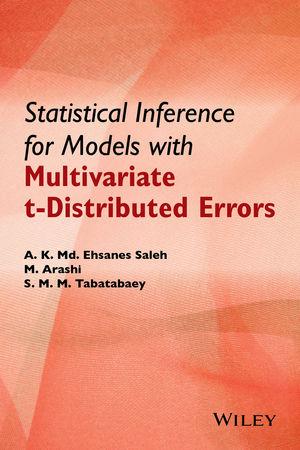
Statistical Inference for Models with Multivariate t-Distributed Errors (eBook)
272 Seiten
Wiley (Verlag)
978-1-118-85396-2 (ISBN)
This book summarizes the results of various models under normal theory with a brief review of the literature. Statistical Inference for Models with Multivariate t-Distributed Errors:
- Includes a wide array of applications for the analysis of multivariate observations
- Emphasizes the development of linear statistical models with applications to engineering, the physical sciences, and mathematics
- Contains an up-to-date bibliography featuring the latest trends and advances in the field to provide a collective source for research on the topic
- Addresses linear regression models with non-normal errors with practical real-world examples
- Uniquely addresses regression models in Student's t-distributed errors and t-models
- Supplemented with an Instructor's Solutions Manual, which is available via written request by the Publisher
A. K. Md. Ehsanes Saleh, PhD, is Professor Emeritus and Distinguished Research Professor in the School of Mathematics and Statistics at Carleton University, Canada. He has published well-over 200 journal articles, and his research interests include nonparametric statistics, order statistics, and robust estimation. Dr. Saleh is a Fellow of the Institute of Mathematical Statistics, the American Statistical Association, and the Bangladesh Academy of Sciences.
M. Arashi, PhD, is Associate Professor in the Department of Statistics at Shahrood University of Technology, Iran. The recipient of the Award for Teaching Excellence from Shahrood University in 2013, his research interests include shrinkage estimation, distribution theory, and multivariate analysis.
S. M. M. Tabatabaey, PhD, is Associate Professor in the Department of Statistics at Ferdowski University of Mashhad, Iran. The author of over fifteen journal articles, he is also a member of the Institute of Mathematical Statistics and the Iranian Statistical Society.
A. K. Md. Ehsanes Saleh, PhD, is Professor Emeritus and Distinguished Research Professor in the School of Mathematics and Statistics at Carleton University, Canada. He has published well-over 200 journal articles, and his research interests include nonparametric statistics, order statistics, and robust estimation. Dr. Saleh is a Fellow of the Institute of Mathematical Statistics, the American Statistical Association, and the Bangladesh Academy of Sciences. M. Arashi, PhD, is Associate Professor in the Department of Statistics at Shahrood University of Technology, Iran. The recipient of the Award for Teaching Excellence from Shahrood University in 2013, his research interests include shrinkage estimation, distribution theory, and multivariate analysis. S. M. M. Tabatabaey, PhD, is Associate Professor in the Department of Statistics at Ferdowski University of Mashhad, Iran. The author of over fifteen journal articles, he is also a member of the Institute of Mathematical Statistics and the Iranian Statistical Society.
List of Figures xv
List of Tables xvii
Preface xix
Glossary xxi
List of Symbols xxiii
1 Introduction 1
1.1 Objective of the Book 1
1.2 Models Under Consideration 3
2 Preliminaries 7
2.1 Normal distribution 8
2.2 Chisquare distribution 8
2.3 Student's t distributions 10
2.4 F distribution 14
2.5 Multivariate Normal distribution 16
2.6 Multivariate t distribution 17
2.7 Problems 28
3 Location Model 31
3.1 Model Specification 32
3.2 Unbiased Estimates of _ and _² andtest of hypothesis 32
3.3 Estimators 36
3.4 Bias and MSE Expressions of the Location Estimators 38
3.5 Various Estimates of Variance 48
3.6 Problems 60
4 Simple Regression Model 61
4.1 Introduction 62
4.2 Estimation and Testing of _ 62
4.3 Properties of Intercept Parameter 66
4.4 Comparison 69
4.5 Numerical Illustration 72
4.6 Problems 77
5 ANOVA 79
5.1 Model Specification 80
5.2 Proposed Estimators and Testing 80
5.3 Bias, MSE and Risk Expressions 85
5.4 Risk Analysis 87
5.5 Problems 93
6 Parallelism Model 95
6.1 Model Specification 96
6.2 Estimation of the Parameters and Test of Parallelism 97
6.3 Bias, MSE, and Risk Expressions 103
6.4 Risk Analysis 106
6.5 Problems 110
7 Multiple Regression Model 111
7.1 Model Specification 112
7.2 Shrinkage Estimators and Testing 112
7.3 Bias and Risk Expressions 116
7.4 Comparison 120
7.5 Problems 126
8 Ridge Regression 127
8.1 Model Specification 128
8.2 Proposed Estimators 129
8.3 Bias, MSE, and Risk Expressions 130
8.4 Performance of the Estimators 135
8.5 Choice of Ridge Parameter 153
8.6 Problems 164
9 Multivariate Models 165
9.1 Location Model 166
9.2 Testing of Hypothesis and Several Estimators of Local Parameter167
9.3 Bias, Quadratic Bias, MSE, and Risk Expressions 169
9.4 Risk Analysis of the Estimators 171
9.5 Simple Multivariate Linear Model 175
9.6 Problems 180
10 Bayesian Analysis 181
10.1 Introduction (Zellner's Model) 181
10.2 Conditional Bayesian Inference 183
10.3 Matrix Variate t Distribution 185
10.4 Bayesian Analysis in Multivariate Regression Model 187
10.5 Problems 194
11 Linear Prediction Models 195
11.1 Model & Preliminaries 196
11.2 Distribution of SRV and RSS 197
11.3 Regression Model for Future Responses 199
11.4 Predictive Distributions of FRV and FRSS 200
11.5 An Illustration 206
11.6 Problems 208
12 Stein Estimation 209
12.1 Class of Estimators 210
12.2 Preliminaries and Some Theorems 213
12.3 Superiority Conditions 216
12.4 Problems 223
References 225
Subject Index 243
CHAPTER 2
PRELIMINARIES
Outline
2.5 Multivariate Normal Distribution
2.6 Multivariate t-Distribution
In this chapter, we discuss some basic results on various distributions, particularly the normal, chi-square, Student’s t-, multivariate t-distributions.
2.1 Normal Distribution
The most basic distribution in statistical theory is the normal distribution, (θ, σ2), with pdf
(2.1.1)
where θ is the mean and σ2 is the variance of this distribution.
It is well known that
(2.1.2)
(2.1.3)
(2.1.4)
2.2 Chi-Square Distribution
If Z is (0, 1), then Z2 follows the central chi-square distribution with one degree of freedom (d.f.). However, if Z is (θ, σ2), then follows the noncentral chi-square distribution with one d.f. and noncentrality parameter , with . The pdf/cdf of this noncentral chi-square variable with one d.f. is given by
(2.2.1)
where
(2.2.2)
and the cdf of the chi-square distribution is given by
(2.2.3)
where H1+2r(c; 0) is the cdf of a central chi-square distribution with 1 + 2r d.f. An important identity w.r.t. the cdf is given by
A central and noncentral chi-square variable will be denoted by χ2γo and χ2γo(Δ2), respectively. In statistical theory, moment results involving chi-square variables are important and they are given below.
If Z ~ N(θ, σ2) and φ(.) is a measurable function of Z2, then
If Z = (Z1,…, Zp)′ be a Np(θ, Ip) (see (2.5.1)) and φ(Z′Z) is a measurable function of Z′Z, then
Further, if , then
(2.2.7)
For details, see Judge and Bock (1978) and Saleh (2006).
2.3 Student’s t-Distribution
It is well known that if and U is independent of Z such that is a chi-square variable with γo degrees of freedom, then follows the Student’s t-distribution with γo d.f. The pdf of this t-statistic is given by
(2.3.1)
The distribution f(u) of u may be obtained as the expected value of the pdf of (0, t−1), which is the conditional distribution of u given t with respect to the inverse gamma distribution, IG (t−1, γo), with the pdf given by
Then,
(2.3.4)
since .
This distribution will be denoted by M(1)t (0, 1, γo).
Clearly, E(u) = 0 and . Further, the odd central moments are zero while the even central moments are given by
(2.3.5)
Now consider the distribution of Z to be (θ, t−1). The distribution of tZ2 is then the noncentral chi-square distribution with one d.f. having the pdf
where h1+2r(x; 0) is the pdf of a central chi-square variable with (1 + 2r) d.f. The cdf of this random variable (r.v.) is given by
(2.3.7)
where H1+2r(x; 0) is the cdf of a central chi-square variable with (1 + 2r) d.f.
Let φ(.) be a measurable function, then
(2.3.8)
based on (2.3.6), where EN denotes getting expectation w.r.t. the normal theory, i.e., (θ, t−1).
In this regard, if t−1 follows the inverse gamma distribution (2.3.2), then the exact distribution of tZ2 is given by the expectation of h1 (χ2(Δ2t)) or H1 (x; Δ2t) using (2.3.3). Thus, the unconditional distribution of tZ2 is given by the pdf and cdf, respectively, as
(2.3.9)
and
(2.3.10)
where the mixing distribution of r is given by
(2.3.11)
for γo ≥ 3. Let us define
Then we may write
where
Specifically, using the fact that
Make the transformation with the Jacobian J(t → u) = to get
Now, we have the following theorem similar to the equations (2.2.5)–(2.2.6).
Theorem 2.3.1. If Z ~ M(1)t(θ, 1, γo) and φ(Z2) is a measurable function, then
Proof:
2.4 F-Distribution
Let Z ~ (0, 1) and mU be the central chi-square variable with m d.f. Then it is well known that follows the central F-distribution with (1, m) d.f. In other words, u2 in the other section follows the central F-distribution with (1, m) d.f.
Now, consider two independent chi-square variables χ2γ1 and χ2γ1 with γ1 and γ2 d.f.s respectively. Then, the ratio follows the central F-distribution with (γ1, γ2) d.f. The pdf of F is given by
(2.4.1)
and the cdf of F is
(2.4.2)
where Iy(a, b) is the incomplete beta (Pearson’s regularized incomplete beta) function.
Further, consider two independent chi-square variables, where one is a noncentral chi-square variable χ2γ1 (Δ2) with γ1 d.f. and noncentral parameter Δ2, and the other, χ2γ2, is a central chi-square variable with γ2 d.f. Then, Fγ1,γ2 (Δ2) = follows the noncentral F-distribution with (γ1, γ2) d.f. and noncentrality parameter Δ2. The cdf of Fγ1,γ2 (Δ2) is given by
(2.4.3)
with pdf
(2.4.4)
Let φ(.) be measurable function of Fγ1,γ2 (Δ2), then
Now, if Z ~ (θ, t−1), then tZ2 follows the noncentral chi-square distribution with one d.f. and noncentrality parameter Δ2t = tθ2. Further, let mU be a central chi-square with m d.f. Then, follows the noncentral F-distribution with (1, m) d.f. and noncentrality parameter Δ2t. Thus, for a measurable function φ(.), we have
(2.4.6)
by (2.4.5).
Further, if Z ~ M(1)t (θ, 1, γo), then
(2.4.7)
where
(2.4.8)
See (2.3.13)–(2.3.14) for details with .
Thus, we have
(2.4.9)
(2.4.10)
similar to (2.3.15). Here, mU is a central chi-square variable with m d.f.
If Gq+i,m+j (c; Δ2t) denote the cdf of a noncentral F-distribution with (q + i, m + j) d.f. with noncentrality parameter Δ2t = tθ2, then we write
(2.4.11)
where
(2.4.12)
2.5 Multivariate Normal Distribution
In the multivariate setup, multivariate normal distribution, , and ∑ S(p) (space of all positive definite matrices of order p), is the basic distribution on which all statistical inference depends. The pdf of a p(θ, ∑) is given by
Then,
(2.5.2)
Further, the distribution of Y′...
| Erscheint lt. Verlag | 1.10.2014 |
|---|---|
| Sprache | englisch |
| Themenwelt | Mathematik / Informatik ► Mathematik ► Analysis |
| Mathematik / Informatik ► Mathematik ► Statistik | |
| Mathematik / Informatik ► Mathematik ► Wahrscheinlichkeit / Kombinatorik | |
| Technik | |
| Schlagworte | Angew. Wahrscheinlichkeitsrechn. u. Statistik / Modelle • Applied Probability & Statistics - Models • Multivariate Analyse • multivariate analysis • Regression Analysis • Regressionsanalyse • Statistics • Statistik |
| ISBN-10 | 1-118-85396-2 / 1118853962 |
| ISBN-13 | 978-1-118-85396-2 / 9781118853962 |
| Informationen gemäß Produktsicherheitsverordnung (GPSR) | |
| Haben Sie eine Frage zum Produkt? |
 EPUB (Adobe DRM)
Kopierschutz: Adobe-DRM
Adobe-DRM ist ein Kopierschutz, der das eBook vor Mißbrauch schützen soll. Dabei wird das eBook bereits beim Download auf Ihre persönliche Adobe-ID autorisiert. Lesen können Sie das eBook dann nur auf den Geräten, welche ebenfalls auf Ihre Adobe-ID registriert sind.
Details zum Adobe-DRM
Dateiformat: EPUB (Electronic Publication)
EPUB ist ein offener Standard für eBooks und eignet sich besonders zur Darstellung von Belletristik und Sachbüchern. Der Fließtext wird dynamisch an die Display- und Schriftgröße angepasst. Auch für mobile Lesegeräte ist EPUB daher gut geeignet.
Systemvoraussetzungen:
PC/Mac: Mit einem PC oder Mac können Sie dieses eBook lesen. Sie benötigen eine
eReader: Dieses eBook kann mit (fast) allen eBook-Readern gelesen werden. Mit dem amazon-Kindle ist es aber nicht kompatibel.
Smartphone/Tablet: Egal ob Apple oder Android, dieses eBook können Sie lesen. Sie benötigen eine
Geräteliste und zusätzliche Hinweise
Buying eBooks from abroad
For tax law reasons we can sell eBooks just within Germany and Switzerland. Regrettably we cannot fulfill eBook-orders from other countries.
aus dem Bereich