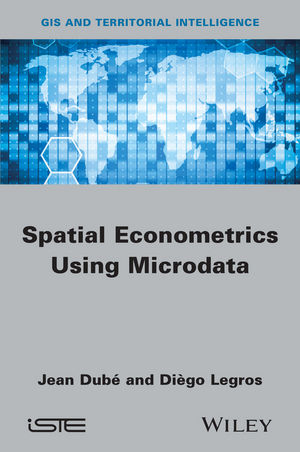
Spatial Econometrics using Microdata (eBook)
John Wiley & Sons (Verlag)
978-1-119-00876-7 (ISBN)
Particular emphasis is put on spatial data compilation and the structuring of the connections between the observations. Descriptive analysis methods of spatial data are presented in order to identify and measure the spatial, global and local dependency.
The authors then focus on autoregressive spatial models, to control the problem of spatial dependency between the residues of a basic linear statistical model, thereby contravening one of the basic hypotheses of the ordinary least squares approach.
This book is a popularized reference for students looking to work with spatialized data, but who do not have the advanced statistical theoretical basics.
Jean DUBÉ is Professor in regional development at Laval University, Canada. Diègo LEGROS is a lecturer in economics and management at the University of Burgundy, France.
ACKNOWLEDGMENTS ix
PREFACE xi
CHAPTER 1. ECONOMETRICS AND SPATIAL DIMENSIONS 1
1.1. Introduction 1
1.2. The types of data 6
1.2.1. Cross-sectional data 7
1.2.2. Time series 8
1.2.3. Spatio-temporal data 9
1.3. Spatial econometrics 11
1.3.1. A picture is worth a thousand words 13
1.3.2. The structure of the databases of spatial microdata15
1.4. History of spatial econometrics 16
1.5. Conclusion 21
CHAPTER 2. STRUCTURING SPATIAL RELATIONS 29
2.1. Introduction 29
2.2. The spatial representation of data 30
2.3. The distance matrix 34
2.4. Spatial weights matrices 37
2.4.1. Connectivity relations 40
2.4.2. Relations of inverse distance 42
2.4.3. Relations based on the inverse (or negative) exponential45
2.4.4. Relations based on Gaussian transformation 47
2.4.5. The other spatial relation 47
2.4.6. One choice in particular? 48
2.4.7. To start 49
2.5. Standardization of the spatial weights matrix 50
2.6. Some examples 51
2.7. Advantages/disadvantages of micro-data 55
2.8. Conclusion 56
CHAPTER 3. SPATIAL AUTOCORRELATION 59
3.1. Introduction 59
3.2. Statistics of global spatial autocorrelation 65
3.2.1. Moran's I statistic 68
3.2.2. Another way of testing significance 72
3.2.3. Advantages of Moran's I statistic inmodeling 74
3.2.4. Moran's I for determining the optimal form ofW 75
3.3. Local spatial autocorrelation 77
3.3.1. The LISA indices 79
3.4. Some numerical examples of the detection tests 86
3.5. Conclusion 89
CHAPTER 4. SPATIAL ECONOMETRIC MODELS 93
4.1. Introduction 93
4.2. Linear regression models 95
4.2.1. The different multiple linear regression modeltypes 99
4.3. Link between spatial and temporal models 102
4.3.1. Temporal autoregressive models 103
4.3.2. Spatial autoregressive models 110
4.4. Spatial autocorrelation sources 115
4.4.1. Spatial externalities 117
4.4.2. Spillover effect 119
4.4.3. Omission of variables or spatial heterogeneity 123
4.4.4. Mixed effects 127
4.5. Statistical tests 129
4.5.1. LM tests in spatial econometrics 134
4.6. Conclusion 140
CHAPTER 5. SPATIO-TEMPORAL MODELING 145
5.1. Introduction 145
5.2. The impact of the two dimensions on the structure of thelinks: structuring of spatio-temporal links 148
5.3. Spatial representation of spatio-temporal data 150
5.4. Graphic representation of the spatial data generatingprocesses pooled over time 154
5.5. Impacts on the shape of the weights matrix 159
5.6. The structuring of temporal links: a temporal weightsmatrix 162
5.7. Creation of spatio-temporal weights matrices 167
5.8. Applications of autocorrelation tests and of autoregressivemodels 170
5.9. Some spatio-temporal applications 172
5.10. Conclusion 173
CONCLUSION 177
GLOSSARY 185
APPENDIX 189
BIBLIOGRAPHY 215
INDEX 227
Preface
P.1. Introduction
Before even bringing up the main subject, it would seem important to define the breadth that we wish to give this book. The title itself is quite evocative: it is an introduction to spatial econometrics when data consist of individual spatial units. The stress is on microdata: observations that are points on a geographical projection rather than geometrical forms that describe the limits (whatever they may be) of a geographical zone. Therefore, we propose to cover the methods of detection and descriptive spatial analysis, and spatial and spatio-temporal modeling.
In no case do we wish this work to substitute important references in the domain such as Anselin [ANS 88], Anselin and Florax [ANS 95], LeSage [LES 99], or even the more recent reference in this domain: LeSage and Pace [LES 09]. We consider these references to be essential for anyone wishing to become invested in this domain.
The objective of the book is to make a link between existing quantitative approaches (correlation analysis, bivaried analysis and linear regression) and the manner in which we can generalize these approaches to cases where the available data for analysis have a spatial dimension. While equations are presented, our approach is largely based on the description of the intuition behind each of the equations. The mathematical language is vital in statistical and quantitative analyses. However, for many people, the acquisition of the knowledge necessary for a proper reading and understanding of the equations is often off-putting. For this reason, we try to establish the links between the intuition of the equations and the mathematical formalizations properly. In our opinion, too few introductory works place importance on this structure, which is nevertheless the cornerstone of quantitative analysis. After all, the goal of the quantitative approach is to provide a set of powerful tools that allow us to isolate some of the effects that we are looking to identify. However, the amplitude of these effects depends on the type of tool used to measure them.
The originality of the approach is, in our opinion, fourfold. First, the book presents simple fictional examples. These examples allow the readers to follow, for small samples, the detail of the calculations, for each of the steps of the construction of weighting matrices and descriptive statistics. The reader is also able to replicate the calculations in simple programs such as Excel, to make sure he/she understands all of the steps properly. In our opinion, this step allows non-specialist readers to integrate the particularities of the equations, the calculations and the spatial data.
Second, this book aims to make the link between summation writing (see double summation) of statistics (or models) and matrix writing. Many people will have difficulties matching the transition from one to the other. In this work, we present for some spatial indices the two writings, stressing the transition from one writing to the other. The understanding of matrix writing is important since it is more compact than summation writing and makes the mathematical expressions containing double summation, such as detection indices of spatial correlation patterns, easier to read; this is particularly useful in the construction of statistics used for spatial detection of local patterns. The use of matrix calculations and simple examples allow the reader to generalize the calculations to greater datasets, helping their understanding of spatial econometrics. The matrix form also makes the calculations directly transposable into specialized software (such as MatLab and Mata (Stata)) allowing us to carry out calculations without having to use previously written programs, at least for the construction of the spatial weighting matrices and for the calculation of spatial concentration indices. The presentation of matrix calculations step by step allows us to properly compute the calculation steps.
Third, in the appendix this work suggests programs that allow the simulation of spatial and spatio-temporal microdata. The programs then allow the transposing of the presentations of the chapters onto cases where the reality is known in advance. This approach, close to the Monte Carlo experiment, can be beneficial for some readers who would want to examine the behavior of test statistics as well as the behavior of estimators in some well-defined contexts. The advantages of this approach by simulation are numerous:
Finally, the greatest particularity of this book is certainly the stress placed on the use of spatial microdata. Most of the works and applications in spatial econometrics rely on aggregate spatial data. This representation thus assumes that each observation takes the form of a polygon (a geometric shape) representing fixed limits of the geographical boundaries surrounding, for example, a country, a region, a town or a neighborhood. The data then represent an aggregate statistic of individual observations (average, median, proportion) rather than the detail of each of the individual observations. In our opinion, the applications relying on microdata are the future for not only putting into practice of spatial econometric methods, but also for a better understanding of several phenomena. Spatial microdata allow us to avoid the classical problem of the ecological error2 [ROB 50] as well as directly replying to several critics saying that spatial aggregate data does not allow capturing some details that are only observable at a microscale. Moreover, while not exempt from the modifiable area unit problem (MAUP)3 [ARB 01, OPE 79], they do at least present the advantage of explicitly allowing for the possibility of testing the effect of spatial aggregation on the results of the analyses.
Thus, this book acts as an intermediatiory for non-econometricians and non-statisticians to transition toward reference books in spatial econometrics. Therefore, the book is not a work of theoretical econometrics based on formal mathematical proofs4, but is rather an introductory document for spatial econometrics applied to microdata.
P.2. Who is this work aimed at?
Nevertheless, reading this book assumes a minimal amount of knowledge in statistics and econometrics. It does not require any particular knowledge of geographical information systems (GIS). Even if the work presents programs that allow for the simulation of data in the appendixes, it requires no particular experience or particular aptitudes in programming.
More particularly, this booked is addressed especially to master’s and PhD students in the domains linked to regional sciences and economic geography. As the domain of regional sciences is rather large and multidisciplinary, we want to provide some context to those who would like to get into spatial quantitative analysis and go a bit further on this adventure. In our opinion, the application of statistics and statistical models can no longer be done without understanding the spatial reality of the observations. The spatial aspect provides a wealth of information that needs to be considered during quantitative empirical analyses.
The books is also aimed at undergraduate and postgraduate students in economics who wish to introduce the spatial dimension into their analyses. We believe that this book provides excellent context before formally dealing with theoretical aspects of econometrics aiming to develop the estimators, show the proofs of convergence as well develop the detection tests according to the classical approaches (likelihood ratio (LR) test, Lagrange multiplier (LM) test and Wald tests).
We also aim to reach researchers who are not econometricians or statisticians, but wish to learn a bit about the logic and the methods that allow the detection of the presence of spatial autocorrelation as well as the methods for the correction of eventual problems occurring in the presence of autocorrelation.
P.3. Structure of the book
The books is split into six chapters that follow a precise logic. Chapter 1 proposes an introduction to spatial analysis related to disaggregated or individual data (spatial microdata). Particular attention is placed on the structure of spatial databases as well as their particularities. It shows why it is essential to take account of the spatial dimension in econometrics if the researcher has data that is geolocalized; it presents a brief history of the development of the branch of spatial econometrics since its formation.
Chapter 2 is definitely the central piece of the work and spatial econometrics. It serves as an opening for the other chapters, which use weights matrices in their calculations. Therefore, it is crucial and it is the reason for which particular emphasis is placed on it with many examples. A fictional example is developed and taken up again in Chapter 3 to demonstrate the calculation of the detection indices of the spatial autocorrelation patterns.
Chapter 3 presents the most commonly used measurements to detect the presence of spatial patterns in the distribution of a given variable. These measurements prove to be particularly crucial to verify the assumption of the absence of spatial...
| Erscheint lt. Verlag | 25.9.2014 |
|---|---|
| Sprache | englisch |
| Themenwelt | Mathematik / Informatik ► Informatik ► Datenbanken |
| Mathematik / Informatik ► Informatik ► Programmiersprachen / -werkzeuge | |
| Informatik ► Theorie / Studium ► Algorithmen | |
| Mathematik / Informatik ► Mathematik | |
| Technik ► Elektrotechnik / Energietechnik | |
| Technik ► Nachrichtentechnik | |
| Schlagworte | Electrical & Electronics Engineering • Elektrotechnik u. Elektronik • Numerical Methods & Algorithms • Numerische Methoden u. Algorithmen • Spatial and Spatio-temporal Data Analysis, Spatial Relationships, Spatial Dependence Between Observations, Spatial Autocorrelation, Spatial Data, Autoregressive Spatial Models |
| ISBN-10 | 1-119-00876-X / 111900876X |
| ISBN-13 | 978-1-119-00876-7 / 9781119008767 |
| Informationen gemäß Produktsicherheitsverordnung (GPSR) | |
| Haben Sie eine Frage zum Produkt? |
 EPUB (Adobe DRM)
Kopierschutz: Adobe-DRM
Adobe-DRM ist ein Kopierschutz, der das eBook vor Mißbrauch schützen soll. Dabei wird das eBook bereits beim Download auf Ihre persönliche Adobe-ID autorisiert. Lesen können Sie das eBook dann nur auf den Geräten, welche ebenfalls auf Ihre Adobe-ID registriert sind.
Details zum Adobe-DRM
Dateiformat: EPUB (Electronic Publication)
EPUB ist ein offener Standard für eBooks und eignet sich besonders zur Darstellung von Belletristik und Sachbüchern. Der Fließtext wird dynamisch an die Display- und Schriftgröße angepasst. Auch für mobile Lesegeräte ist EPUB daher gut geeignet.
Systemvoraussetzungen:
PC/Mac: Mit einem PC oder Mac können Sie dieses eBook lesen. Sie benötigen eine
eReader: Dieses eBook kann mit (fast) allen eBook-Readern gelesen werden. Mit dem amazon-Kindle ist es aber nicht kompatibel.
Smartphone/Tablet: Egal ob Apple oder Android, dieses eBook können Sie lesen. Sie benötigen eine
Geräteliste und zusätzliche Hinweise
Buying eBooks from abroad
For tax law reasons we can sell eBooks just within Germany and Switzerland. Regrettably we cannot fulfill eBook-orders from other countries.
aus dem Bereich