


Rhythm and Transforms
Seiten
2014
|
2007 ed.
Springer London Ltd (Verlag)
978-1-4471-6049-6 (ISBN)
Springer London Ltd (Verlag)
978-1-4471-6049-6 (ISBN)
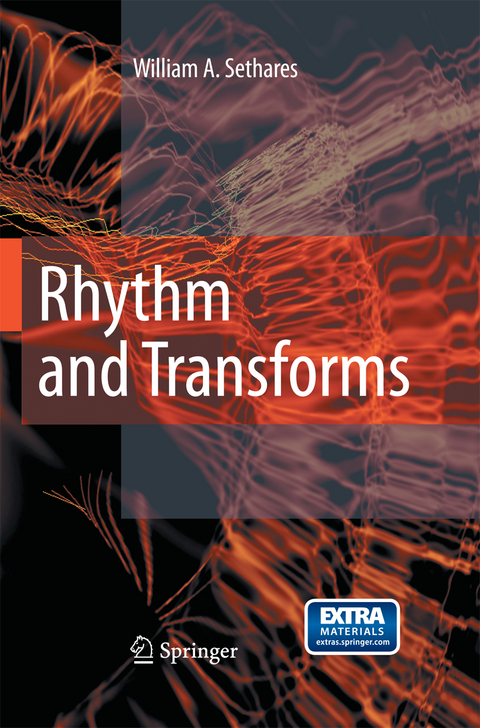
People naturally identify the rhythm of music as they tap their feet and sway in time with the beat. Underlying such motions is an act of cognition that is not easily reproduced in a computer program or automated by machine. "Rhythm and Transforms" asks (and answers) the question: How can we build a device that can "tap its foot" along with the music? The result is a tool for detecting and measuring the temporal aspects of a musical performance: the periodicities, the regularities (and irregularities), the beat, the rhythm. The impact of such a "rhythm meter" on music theory and on the design of sound processing electronics is described. It allows discussion of the relationship between cognitive processing of temporal information and mathematical techniques used to describe and understand regularities in data.
This book will interest engineers and others interested in the design of audio devices such as musical synthesizers, special effects devices, drum machines, and electronic keyboards. It will be useful to musicians and composers who exploit computer-based tools; arrangers, musicologists, and others interested in musical analysis; and those interested in the way the ear works, and how this influences the types of sound patterns we like to listen to.
This book will interest engineers and others interested in the design of audio devices such as musical synthesizers, special effects devices, drum machines, and electronic keyboards. It will be useful to musicians and composers who exploit computer-based tools; arrangers, musicologists, and others interested in musical analysis; and those interested in the way the ear works, and how this influences the types of sound patterns we like to listen to.
William Sethares is a professor at the University of Wisconsin-Madison, where he teaches about electro-acoustics and signal processing. A focus of his research is the relationship between the rhythmic qualities of music – how they are perceived biologically and the qualities of the instruments or machine making the sounds.
What is Rhythm?.- Visualizing and Conceptualizing Rhythm.- Varieties of Rhythmic Experience.- Auditory Perception.- Transforms.- Adaptive Oscillators.- Statistical Models.- Automated Rhythm Analysis.- Beat-based Signal Processing.- Musical Composition and Recomposition.- Musical Analysis via Feature Scores.- Speculations, Interpretations, Conclusions.
| Erscheint lt. Verlag | 20.9.2014 |
|---|---|
| Zusatzinfo | XIII, 336 p. |
| Verlagsort | London |
| Sprache | englisch |
| Maße | 155 x 235 mm |
| Themenwelt | Kunst / Musik / Theater ► Musik |
| Mathematik / Informatik ► Mathematik ► Angewandte Mathematik | |
| Naturwissenschaften ► Biologie ► Zoologie | |
| Technik ► Maschinenbau | |
| ISBN-10 | 1-4471-6049-5 / 1447160495 |
| ISBN-13 | 978-1-4471-6049-6 / 9781447160496 |
| Zustand | Neuware |
| Informationen gemäß Produktsicherheitsverordnung (GPSR) | |
| Haben Sie eine Frage zum Produkt? |
Mehr entdecken
aus dem Bereich


aus dem Bereich
für Ingenieure und Naturwissenschaftler
Buch | Softcover (2024)
Springer Vieweg (Verlag)
CHF 48,95
Buch | Softcover (2025)
Springer Vieweg (Verlag)
CHF 62,95
Buch | Softcover (2025)
Springer Fachmedien Wiesbaden (Verlag)
CHF 69,95


