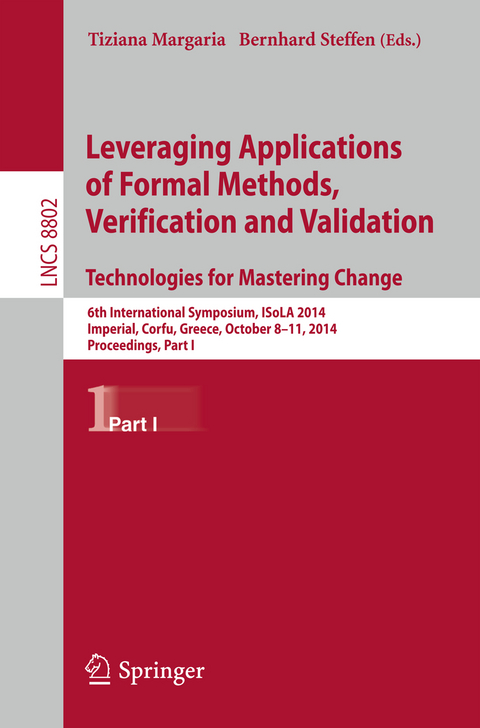
Leveraging Applications of Formal Methods, Verification and Validation. Technologies for Mastering Change
Springer Berlin (Verlag)
978-3-662-45233-2 (ISBN)
Bernhard Steffen studierte Mathematik an der Christian-Albrechts Universität zu Kiel, wo er anschließend auch in der Informatik promovierte. Nach Forschungsaufenthalten am Laboratory for Foundations in Computer Science in Edinburgh und an der Universität Aarhus, wurde er 1990 an die RWTH Aachen berufen, von wo er 1993 an die Universität Passau auf den Lehrstuhl für Programmiersysteme wechselte. Seit 1997 leitet er den Lehrstuhl für Programmiersysteme und Compilerbau an der TU-Dortmund. Bernhard Steffen ist Gründer der internationalen Konferenz über Tools and Algorithm for the Conbstruction and Analysis of Systems (TACAS) und des internationalen Journals über Software Tools for Technology Transfer (STTT).
Evolving Critical Systems - Track Introduction.- Statistical Abstraction Boosts Design and Test Efficiency of Evolving Critical Systems.- Combinatory Logic Synthesizer.- Incremental Syntactic-Semantic Reliability Analysis of Evolving Structured Workflows.- Prototype-Driven Development of Web Applications with DyWA.,- Domain-Specific Languages for Enterprise Systems.- Introduction to "Rigorous Engineering of Autonomic Ensembles".- Helena@Work: Modeling the Science Cloud Platform.- Formalizing Self-adaptive Clouds with KnowLang.- Towards Performance-Aware Engineering of Autonomic Component Ensembles.- Self-expression and Dynamic Attribute-Based Ensembles in SCEL.- On Programming and Policing Autonomic Computing Systems.- Rigorous System Design Flow for Autonomous Systems.- Learning Models for Verification and Testing - Special Track at ISoLA 2014 - Track Introduction.- Active Learning of Nondeterministic Systems from an ioco Perspective.- Verification of GUI Applications: A Black-Box Approach.- Fomal Methods and Analyses in Software Product Line Engineering (Track Summary).- A Core Language for Separate Variability Modeling.- Domain Specific Languages for Managing Feature Models: Advances and Challenges.- Delta-Trait Programming of Software Product Lines.- Deployment Variability in Delta-Oriented Models.- DeltaCCS: A Core Calculus for Behavioral Change.- Coverage Criteria for Behavioural Testing of Software Product Lines.- Challenges in Modelling and Analyzing Quantitative Aspects of Bike-Sharing Systems.- Towards Modular Verification of Software Product Lines with mCRL2.- Model-Based Code-Generators and Compilers - Track Introduction.- DSL Implementation for Model-Based Development of Pumps.- Building Code Generators for DSLs Using a Partial Evaluator for the Xtend Language.- Back-To-Back Testing of Model-Based Code Generators.- Rewriting Object Models with Cycles and Nested Collections: A Model-Based Metaprogramming Problem.- Compiling SCCharts - A Case-Study on Interactive Model-Based Compilation.- Domain-Specific Code Generator Modeling: A Case Study for Multi-faceted Concurrent Systems.- Tutorial: Automata Learning in Practice.- LNCS Transactions on the Foundations for Mastering Change LNCS Transaction on the Foundations for Mastering Change: Preliminary Manifesto.- XII Table of Contents - Part I Formal Methods for Collective Adaptive Ensembles.- Current Issues on Model-Based Software Quality Assurance for Mastering Change.- Compositional Model-Based System Design as a Foundation for Mastering Change.- Managing Change in Formal Software Analysis: Two Research Challenges.- Mastering Changes: Some Research Topics.- Mastering Change @ Runtime.- Forever Software.- Software (must) Change.- The Change of Change.
| Erscheint lt. Verlag | 7.10.2014 |
|---|---|
| Reihe/Serie | Lecture Notes in Computer Science | Theoretical Computer Science and General Issues |
| Zusatzinfo | XVIII, 547 p. 139 illus. |
| Verlagsort | Berlin |
| Sprache | englisch |
| Maße | 155 x 235 mm |
| Gewicht | 860 g |
| Themenwelt | Mathematik / Informatik ► Informatik ► Software Entwicklung |
| Schlagworte | Automata • automated software engineering • Autonomic Systems • business process modeling • code generation • component-based • coordination patterns • domain-specific languages • ensemble computing • model based testing • Model Checking • Operational Semantics • Prototyping • real-time • robot swarms • Software engineering • Software Engineering / Softwareentwicklung • Softwareentwicklung • Software Product Lines • timed automata • verification |
| ISBN-10 | 3-662-45233-2 / 3662452332 |
| ISBN-13 | 978-3-662-45233-2 / 9783662452332 |
| Zustand | Neuware |
| Informationen gemäß Produktsicherheitsverordnung (GPSR) | |
| Haben Sie eine Frage zum Produkt? |
aus dem Bereich