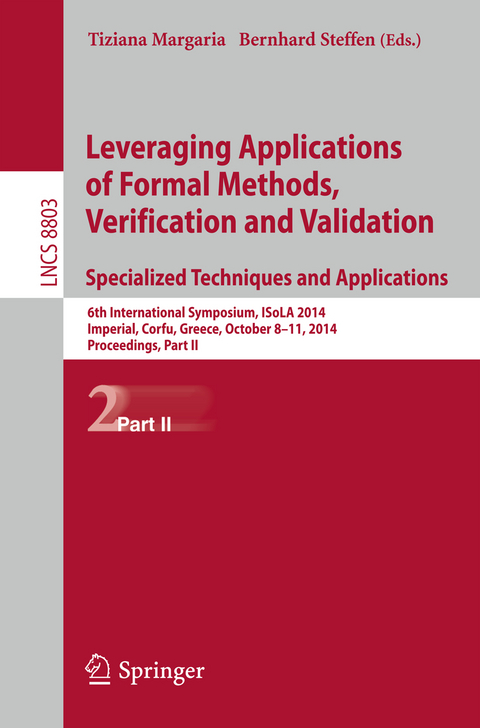
Leveraging Applications of Formal Methods, Verification and Validation. Specialized Techniques and Applications
Springer Berlin (Verlag)
978-3-662-45230-1 (ISBN)
Bernhard Steffen studierte Mathematik an der Christian-Albrechts Universität zu Kiel, wo er anschließend auch in der Informatik promovierte. Nach Forschungsaufenthalten am Laboratory for Foundations in Computer Science in Edinburgh und an der Universität Aarhus, wurde er 1990 an die RWTH Aachen berufen, von wo er 1993 an die Universität Passau auf den Lehrstuhl für Programmiersysteme wechselte. Seit 1997 leitet er den Lehrstuhl für Programmiersysteme und Compilerbau an der TU-Dortmund. Bernhard Steffen ist Gründer der internationalen Konferenz über Tools and Algorithm for the Conbstruction and Analysis of Systems (TACAS) und des internationalen Journals über Software Tools for Technology Transfer (STTT).
Introduction to Track on Engineering Virtualized Services.- Erlang-Style Error Recovery for Concurrent Objects with Cooperative Scheduling.- Fault Model Design Space for Cooperative Concurrency.- Programming with Actors in Java 8.- Contracts in CML.- Distributed Energy Management Case Study: A Formal Approach to Analyzing Utility Functions.- Towards the Typing of Resource Deployment.- Static Inference of Transmission Data Sizes in Distributed Systems.- Fully Abstract Operation Contracts.- Statistical Model Checking Statistical Model Checking Past, Present, and Future.- An Effective Heuristic for Adaptive Importance Splitting in Statistical Model Checking.- A Formalism for Stochastic Adaptive Systems.- A Review of Statistical Model Checking Pitfalls on Real-Time Stochastic Models.- Formal Analysis of the Wnt/beta-catenin Pathway through Statistical Model Checking.- Battery-Aware Scheduling of Mixed Criticality Systems.- Using Statistical Model Checking for Measuring Systems.- Blocking Advertisements on Android Devices Using Monitoring Techniques.- Monitoring with Data Automata.- Risk-Based Testing (Track Introduction).- A Technique for Risk-Based Test Procedure Identification, Prioritization and Selection.- A Risk Assessment Framework for Software Testing.- Data Driven Testing of Open Source Software.- Combining Risk Analysis and Security Testing.- Risk-Based Vulnerability Testing Using Security Test Patterns.- Medical Cyber-Physical Systems (Track Introduction).- Compositional, Approximate, and Quantitative Reasoning for Medical Cyber-Physical Systems with Application to Patient-Specific Cardiac Dynamics and Devices.- On Quantitative Software Quality Assurance Methodologies for Cardiac Pacemakers.- Model Checking Hybrid Systems (Invited Talk).- Challenges for the Dynamic Interconnection of Medical Devices.- Temporal Logic Based Monitoring of Assisted Ventilation in Intensive Care Patients.- Track Introduction: Scientific Workflows.- Meta-analysis of Disjoint Sets ofAttributes in Large Cohort Studies.- Towards a Flexible Assessment of Climate Impacts: The Exampleof Agile Workflows for the ci:grasp Platform.- A Visual Programming Approach to Beat-Driven Humanoid Robot Dancing.- jABCstats: An Extensible Process Library for the Empirical Analysis of jABC Workflows.- Automatic Annotation of Bioinformatics Workflows with BiomedicalOntologies.- Evaluation and Reproducibility of Program Analysis(Track Introduction).- SWEET - A Tool for WCET Flow Analysis (Extended Abstract).- Test-Driving Static Analysis Tools in Search of C Code Vulnerabilities II (Extended Abstract).- Construction of Abstract Domains for Heterogeneous Properties (Position Paper).- Verification of Polyhedral Optimizations with Constant Loop Bounds in Finite State Space Computations.- The Guided System Development Framework: Modeling and Verifying Communication Systems.- Processes and Data Integration in the Networked Healthcare Processes and Data Integration in the Networked Healthcare.- Simple Management of High Assurance Data in Long-LivedInterdisciplinary Healthcare Research: A Proposal.- Domain-Specific Business Modeling with the Business Model Developer.- Dr. Watson? Balancing Automation and Human Expertise in Healthcare Delivery.- Semantic Heterogeneity in the Formal Development of Complex Systems: An Introduction.- Modelling and Verifying an Evolving Distributed Control System Using an Event-Based Approach.- Requirements Driven Data Warehouse Design: We Can Go Further.- On Implicit and Explicit Semantics: Integration Issues in Proof-Based Development of Systems Version to Read - Version to Read.- Industrial Track.- The Technological and Interdisciplinary Evolution in Machine and Plant Engineering - Industry 4.0.- Doctoral Symposium and Poster Session.- Integrated Code Motion and Register Allocation.- On the Algebraic Specification and Verification of Parallel Systems.- Property-Specific Benchmark Generation.- Steering Active Automata Learning withModel-Dr
| Erscheint lt. Verlag | 7.10.2014 |
|---|---|
| Reihe/Serie | Lecture Notes in Computer Science | Theoretical Computer Science and General Issues |
| Zusatzinfo | XVIII, 644 p. 187 illus. |
| Verlagsort | Berlin |
| Sprache | englisch |
| Maße | 155 x 235 mm |
| Gewicht | 1003 g |
| Themenwelt | Mathematik / Informatik ► Informatik ► Software Entwicklung |
| Schlagworte | Automata • automated software engineering • Autonomic Systems • business process modeling • code generation • component-based • coordination patterns • domain-specific languages • ensemble computing • model based testing • Model Checking • Operational Semantics • Prototyping • real-time • robot swarms • Software engineering • Software Engineering / Softwareentwicklung • Softwareentwicklung • Software Product Lines • timed automata • verification |
| ISBN-10 | 3-662-45230-8 / 3662452308 |
| ISBN-13 | 978-3-662-45230-1 / 9783662452301 |
| Zustand | Neuware |
| Informationen gemäß Produktsicherheitsverordnung (GPSR) | |
| Haben Sie eine Frage zum Produkt? |
aus dem Bereich