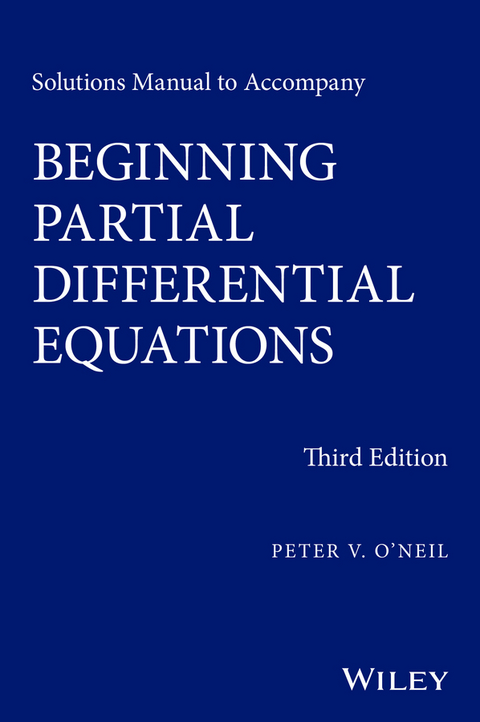
Solutions Manual to Accompany Beginning Partial Differential Equations (eBook)
John Wiley & Sons (Verlag)
9781118969670 (ISBN)
Featuring a challenging, yet accessible, introduction to partial differential equations, Beginning Partial Differential Equations provides a solid introduction to partial differential equations, particularly methods of solution based on characteristics, separation of variables, as well as Fourier series, integrals, and transforms. Thoroughly updated with novel applications, such as Poe's pendulum and Kepler's problem in astronomy, this third edition is updated to include the latest version of Maples, which is integrated throughout the text. New topical coverage includes novel applications, such as Poe's pendulum and Kepler's problem in astronomy.
Peter V. O'Neil, PhD, is Professor Emeritus in the Department of Mathematics at The University of Alabama at Birmingham. Dr. O'Neil has over forty years of academic experience and is the recipient of the Lester R. Ford Award from the Mathematical Association of America. He is a member of the American Mathematical Society, the Society for Industrial and Applied Mathematics, and the American Association for the Advancement of Science.
Solutions Manual to Accompany Beginning Partial Differential Equations, 3rd Edition Featuring a challenging, yet accessible, introduction to partial differential equations, Beginning Partial Differential Equations provides a solid introduction to partial differential equations, particularly methods of solution based on characteristics, separation of variables, as well as Fourier series, integrals, and transforms. Thoroughly updated with novel applications, such as Poe's pendulum and Kepler's problem in astronomy, this third edition is updated to include the latest version of Maples, which is integrated throughout the text. New topical coverage includes novel applications, such as Poe's pendulum and Kepler's problem in astronomy.
Peter V. O'Neil, PhD, is Professor Emeritus in the Department of Mathematics at The University of Alabama at Birmingham. Dr. O'Neil has over forty years of academic experience and is the recipient of the Lester R. Ford Award from the Mathematical Association of America. He is a member of the American Mathematical Society, the Society for Industrial and Applied Mathematics, and the American Association for the Advancement of Science.
Preface vii
1 First Ideas 1
1.1 Two Partial Differential Equations 1
1.2 Fourier Series 4
1.3 Two Eigenvalue Problems 12
1.4 A Proof of the Convergence Theorem 14
2 Solutions of the Heat Equation 15
2.1 Solutions on an Interval [0, L] 15
2.2 A Nonhomogeneous Problem 19
3 Solutions of the Wave Equation 25
3.1 Solutions on Bounded Intervals 25
3.2 The Cauchy Problem 32
3.2.1 d'Alembert's Solution 32
3.2.2 The Cauchy Problem on a Half Line 36
3.2.3 Characteristic Triangles and Quadrilaterals 41
3.2.4 A Cauchy Problem with a Forcing Term 41
3.2.5 String with Moving Ends 42
3.3 The Wave Equation in Higher Dimensions 46
3.3.1 Vibrations in a Membrane with Fixed Frame 46
3.3.2 The Poisson Integral Solution 47
3.3.3 Hadamard's Method of Descent 47
4 Dirichlet and Neumann Problems 49
4.1 Laplace's Equation and Harmonic Functions 49
4.2 The Dirichlet Problem for a Rectangle 50
4.3 The Dirichlet Problem for a Disk 52
4.4 Properties of Harmonic Functions 57
4.4.1 Topology of Rn 57
4.4.2 Representation Theorems 58
4.4.3 The Mean Value Theorem and the Maximum Principle 60
4.5 The Neumann Problem 61
4.5.1 Uniqueness and Existence 61
4.5.2 Neumann Problem for a Rectangle 62
4.5.3 Neumann Problem for a Disk 63
4.6 Poisson's Equation 64
4.7 An Existence Theorem for the Dirichlet Problem 65
5 Fourier Integral Methods of Solution 67
5.1 The Fourier Integral of a Function 67
5.2 The Heat Equation on the Real Line 70
5.3 The Debate Over the Age of the Earth 73
5.4 Burgers' Equation 73
5.5 The Cauchy Problem for the Wave Equation 74
5.6 Laplace's Equation on Unbounded Domains 76
6 Solutions Using Eigenfunction Expansions 79
6.1 A Theory of Eigenfunction Expansions 79
6.2 Bessel Functions 83
6.3 Applications of Bessel Functions 87
6.3.1 Temperature Distribution in a Solid Cylinder 87
6.3.2 Vibrations of a Circular Drum 87
6.4 Legendre Polynomials and Applications 90
7 Integral Transform Methods of Solution 97
7.1 The Fourier Transform 97
7.2 Heat and Wave Equations 101
7.3 The Telegraph Equation 104
7.4 The Laplace Transform 106
8 First-Order Equations 109
8.1 Linear First-Order Equations 109
8.2 The Significance of Characteristics 111
8.3 The Quasi-Linear Equation 114
Series List 117
| Erscheint lt. Verlag | 2.9.2014 |
|---|---|
| Reihe/Serie | Pure and Applied Mathematics: A Wiley Series of Texts, Monographs and Tracts |
| Wiley Series in Pure and Applied Mathematics | Wiley Series in Pure and Applied Mathematics |
| Sprache | englisch |
| Themenwelt | Mathematik / Informatik ► Mathematik ► Analysis |
| Technik | |
| Schlagworte | Applied Mathematics in Engineering • Applied Mathematics in Science • Applied Mathmatics in Engineering • Cauchy • convergence • Differential Equations • Differentialgleichung • Differentialgleichungen • Equation • forcing • Half • Heat • Intervals • line • Mathematics • Mathematik • Mathematik in den Ingenieurwissenschaften • Mathematik in den Naturwissenschaften • moving • Nonhomogeneous • Partial • Partielle Differentialgleichung • Problem • Proof • Solutions • Term • Theorem • Wave |
| ISBN-13 | 9781118969670 / 9781118969670 |
| Informationen gemäß Produktsicherheitsverordnung (GPSR) | |
| Haben Sie eine Frage zum Produkt? |
 PDF (Adobe DRM)
Kopierschutz: Adobe-DRM
Adobe-DRM ist ein Kopierschutz, der das eBook vor Mißbrauch schützen soll. Dabei wird das eBook bereits beim Download auf Ihre persönliche Adobe-ID autorisiert. Lesen können Sie das eBook dann nur auf den Geräten, welche ebenfalls auf Ihre Adobe-ID registriert sind.
Details zum Adobe-DRM
Dateiformat: PDF (Portable Document Format)
Mit einem festen Seitenlayout eignet sich die PDF besonders für Fachbücher mit Spalten, Tabellen und Abbildungen. Eine PDF kann auf fast allen Geräten angezeigt werden, ist aber für kleine Displays (Smartphone, eReader) nur eingeschränkt geeignet.
Systemvoraussetzungen:
PC/Mac: Mit einem PC oder Mac können Sie dieses eBook lesen. Sie benötigen eine
eReader: Dieses eBook kann mit (fast) allen eBook-Readern gelesen werden. Mit dem amazon-Kindle ist es aber nicht kompatibel.
Smartphone/Tablet: Egal ob Apple oder Android, dieses eBook können Sie lesen. Sie benötigen eine
Geräteliste und zusätzliche Hinweise
Buying eBooks from abroad
For tax law reasons we can sell eBooks just within Germany and Switzerland. Regrettably we cannot fulfill eBook-orders from other countries.
aus dem Bereich