Correspondence Analysis (eBook)
John Wiley & Sons (Verlag)
978-1-118-76290-5 (ISBN)
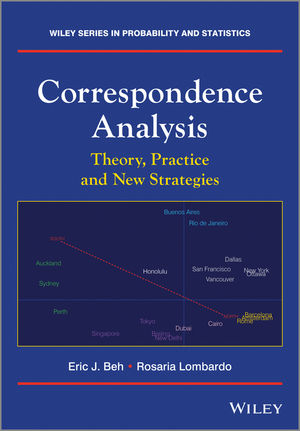
Correspondence Analysis: Theory, Practice and New Strategies examines the key issues of correspondence analysis, and discusses the new advances that have been made over the last 20 years.
The main focus of this book is to provide a comprehensive discussion of some of the key technical and practical aspects of correspondence analysis, and to demonstrate how they may be put to use. Particular attention is given to the history and mathematical links of the developments made. These links include not just those major contributions made by researchers in Europe (which is where much of the attention surrounding correspondence analysis has focused) but also the important contributions made by researchers in other parts of the world.
Key features include:
- A comprehensive international perspective on the key developments of correspondence analysis.
- Discussion of correspondence analysis for nominal and ordinal categorical data.
- Discussion of correspondence analysis of contingency tables with varying association structures (symmetric and non-symmetric relationship between two or more categorical variables).
- Extensive treatment of many of the members of the correspondence analysis family for two-way, three-way and multiple contingency tables.
Correspondence Analysis offers a comprehensive and detailed overview of this topic which will be of value to academics, postgraduate students and researchers wanting a better understanding of correspondence analysis. Readers interested in the historical development, internationalisation and diverse applicability of correspondence analysis will also find much to enjoy in this book.
Eric J. Beh
School of Mathematics & Physical Sciences, University of Newcastle, Australia
Rosaria Lombardo
Department of Economics, Second University of Naples, Italy
A comprehensive overview of the internationalisation of correspondence analysis Correspondence Analysis: Theory, Practice and New Strategies examines the key issues of correspondence analysis, and discusses the new advances that have been made over the last 20 years. The main focus of this book is to provide a comprehensive discussion of some of the key technical and practical aspects of correspondence analysis, and to demonstrate how they may be put to use. Particular attention is given to the history and mathematical links of the developments made. These links include not just those major contributions made by researchers in Europe (which is where much of the attention surrounding correspondence analysis has focused) but also the important contributions made by researchers in other parts of the world. Key features include: A comprehensive international perspective on the key developments of correspondence analysis. Discussion of correspondence analysis for nominal and ordinal categorical data. Discussion of correspondence analysis of contingency tables with varying association structures (symmetric and non-symmetric relationship between two or more categorical variables). Extensive treatment of many of the members of the correspondence analysis family for two-way, three-way and multiple contingency tables. Correspondence Analysis offers a comprehensive and detailed overview of this topic which will be of value to academics, postgraduate students and researchers wanting a better understanding of correspondence analysis. Readers interested in the historical development, internationalisation and diverse applicability of correspondence analysis will also find much to enjoy in this book.
Eric J. Beh School of Mathematics & Physical Sciences, University of Newcastle, Australia Rosaria Lombardo Department of Economics, Second University of Naples, Italy
"the book is outstandingly comprehensive and informative, well written, and clear. If the book is adopted for courses in Statistics for not only students in applied fields, but also for students in Statistics, it will provide them with an excellent up-to-date knowledge of the entire spectrum of correspondence analysis. I would also like to recommend the book very strongly to most researchers including seasoned researchers in data analysis, for the book will undoubtedly fill in the gap of their knowledge about versatile correspondence analysis. I learned a lot, reading the book." (Psychometrika 2016)
Preface
The correspondence analysis family tree is ever growing. From its roots that lie in Europe (or the United Kingdom, depending on which perspective one takes), it has matured more rapidly over the past two decades than at any time since its development. This is largely due to the continual application of correspondence analysis in all fields of research influenced largely by the advances in computer programming facilities. The widespread use of the Internet has also helped to promote both the use of all types of exploratory data analysis, including correspondence analysis, and its world-wide exposure to data analysts. So it is appropriate to step back and take stock of the original contributions to correspondence analysis, and their importance on this development, and reflect on what impact correspondence analysis has had on the statistical and allied disciplines. It should be no surprise that core developments made in the early days of correspondence analysis still resonate with us today, and many of the key researchers still play a major role in its development. With such strong foundations, a new generation of correspondence analysts (or CA'ists) is now emerging. As a result, new ideas and perspectives are emerging. These come from not just the correspondence analysis strongholds of Europe and Japan but are now far more international –however, unfortunately, its technical evolution still remains relatively slow in some parts of the world (including Australia and New Zealand).
It should therefore be no real surprise that this book provides an overview of many of the aspects concerned with correspondence analysis. In particular, we focus on the mathematical, and practical, development of correspondence analysis for two-way and multi-way contingency tables with nominal and ordinal variables. Hence, this book describes some of the old and some of the new approaches to correspondence analysis. We do so by
- providing an overview of methods (old and new) that can be used for reducing the dimensionality of the cloud of points,
- discussing the classical approaches, and new strategies, concerning the technical aspects, and graphical presentation, of symmetrically and asymmetrically structured categorical variables with nominal and ordered categories,
- providing an overview of the internationalisation of correspondence analysis,
- describing some of the popular, and no-so-popular, variations of correspondence analysis that now exist,
- emphasising the use of R to perform many of the calculations necessary to undertake correspondence analysis, and
- giving a historical perspective on the development of correspondence analysis.
In order to do this, the book is arranged into four sections:
- Part One gives an overview of the quantification and visualisation of categorical data. Chapter 1 provides a history of the development of graphical techniques and introduces the data sets used as a motivating example to many of the aspects we shall discuss. Chapter 2 briefly describes Pearson's chi-squared statistic and its characteristics.
- Part Two provides a comprehensive discussion of issues concerned with the correspondence analysis of a two-way contingency table. Chapter 3 discusses a variety of methods of decomposition of matrices, including singular value decomposition, bivariate moment decomposition and hybrid decomposition. Chapter 4 discusses many of the technical and practical aspects concerned with the simple correspondence analysis, while Chapter 5 provides a similar discussion of non-symmetrical correspondence analysis. Both these chapters describe the correspondence analysis of two variables with nominal categories. We expand these discussions in Chapters 6 and 7 by considering the correspondence analysis of two-way tables with ordered categorical variables. Some inferential aspects concerned with the graphical depiction of association is given in Chapter 8 where we describe parametric confidence regions and their associated p-values for points as well as non-parametric confidence regions in a low-dimensional display. Chapter 9 gives an overview of some variations of correspondence analysis not described in the earlier chapters and describes the growth of the correspondence analysis family tree.
- Part Three presents a comprehensive discussion of the correspondence analysis of multiple categorical variables. Chapter 10 gives an overview of some of the classical techniques for dealing with nominal and ordinal categories, including the recoding of a multi-way contingency table. Chapter 11 provides an overview of techniques for analysing symmetrically and asymmetrically structured variables as a data cube.
- Part Four gives an overview of some of the computational aspects to correspondence analysis. While R is extensively used, and described, throughout the book, Chapter 12 gives an overview of other R code that may be used. The chapter also describes the use of some popular commercially available packages and other programs that enable a variety of correspondence analysis techniques to be considered.
When reading this book, our expectation is that the reader has a fundamental understanding of statistics and linear algebra. However, where all mathematical aspects are concerned, we have tried to provide a proof of the results where needed and have given a conceptual discussion of their relevance.
This book would not have been possible without the generosity and encouragement from a host of people. We would like to thank the following people for their encouragement, guidance, discussions and help during the preparation of the book: Ida Camminatiello, Salman Cheema, Luigi D'Ambra, Irene Hudson, Pieter Kroonenberg, John Rayner, Trevor Ringrose, Duy Tran and Sidra Zafar.
We are very grateful to the generosity of the following people (listed alphabetically) for allowing us to include their photos in the book: Vartan Choulakian, Luigi D'Ambra, Michael Greenacre, William Heiser, Pieter Kroonenberg, Ludovic Lebart, Carlo Lauro, Jan de Leeuw, Jaqueline Meulman, Shizuhiko Nishisato and Yoshio Takane.
We are very much humbled by the excitement and willingness that everyone has shown in being an important part of this book. We are grateful for those photos that come from personal collections. We are indebted to those who have also given their insight, experience and expertise on various matters of the early years of correspondence analysis. However, we acknowledge that any errors (a few would have crept in no doubt) in the text are our own. We also thank Michael Greenacre for sharing with us a photo of Jean-Paul Benzécri that appears in Chapter 4 of this book.
We would like to give special credit and thanks to Pieter Kroonenberg for looking through the book when we were (nearly) finished and for many discussions on the technical and practical aspects of correspondence analysis. We would also like to give a special thanks to our Wiley project editor Richard Davies in Chichester. Our thanks also go to Kathryn Sharples and Jo Taylor at Wiley and Shikha Pahuja at Thomson Digital for their support and patience.
This book contains an accompanying website. Please visit www.wiley.com/go/correspondence_analysis.
Some Personal Acknowledgements: Eric J. Beh
I would like to express my gratitude to Pam Davy at the University of Wollongong who paved the way for me to work on correspondence analysis. While it was a happy opportunity that I was assigned to read, and report on, Michael Greenacre's Theory and Application of Correspondence Analysis for my Honours research topic in 1994, we learnt a lot together and our collaboration fed my passion for correspondence analysis and categorical data analysis. Your support, guidance and encouragement during this time and, of course, during my Ph.D. days (1995–1998) are a big part of why I do what I do. I also thank John Rayner who has been my long time mentor, co-author, colleague and friend. My first international collaborative links commenced with Luigi D'Ambra, Biagio Simonetti and (of course) Rosaria. Without your insight, experience and inspiration, many of the ideas that we discuss in this book would not have been possible.
Some Personal Acknowledgements: Rosaria Lombardo
I would like to take this opportunity to say that I am very grateful to Luigi D'Ambra and Carlo Natale Lauro at the University of Naples who introduced me to non-symmetrical correspondence analysis when I studied for my Ph.D. (1991–1994). I convey my sincere thanks to André Carlier who was at the University of Toulouse (he may be gone but he will never be forgotten) and Pieter Kroonenberg at the University of Leiden who guided me to work on multi-way correspondence analysis while I was visiting their Department for my Ph.D. research topic in 1991–1992. I also express my thanks to Jean-François Durand who, some years later, introduced me to non-linear data transformations. You all opened my mind to new perspectives on exploratory data analysis and our collaborations fed my passion for all aspects of exploratory data analysis and non-linear principal component analysis. Without your continual support, guidance and motivation, I surely would not have been what I am. Furthermore, I would like to thank my Aussie co-author, colleague and friend Eric.
Lastly, but certainly not ‘least’, we would like to thank our families for their immense patience, love and support. Our special thanks thus go to Rosey, Alex, Donato, Renato and...
| Erscheint lt. Verlag | 4.9.2014 |
|---|---|
| Reihe/Serie | Wiley Series in Probability and Statistics |
| Wiley Series in Probability and Statistics | Wiley Series in Probability and Statistics |
| Sprache | englisch |
| Themenwelt | Mathematik / Informatik ► Mathematik ► Statistik |
| Mathematik / Informatik ► Mathematik ► Wahrscheinlichkeit / Kombinatorik | |
| Technik | |
| Schlagworte | Angew. Wahrscheinlichkeitsrechn. u. Statistik / Modelle • Applied Probability & Statistics - Models • categorical data analysis • Correspondence Analysis: Theory, Practice and New Strategies • Eric John Beh • Health Science • Kategorielle Datenanalyse • Marketing research • Multivariate Analyse • multivariate analysis • multivariate statistical technique • Political Science • Rosaria Lombardo • Statistics • Statistik • Survey Analysis |
| ISBN-10 | 1-118-76290-8 / 1118762908 |
| ISBN-13 | 978-1-118-76290-5 / 9781118762905 |
| Informationen gemäß Produktsicherheitsverordnung (GPSR) | |
| Haben Sie eine Frage zum Produkt? |
 EPUB (Adobe DRM)
Kopierschutz: Adobe-DRM
Adobe-DRM ist ein Kopierschutz, der das eBook vor Mißbrauch schützen soll. Dabei wird das eBook bereits beim Download auf Ihre persönliche Adobe-ID autorisiert. Lesen können Sie das eBook dann nur auf den Geräten, welche ebenfalls auf Ihre Adobe-ID registriert sind.
Details zum Adobe-DRM
Dateiformat: EPUB (Electronic Publication)
EPUB ist ein offener Standard für eBooks und eignet sich besonders zur Darstellung von Belletristik und Sachbüchern. Der Fließtext wird dynamisch an die Display- und Schriftgröße angepasst. Auch für mobile Lesegeräte ist EPUB daher gut geeignet.
Systemvoraussetzungen:
PC/Mac: Mit einem PC oder Mac können Sie dieses eBook lesen. Sie benötigen eine
eReader: Dieses eBook kann mit (fast) allen eBook-Readern gelesen werden. Mit dem amazon-Kindle ist es aber nicht kompatibel.
Smartphone/Tablet: Egal ob Apple oder Android, dieses eBook können Sie lesen. Sie benötigen eine
Geräteliste und zusätzliche Hinweise
Buying eBooks from abroad
For tax law reasons we can sell eBooks just within Germany and Switzerland. Regrettably we cannot fulfill eBook-orders from other countries.
aus dem Bereich