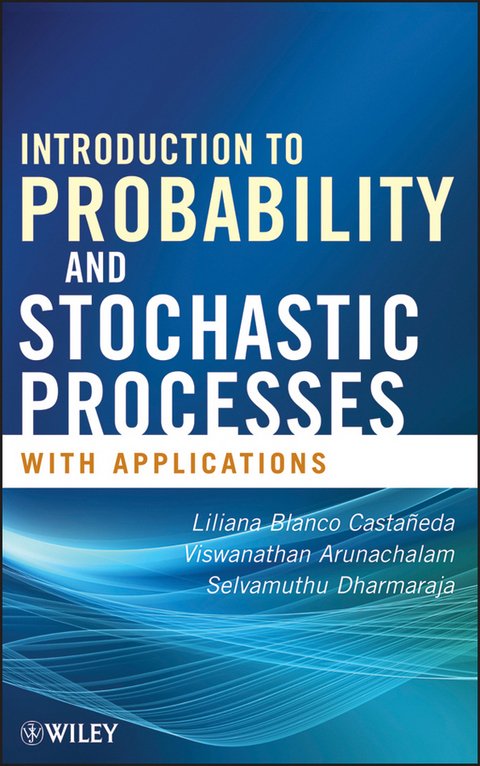
Introduction to Probability and Stochastic Processes with Applications (eBook)
614 Seiten
Wiley (Verlag)
978-1-118-34496-5 (ISBN)
LILIANA BLANCO CASTAÑEDA, DrRerNat, is AssociateProfessor in the Department of Statistics at the NationalUniversity of Colombia and the author of several journal articlesand three books on basic and advanced probability. VISWANATHAN ARUNACHALAM, PhD, is Associate Professor inthe Department of Mathematics at the Universidad de los Andes,Colombia. He has published numerous journal articles in areas suchas optimization, stochastic processes, and the mathematics offinancial derivatives. SELVAMUTHU DHARMARAJA, PhD, is Associate Professor in theDepartment of Mathematics and the Bharti School ofTelecommunication Technology and Management at the Indian Instituteof Technology Delhi. The author of several journal articles, he isAssociate Editor for the International Journal of CommunicationSystems.
Foreword xiii
Preface xv
Acknowledgments xvii
Introduction xix
1. Basic Concepts 1
1.1 Probability Space 1
1.2 Laplace Probability Space 13
1.3 Conditional Probability and Event Independence 18
1.4 Geometric Probability 34
Exercises 36
2. Random Variables and their Distributions 49
2.1 Definitions and Properties 49
2.2 Discrete Random Variables 59
2.3 Continuous Random Variables 64
2.4 Distribution of a Function of a Random Variable 69
2.5 Expected Value and Variance of a Random Variable 77
Exercises 97
3. Some Discrete Distributions 111
3.1 Discrete Uniform, Binomial and Bernoulli Distributions111
3.2 Hypergeometric and Poisson Distributions 119
3.3 Geometric and Negative Binomial Distributions 128
Exercises 133
4. Some Continuous Distributions 141
4.1 Uniform Distribution 141
4.2 Normal Distribution 147
4.3 Family of Gamma Distribution 158
4.4 Weibull Distribution 167
4.5 Beta Distribution 169
4.6 Other Continuous Distributions 173
Exercises 178
5. Random Vectors 189
5.1 Joint Distribution of Random Variables 189
5.2 Independent Random Variables 206
5.3 Distribution of Functions of a Random Vector 214
5.4 Covariance and Correlation Coefficient 224
5.5 Expected Value and Variance of a Random Vector 232
5.6 Generating Functions 236
Exercises 247
6. Conditional Expectation 261
6.1 Conditional Distribution 261
6.2 Conditional Expectation given a sigma¯-algebra276
Exercises 283
7. Multivariate Normal Distribution 291
7.1 Multivariate Normal Distribution 291
7.2 Distribution of Quadratic Forms of Multivariate NormalVectors 298
Exercises 304
8. Limit Theorems 307
8.1 The Weak Law of Large Numbers 307
8.2 Convergence of Sequences of Random Variables 313
8.3 The Strong Law of Large Numbers 316
8.4 Central Limit Theorem 323
Exercises 328
9. Introduction to Stochastic Processes 333
9.1 Definitions and Properties 334
9.2 Discrete Time Markov Chain 338
9.3 Continuous Time Markov Chains 364
9.4 Poisson Process 374
9.5 Renewal Processes 383
9.6 Semi-Markov process 393
Exercises 399
10. Introduction to Queueing Models 409
10.1 Introduction 409
10.2 Markovian Single Server Models 411
10.3 Markovian Multi Server Models 423
10.4 Non-Markovian Models 432
Exercises 449
11. Stochastic Calculus 453
11.1 Martingales 453
11.2 Brownian Motion 464
11.3 Itô Calculus 473
Exercises 484
12. Introduction to Mathematical Finance 489
12.1 Financial Derivatives 490
12.2 Discrete-time Models 496
12.3 Continuous-time models 513
12.4 Volatility 523
Exercises 525
Appendix A. Basic Concepts on Set Theory 529
Appendix B. Introduction to Combinatorics 535
Appendix C. Topics on Linear Algebra 545
Appendix D. Statistical Tables 547
Problem Solutions 559
References 575
Bibliography 575
Glossary 579
Index 583
"A great strength of this book is the enormous number ofdetailed examples and the exercises at the end of each chapter,many of which include solutions. The writing style is very clear,because the authors brought their experiences in teaching forseveral years to its writing. . .In summary, the first eightchapters provide an excellent introduction to and quick overview ofprobability theory, with many examples." (Interfaces, 1 September 2013)
"The choice of material and the presentation make thisbook an excellent first introduction into probability theory andstochastic processes from upper undergraduate level onwards in allthe areas mentioned above. It may also serve math students at thevery initial stages of their studies as a stepping stone to get asound grasp of some basic concepts of probability." (Contemporary Physics, 13 August 2012)
| Erscheint lt. Verlag | 21.8.2014 |
|---|---|
| Sprache | englisch |
| Themenwelt | Mathematik / Informatik ► Mathematik ► Statistik |
| Mathematik / Informatik ► Mathematik ► Wahrscheinlichkeit / Kombinatorik | |
| Technik | |
| Schlagworte | Angewandte Wahrscheinlichkeitsrechnung u. Statistik • Applied Probability & Statistics • Finance & Investments • Financial Engineering • Finanztechnik • Finanz- u. Anlagewesen • Finanz- u. Wirtschaftsstatistik • Statistics • Statistics for Finance, Business & Economics • Statistik • Stochastischer Prozess • Wahrscheinlichkeitsrechnung |
| ISBN-10 | 1-118-34496-0 / 1118344960 |
| ISBN-13 | 978-1-118-34496-5 / 9781118344965 |
| Informationen gemäß Produktsicherheitsverordnung (GPSR) | |
| Haben Sie eine Frage zum Produkt? |
 EPUB (Adobe DRM)
Kopierschutz: Adobe-DRM
Adobe-DRM ist ein Kopierschutz, der das eBook vor Mißbrauch schützen soll. Dabei wird das eBook bereits beim Download auf Ihre persönliche Adobe-ID autorisiert. Lesen können Sie das eBook dann nur auf den Geräten, welche ebenfalls auf Ihre Adobe-ID registriert sind.
Details zum Adobe-DRM
Dateiformat: EPUB (Electronic Publication)
EPUB ist ein offener Standard für eBooks und eignet sich besonders zur Darstellung von Belletristik und Sachbüchern. Der Fließtext wird dynamisch an die Display- und Schriftgröße angepasst. Auch für mobile Lesegeräte ist EPUB daher gut geeignet.
Systemvoraussetzungen:
PC/Mac: Mit einem PC oder Mac können Sie dieses eBook lesen. Sie benötigen eine
eReader: Dieses eBook kann mit (fast) allen eBook-Readern gelesen werden. Mit dem amazon-Kindle ist es aber nicht kompatibel.
Smartphone/Tablet: Egal ob Apple oder Android, dieses eBook können Sie lesen. Sie benötigen eine
Geräteliste und zusätzliche Hinweise
Buying eBooks from abroad
For tax law reasons we can sell eBooks just within Germany and Switzerland. Regrettably we cannot fulfill eBook-orders from other countries.
aus dem Bereich