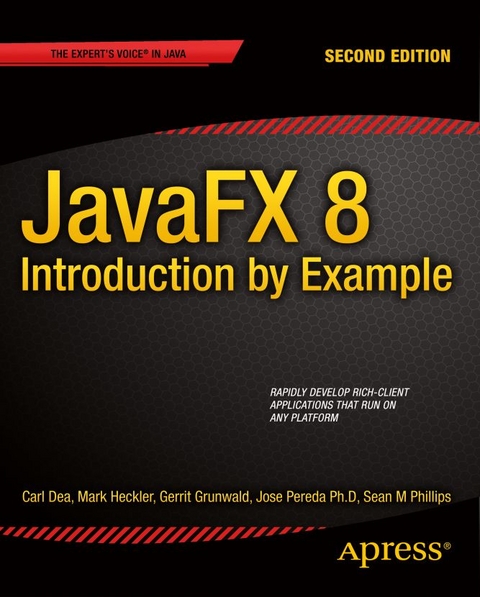
JavaFX 8: Introduction by Example (eBook)
XXIII, 420 Seiten
Apress (Verlag)
978-1-4302-6461-3 (ISBN)
JavaFX 8: Introduction by Example shows you how to use your existing Java skills to create graphically exciting client applications with the JavaFX 8 platform. The book is a new and much improved edition of JavaFX 2.0: Introduction by Example, taking you through a series of engaging, fun-to-work examples that bring you up to speed on the major facets of the platform. It will help you to create applications that look good, are fun to use, and that take advantage of the medium to present data of all types in ways that engage the user and lead to increased productivity.
Entirely example-based, JavaFX 8: Introduction by Example begins with the fundamentals of installing the software and creating a simple interface. From there, you'll move in progressive steps through the process of developing applications using JavaFX’s standard drawing primitives. You'll then explore images, animations, media, and web. This new edition incorporates the changes resulting from the switch to Java 8 SDK. It covers advanced topics such as custom controls, JavaFX 3D, gesture devices, and embedded systems. Best of all, the book is full of working code that you can adapt and extend to all your future projects.
- Entirely example-based
- Filled with fun and practical code examples
- Covers all that's new in Java 8 relating to JavaFX such as Lambda expressions and Streams
- Covers gesture devices, 3D display, embedded systems, and other advanced topics
Carl P. Dea is a software engineer working for BCT LLC on projects with high performance computing (HPC) architectures. He has been developing software for 15 years with many clients, from Fortune 500 companies to nonprofit organizations. He has written software ranging from mission-critical applications to Web applications. Carl has been using Java since the very beginning and is a JavaFX enthusiast dating back to when JavaFX used to be called F3. He has been involved with open-source projects such as JFXtras and JDIC. Carl's passion for software development started when his middle school science teacher showed him the TRS-80 computer. His current software development interests are: rich client platforms (RCP), rich Internet applications (RIAs), Groovy, game programming, Arduino, mobile phones, and tablet computers. When he's not working, Carl and his wife love to watch their daughters perform at gymnastics meets. Carl lives on the East Coast in Pasadena (aka 'The Dena'), Maryland. You can follow him on Twitter @carldea, and on LinkedIn at www.linkedin.com/in/carldea. Carl also blogs at carlfx.wordpress.com.
JavaFX 8: Introduction by Example shows you how to use your existing Java skills to create graphically exciting client applications with the JavaFX 8 platform. The book is a new and much improved edition of JavaFX 2.0: Introduction by Example, taking you through a series of engaging, fun-to-work examples that bring you up to speed on the major facets of the platform. It will help you to create applications that look good, are fun to use, and that take advantage of the medium to present data of all types in ways that engage the user and lead to increased productivity. Entirely example-based, JavaFX 8: Introduction by Example begins with the fundamentals of installing the software and creating a simple interface. From there, you'll move in progressive steps through the process of developing applications using JavaFX’s standard drawing primitives. You'll then explore images, animations, media, and web. This new edition incorporates the changes resulting from the switch to Java 8 SDK. It covers advanced topics such as custom controls, JavaFX 3D, gesture devices, and embedded systems. Best of all, the book is full of working code that you can adapt and extend to all your future projects.Entirely example-based Filled with fun and practical code examples Covers all that's new in Java 8 relating to JavaFX such as Lambda expressions and StreamsCovers gesture devices, 3D display, embedded systems, and other advanced topics
Carl P. Dea is a software engineer working for BCT LLC on projects with high performance computing (HPC) architectures. He has been developing software for 15 years with many clients, from Fortune 500 companies to nonprofit organizations. He has written software ranging from mission-critical applications to Web applications. Carl has been using Java since the very beginning and is a JavaFX enthusiast dating back to when JavaFX used to be called F3. He has been involved with open-source projects such as JFXtras and JDIC. Carl's passion for software development started when his middle school science teacher showed him the TRS-80 computer. His current software development interests are: rich client platforms (RCP), rich Internet applications (RIAs), Groovy, game programming, Arduino, mobile phones, and tablet computers. When he's not working, Carl and his wife love to watch their daughters perform at gymnastics meets. Carl lives on the East Coast in Pasadena (aka "The Dena"), Maryland. You can follow him on Twitter @carldea, and on LinkedIn at www.linkedin.com/in/carldea. Carl also blogs at carlfx.wordpress.com.
1. Getting started2. JavaFX Fundamentals3. Java 8 Lambda Expressions4. Layout & UI Controls5. Graphics with JavaFX6. Custom Controls7. Media with JavaFX8. JavaFX on the Web9. JavaFX 3D10. JavaFX and Arduino11. JavaFX on the Raspberry Pi12. Gesture-based Interfaces13. Appendix A. References
| Erscheint lt. Verlag | 14.6.2014 |
|---|---|
| Zusatzinfo | XXIII, 420 p. 139 illus. |
| Verlagsort | Berkeley |
| Sprache | englisch |
| Themenwelt | Mathematik / Informatik ► Informatik ► Programmiersprachen / -werkzeuge |
| Informatik ► Software Entwicklung ► User Interfaces (HCI) | |
| Mathematik / Informatik ► Informatik ► Theorie / Studium | |
| Mathematik / Informatik ► Informatik ► Web / Internet | |
| ISBN-10 | 1-4302-6461-6 / 1430264616 |
| ISBN-13 | 978-1-4302-6461-3 / 9781430264613 |
| Informationen gemäß Produktsicherheitsverordnung (GPSR) | |
| Haben Sie eine Frage zum Produkt? |
 PDF (Wasserzeichen)
DRM: Digitales Wasserzeichen
Dieses eBook enthält ein digitales Wasserzeichen und ist damit für Sie personalisiert. Bei einer missbräuchlichen Weitergabe des eBooks an Dritte ist eine Rückverfolgung an die Quelle möglich.
Dateiformat: PDF (Portable Document Format)
Mit einem festen Seitenlayout eignet sich die PDF besonders für Fachbücher mit Spalten, Tabellen und Abbildungen. Eine PDF kann auf fast allen Geräten angezeigt werden, ist aber für kleine Displays (Smartphone, eReader) nur eingeschränkt geeignet.
Systemvoraussetzungen:
PC/Mac: Mit einem PC oder Mac können Sie dieses eBook lesen. Sie benötigen dafür einen PDF-Viewer - z.B. den Adobe Reader oder Adobe Digital Editions.
eReader: Dieses eBook kann mit (fast) allen eBook-Readern gelesen werden. Mit dem amazon-Kindle ist es aber nicht kompatibel.
Smartphone/Tablet: Egal ob Apple oder Android, dieses eBook können Sie lesen. Sie benötigen dafür einen PDF-Viewer - z.B. die kostenlose Adobe Digital Editions-App.
Buying eBooks from abroad
For tax law reasons we can sell eBooks just within Germany and Switzerland. Regrettably we cannot fulfill eBook-orders from other countries.
aus dem Bereich