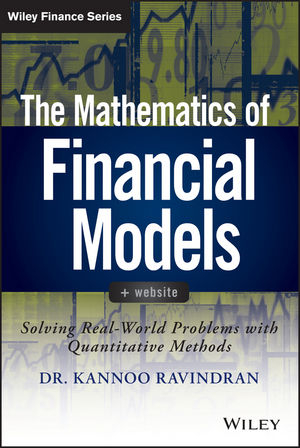
The Mathematics of Financial Models (eBook)
352 Seiten
John Wiley & Sons (Verlag)
9781118221853 (ISBN)
head-on
Before financial problems can be solved, they need to be fully
understood. Since in-depth quantitative modeling techniques are a
powerful tool to understanding the drivers associated with
financial problems, one would need a solid grasp of these
techniques before being able to unlock their full potential of the
methods used. In The Mathematics of Financial Models, the
author presents real world solutions to the everyday problems
facing financial professionals. With interactive tools such as
spreadsheets for valuation, pricing, and modeling, this resource
combines highly mathematical quantitative analysis with useful,
practical methodologies to create an essential guide for investment
and risk-management professionals facing modeling issues in
insurance, derivatives valuation, and pension benefits, among
others. In addition to this, this resource also provides the
relevant tools like matrices, calculus, statistics and numerical
analysis that are used to build the quantitative methods used.
Financial analysts, investment professionals, risk-management
professionals, and graduate students will find applicable
information throughout the book, and gain from the self-study
exercises and the refresher course on key mathematical topics.
Equipped with tips and information, The Mathematics of Financial
Models
* Provides practical methodologies based on mathematical
quantitative analysis to help analysts, investment and
risk-management professionals better navigate client issues
* Contains interactive tools that demonstrate the power of
analysis and modeling
* Helps financial professionals become more familiar with the
challenges across a range of industries
* Includes a mathematics refresher course and plenty of exercises
to get readers up to speed
The Mathematics of Financial Models is an in-depth guide
that helps readers break through common client financial problems
and emerge with clearer strategies for solving issues in the
future.
DR. KANNOO RAVINDRAN consults with corporations on investments, derivatives trading, modeling, and risk management. He also lectures around the world on these topics and runs a private equity fund. Dr. Ravindran pioneered the use of derivatives to manage risks embedded in variable annuity products.
Preface ix
Acknowledgments xi
Chapter 1 Setting the Stage 1
Why is This Book Different? 2
Road Map of the Book 3
References 5
Chapter 2 Building Zero Curves 7
Market Instruments 8
Linear Interpolation 16
Cubic Splining 25
Appendix: Finding Swap Rates Using a Floating Coupon Bond Approach 41
References 43
Chapter 3 Valuing Vanilla Options 45
Black-Scholes Formulae 47
Adaptations of the Black-Scholes Formulae 53
Limitations of the Black-Scholes Formulae 70
Application in Currency Risk Management 74
Appendix 78
References 80
Chapter 4 Simulations 81
Uniform Number Generation 82
Non-Uniform Number Generation 86
Applications of Simulations 93
Variance Reduction Techniques 100
References 104
Chapter 5 Valuing Exotic Options 107
Valuing Path-Independent, European-Style Options on a Single Variable 108
Valuing Path-Dependent, European-Style Options on a Single Variable 114
Valuing Path-Independent, European-Style Options on Two Variables 135
Valuing Path-Dependent, European-Style Options on Multiple Variables 152
References 157
Chapter 6 Estimating Model Parameters 159
Calibration of Parameters in the Black-Scholes Model 161
Using Implied Black-Scholes Volatility Surface and Zero Rate Term Structure to Value Options 169
Using Volatility Surface 178
Calibration of Interest Rate Option Model Parameters 190
Statistical Estimation 196
References 203
Chapter 7 The Effectiveness of Hedging Strategies 205
Delta Hedging 206
Assumptions Underlying Delta Hedging 216
Beyond Delta Hedging 223
Testing Hedging Strategies 230
Analysis Associated with the Hedging of a European-Style Vanilla Put Option 235
References 244
Chapter 8 Valuing Variable Annuity Guarantees 245
Basic GMDB 246
Death Benefit Riders 261
Other Details Associated with GMDB Products 269
Improving Modeling Assumptions 273
Living Benefit Riders 276
References 279
Chapter 9 Real Options 281
Surrendering a GMAB Rider 282
Adding Servers in a Queue 300
References 314
Chapter 10 Parting Thoughts 315
About the Author 317
About the Website 319
Index 321
| Erscheint lt. Verlag | 18.8.2014 |
|---|---|
| Reihe/Serie | Wiley Finance Editions | Wiley Finance Editions |
| Sprache | englisch |
| Themenwelt | Mathematik / Informatik ► Mathematik ► Angewandte Mathematik |
| Recht / Steuern ► Wirtschaftsrecht | |
| Wirtschaft ► Betriebswirtschaft / Management ► Finanzierung | |
| Schlagworte | Finance & Investments • Finanz- u. Anlagewesen • Investments & Securities • Kapitalanlage • Kapitalanlagen u. Wertpapiere |
| ISBN-13 | 9781118221853 / 9781118221853 |
| Informationen gemäß Produktsicherheitsverordnung (GPSR) | |
| Haben Sie eine Frage zum Produkt? |
 PDF (Adobe DRM)
Kopierschutz: Adobe-DRM
Adobe-DRM ist ein Kopierschutz, der das eBook vor Mißbrauch schützen soll. Dabei wird das eBook bereits beim Download auf Ihre persönliche Adobe-ID autorisiert. Lesen können Sie das eBook dann nur auf den Geräten, welche ebenfalls auf Ihre Adobe-ID registriert sind.
Details zum Adobe-DRM
Dateiformat: PDF (Portable Document Format)
Mit einem festen Seitenlayout eignet sich die PDF besonders für Fachbücher mit Spalten, Tabellen und Abbildungen. Eine PDF kann auf fast allen Geräten angezeigt werden, ist aber für kleine Displays (Smartphone, eReader) nur eingeschränkt geeignet.
Systemvoraussetzungen:
PC/Mac: Mit einem PC oder Mac können Sie dieses eBook lesen. Sie benötigen eine
eReader: Dieses eBook kann mit (fast) allen eBook-Readern gelesen werden. Mit dem amazon-Kindle ist es aber nicht kompatibel.
Smartphone/Tablet: Egal ob Apple oder Android, dieses eBook können Sie lesen. Sie benötigen eine
Geräteliste und zusätzliche Hinweise
Buying eBooks from abroad
For tax law reasons we can sell eBooks just within Germany and Switzerland. Regrettably we cannot fulfill eBook-orders from other countries.
aus dem Bereich