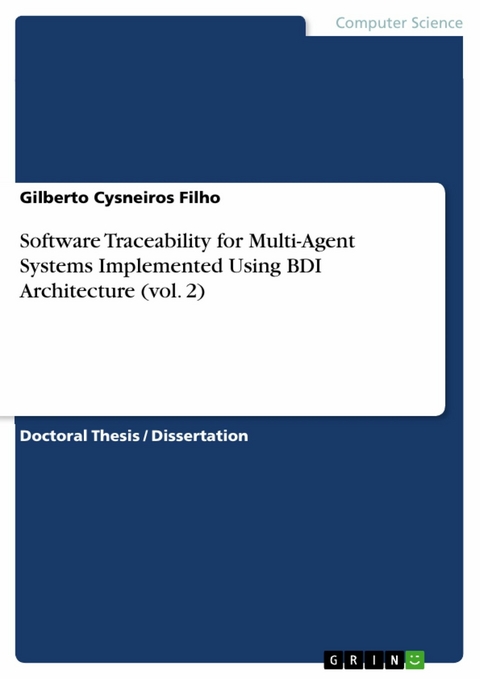
Software Traceability for Multi-Agent Systems Implemented Using BDI Architecture (vol. 2) (eBook)
382 Seiten
GRIN Verlag
978-3-656-71842-0 (ISBN)
In order to alleviate the above problems, in this thesis, a traceability framework is described to support the development of multi-agent systems. The framework supports automatic generation of traceability relations and identification of missing elements (i.e., completeness checking) in the models created during the development life-cycle of multi-agent systems using the Belief-Desire-Intention (BDI) architecture.
Traceability has been recognized as an important activity in the software development process. Traceability relations can guarantee and improve software quality and can help with several tasks such as the evolution of software systems, reuse of parts of the system, validation that a system meets its requirements, understanding of the rationale for certain design decisions, identification of common aspects of the system, and analysis of implications of changes in the system.
The traceability framework presented in this thesis concentrates on multi-agent software systems developed using i* framework, Prometheus methodology, and JACK language. Here, a traceability reference model is presented for software artefacts generated when using i* framework, Prometheus methodology, and JACK language. Different types of relations between the artefacts are identified. The framework is based on a rule-based approach to support automatic identification of traceability relations and missing elements between the generated artefacts. Software models represented in XML were used to support the heterogeneity of models and tools used during the software development life-cycle. In the framework, the rules are specified in an extension of XQuery to support (i) representation of the consequence part of the rules, i.e. the actions to be taken when the conditions are satisfied, and (ii) extra functions to cover some of the traceability relations being proposed and completeness checking of the models.
A prototype tool has been developed to illustrate and evaluate the work.
| Erscheint lt. Verlag | 18.9.2014 |
|---|---|
| Verlagsort | München |
| Sprache | englisch |
| Themenwelt | Mathematik / Informatik ► Informatik ► Software Entwicklung |
| Schlagworte | Architecture • implemented • multi_agent • Multi-agent • Software • Systems • Traceability • Using |
| ISBN-10 | 3-656-71842-3 / 3656718423 |
| ISBN-13 | 978-3-656-71842-0 / 9783656718420 |
| Informationen gemäß Produktsicherheitsverordnung (GPSR) | |
| Haben Sie eine Frage zum Produkt? |
 EPUB (Ohne DRM)
Digital Rights Management: ohne DRM
Dieses eBook enthält kein DRM oder Kopierschutz. Eine Weitergabe an Dritte ist jedoch rechtlich nicht zulässig, weil Sie beim Kauf nur die Rechte an der persönlichen Nutzung erwerben.
Dateiformat: EPUB (Electronic Publication)
EPUB ist ein offener Standard für eBooks und eignet sich besonders zur Darstellung von Belletristik und Sachbüchern. Der Fließtext wird dynamisch an die Display- und Schriftgröße angepasst. Auch für mobile Lesegeräte ist EPUB daher gut geeignet.
Systemvoraussetzungen:
PC/Mac: Mit einem PC oder Mac können Sie dieses eBook lesen. Sie benötigen dafür die kostenlose Software Adobe Digital Editions.
eReader: Dieses eBook kann mit (fast) allen eBook-Readern gelesen werden. Mit dem amazon-Kindle ist es aber nicht kompatibel.
Smartphone/Tablet: Egal ob Apple oder Android, dieses eBook können Sie lesen. Sie benötigen dafür eine kostenlose App.
Geräteliste und zusätzliche Hinweise
Buying eBooks from abroad
For tax law reasons we can sell eBooks just within Germany and Switzerland. Regrettably we cannot fulfill eBook-orders from other countries.
aus dem Bereich