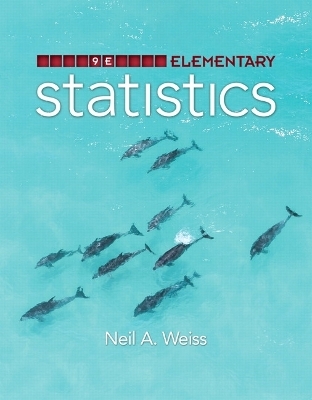
Elementary Statistics
Pearson (Verlag)
978-0-321-98939-0 (ISBN)
- Keine Verlagsinformationen verfügbar
- Artikel merken
Used books, rentals, and purchases made outside of Pearson
If purchasing or renting from companies other than Pearson, the access codes for Pearson's MyLab & Mastering products may not be included, may be incorrect, or may be previously redeemed. Check with the seller before completing your purchase.
Weiss’s Elementary Statistics, Ninth Edition, is the ideal textbook for introductory statistics classes that emphasize statistical reasoning and critical thinking. Comprehensive in its coverage, Weiss’s meticulous style offers careful, detailed explanations to ease the learning process. With more than 850 data sets and over 2,350 exercises, this text takes a data-driven approach that encourages students to apply their knowledge and develop statistical understanding.
This text contains parallel presentation of critical-value and p-value approaches to hypothesis testing. This unique design allows the flexibility to concentrate on one approach or the opportunity for greater depth in comparing the two.
Note: You are purchasing a standalone product; MyStatLab does not come packaged with this content. MyStatLab is not a self-paced technology and should only be purchased when required by an instructor. If you would like to purchase both the physical text and MyStatLab, search for:
0321989678 / 9780321989673 Elementary Statistics Plus MyStatLab with Pearson eText -- Access Card Package
Package consists of:
0321847997 / 9780321847997 My StatLab Glue-in Access Card
0321929713 / 9780321929716 MyStatLab for Business Statistics Sticker
0321989392 / 9780321989390 Elementary Statistics
Students, if interested in purchasing this title with MyMathLab, ask your instructor for the correct package ISBN and Course ID. Instructors, contact your Pearson representative for more information.
About our author The late Neil A. Weiss received his Ph.D. from UCLA and subsequently accepted an assistant professor position at Arizona State University (ASU), where he was ultimately promoted to the rank of full professor. Dr. Weiss taught statistics, probability, and mathematics from the freshman level to the advanced graduate level for more than 30 years. In recognition of his excellence in teaching, Dr. Weiss received the Dean’s Quality Teaching Award from the ASU College of Liberal Arts and Sciences. He also was runner-up twice for the Charles Wexler Teaching Award in the ASU School of Mathematical and Statistical Sciences. Dr.Weiss’s comprehensive knowledge and experience ensures that his texts are mathematically and statistically accurate, as well as pedagogically sound. In addition to his numerous research publications, Dr. Weiss was the author of A Course in Probability (Addison-Wesley, 2006).He also authored or coauthored books in finite mathematics, statistics, and real analysis. His texts, well known for their precision, readability and pedagogical excellence, are used worldwide. Dr. Weiss was a pioneer of the integration of statistical software into textbooks and the classroom, first providing such integration in the book Introductory Statistics (Addison-Wesley, 1982). Since this first publication, Neil Weiss’s work continues to inspire future statisticians and current students of statistics alike.
(NOTE: Each chapter concludes with Chapter in Review, Review Problems, Focusing on Data Analysis, Case Study Discussion, and Biography.) Technology Resources Data Sources I: INTRODUCTION
The Nature of Statistics
1.1 Statistics Basics
1.2 Simple Random Sampling
1.3 Other Sampling Designs∗
1.4 Experimental Designs∗
II: DESCRIPTIVE STATISTICS
Organizing Data
Case Study: World’s Richest People
2.1 Variables and Data
2.2 Organizing Qualitative Data
2.3 Organizing Quantitative Data
2.4 Distribution Shapes
2.5 Misleading Graphs∗
Descriptive Measures
Case Study: The Beatles’ Song Length
3.1 Measures of Center
3.2 Measures of Variation
3.3 Chebyshev’s Rule and the Empirical Rule∗
3.4 The Five-Number Summary; Boxplots
3.5 Descriptive Measures for Populations; Use of Samples
Descriptive Methods in Regression and Correlation
Case Study: Healthcare: Spending and Outcomes
4.1 Linear Equations with One Independent Variable
4.2 The Regression Equation
4.3 The Coefficient of Determination
4.4 Linear Correlation
III: PROBABILITY, RANDOM VARIABLES, AND SAMPLING DISTRIBUTIONS
Probability and Random Variables
Case Study: Texas Hold ‘em
5.1 Probability Basics
5.2 Events
5.3 Some Rules of Probability
5.4 Discrete Random Variables and Probability Distributions∗
5.5 The Mean and Standard Deviation of a Discrete Random Variable∗
5.6 The Binomial Distribution∗
The Normal Distribution
Case Study: Chest Sizes of Scottish Militiamen
6.1 Introducing Normally Distributed Variables
6.2 Areas under the Standard Normal Curve
6.3 Working with Normally Distributed Variables
6.4 Assessing Normality; Normal Probability Plots
The Sampling Distribution of the Sample Mean
Case Study: The Chesapeake and Ohio Freight Study
7.1 Sampling Error; the Need for Sampling Distributions
7.2 The Mean and Standard Deviation of the Sample Mean
7.3 The Sampling Distribution of the Sample Mean
IV: INFERENTIAL STATISTICS
Confidence Intervals for One Population Mean
Case Study: Bank Robberies: A Statistical Analysis
8.1 Estimating a Population Mean
8.2 Confidence Intervals for One Population Mean When σ Is Known
8.3 Confidence Intervals for One Population Mean When σ Is Unknown
Hypothesis Tests for One Population Mean
Case Study: Gender and Sense of Direction
9.1 The Nature of Hypothesis Testing
9.2 Critical-Value Approach to Hypothesis Testing
9.3 P-Value Approach to Hypothesis Testing
9.4 Hypothesis Tests for One Population Mean When σ Is Known
9.5 Hypothesis Tests for One Population Mean When σ Is Unknown
Inferences for Two Population Means
Case Study: Dexamethasone Therapy and IQ
10.1 The Sampling Distribution of the Difference between Two Sample Means for Independent Samples
10.2 Inferences for Two Population Means, Using Independent Samples: Standard Deviations Assumed Equal
10.3 Inferences for Two Population Means, Using Independent Samples: Standard Deviations Not Assumed Equal
10.4 Inferences for Two Population Means, Using Paired Samples
Inferences for Population Proportions
Case Study: Arrested Youths
11.1 Confidence Intervals for One Population Proportion
11.2 Hypothesis Tests for One Population Proportion
11.3 Inferences for Two Population Proportions
Chi-Square Procedures
Case Study: Eye and Hair Color
12.1 The Chi-Square Distribution
12.2 Chi-Square Goodness-of-Fit Test
12.3 Contingency Tables; Association
12.4 Chi-Square Independence Test
12.5 Chi-Square Homogeneity Test
Analysis of Variance (ANOVA)
Case Study: Self-Perception and Physical Activity
13.1 The F-Distribution
13.2 One-Way ANOVA: The Logic
13.3 One-Way ANOVA: The Procedure
Inferential Methods in Regression and Correlation
Case Study: Shoe Size and Height
14.1 The Regression Model; Analysis of Residuals
14.2 Inferences for the Slope of the Population Regression Line
14.3 Estimation and Prediction
14.4 Inferences in Correlation
*Indicates optional material. Appendix A: Statistical Tables Appendix B: Answers to Selected Exercises Index Photo Credits
| Erscheint lt. Verlag | 3.2.2015 |
|---|---|
| Sprache | englisch |
| Maße | 100 x 100 mm |
| Gewicht | 100 g |
| Themenwelt | Mathematik / Informatik ► Mathematik ► Statistik |
| ISBN-10 | 0-321-98939-2 / 0321989392 |
| ISBN-13 | 978-0-321-98939-0 / 9780321989390 |
| Zustand | Neuware |
| Informationen gemäß Produktsicherheitsverordnung (GPSR) | |
| Haben Sie eine Frage zum Produkt? |
aus dem Bereich