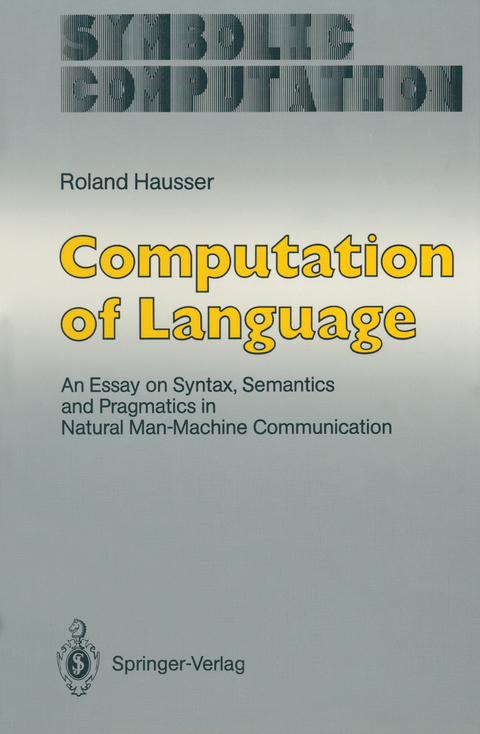
Computation of Language
Springer Berlin (Verlag)
978-3-642-74566-9 (ISBN)
I Natural Language and Formal Grammar.- 1 Goals and Results.- 2 Grammar and Interpretation.- 3 Outline of Left-Associative Grammar.- 4 Continuations in Natural Language.- 5 Analysis and Generation.- II Algebraic and Automata-Theoretic Characterization.- 6 The Left-Associative Algorithm.- 7 Language Hierarchies.- 8 LA-Grammar and Automata.- 9 Decidability and Efficiency.- 10 Computational Complexity Results.- III Logic and Communication.- 11 Principles of Pragmatics.- 12 Meaning, Truth and Ontology.- 13 Model Theory and Artificial Intelligence.- 14 Reference and Denotation.- 15 Surface Compositional Semantics.- Conclusion.- Appendices.- Introductory Remarks.- A ECAT Category Segments and Categories.- A.l Alphabetical List of Category Segments.- A.2 List of ELEX Categories.- A.3 Derived ECAT Categories.- B Sample Derivations.- B.l Yes/No Interrogative.- B.2 Ambiguity in a Passive Sentence.- B.3 Recursion of Control.- B.4 Unbounded Dependency.- B.5 Relative Clauses.- B.6 Genitive Recursion.- B.7 Idiom.- C The Current Example Set of ECAT.- References.- Name Index.
| Erscheint lt. Verlag | 23.8.2014 |
|---|---|
| Reihe/Serie | Artificial Intelligence | Symbolic Computation |
| Vorwort | Dana Scott |
| Zusatzinfo | XVI, 428 p. |
| Verlagsort | Berlin |
| Sprache | englisch |
| Maße | 170 x 244 mm |
| Gewicht | 767 g |
| Themenwelt | Informatik ► Theorie / Studium ► Künstliche Intelligenz / Robotik |
| Schlagworte | algorithms • Artificial Intelligence • Automata • Complexity • Control • formal grammar • grammar • Intelligence • Logic • Machine Translation • natural language • Natural Language Processing • Ontology • robot • Semantics |
| ISBN-10 | 3-642-74566-0 / 3642745660 |
| ISBN-13 | 978-3-642-74566-9 / 9783642745669 |
| Zustand | Neuware |
| Informationen gemäß Produktsicherheitsverordnung (GPSR) | |
| Haben Sie eine Frage zum Produkt? |
aus dem Bereich