


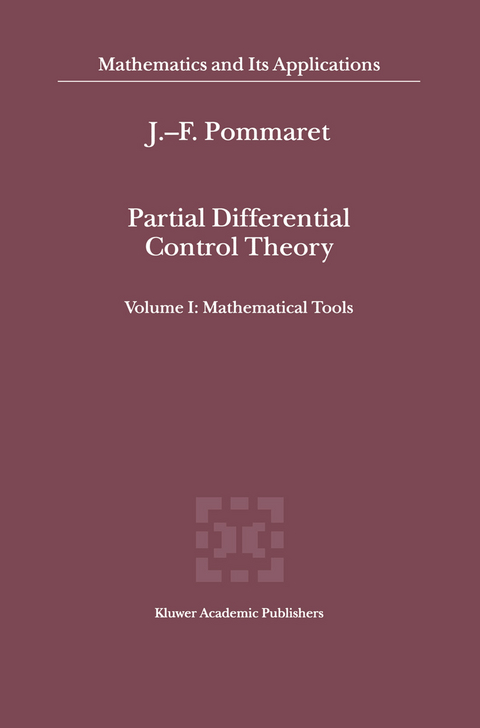
Partial Differential Control Theory
Volume I: Mathematical Tools, Volume II: Control System
Seiten
2014
|
Softcover reprint of the original 1st ed. 2001
Springer (Verlag)
978-94-010-3845-4 (ISBN)
Springer (Verlag)
978-94-010-3845-4 (ISBN)
The mathematical theory of "open" dynamical systems is a creation of the twentieth century. The introduction of input/state/output models led to a tempestuous development that made systems and control into a mature discipline with a wide range of concepts, results, algorithms, and applications.
The mathematical theory of "open" dynamical systems is a creation of the twentieth century. Its humble beginnings focused on ideas of Laplace transforms applied to linear problems of automatic control and to the analysis and synthesis of electrical circuits. However during the second half of the century, it flowered into a field based on an array of sophisticated mathematical concepts and techniques from algebra, nonlinear analysis and differential geometry. The central notion is that of a dynamical system that exchanges matter, energy, or information with its surroundings, i.e. an "open" dynamical system. The mathema tization of this notion evolved considerably over the years. The early development centered around the input/output point of view and led to important results, particularly in controller design. Thinking about open systems as a "black box" that accepts stimuli and produces responses has had a wide influence also in areas outside engineering, for example in biology, psychology, and economics. In the early 1960's, especially through the work of Kalman, input/state/output models came in vogue. This model class accommodates very nicely the internal initial conditions that are essentially always present in a dynamical system. The introduction of input/state/output models led to a tempestuous development that made systems and control into a mature discipline with a wide range of concepts, results, algorithms, and applications.
The mathematical theory of "open" dynamical systems is a creation of the twentieth century. Its humble beginnings focused on ideas of Laplace transforms applied to linear problems of automatic control and to the analysis and synthesis of electrical circuits. However during the second half of the century, it flowered into a field based on an array of sophisticated mathematical concepts and techniques from algebra, nonlinear analysis and differential geometry. The central notion is that of a dynamical system that exchanges matter, energy, or information with its surroundings, i.e. an "open" dynamical system. The mathema tization of this notion evolved considerably over the years. The early development centered around the input/output point of view and led to important results, particularly in controller design. Thinking about open systems as a "black box" that accepts stimuli and produces responses has had a wide influence also in areas outside engineering, for example in biology, psychology, and economics. In the early 1960's, especially through the work of Kalman, input/state/output models came in vogue. This model class accommodates very nicely the internal initial conditions that are essentially always present in a dynamical system. The introduction of input/state/output models led to a tempestuous development that made systems and control into a mature discipline with a wide range of concepts, results, algorithms, and applications.
I Commutative Algebra.- II Homological Algebra.- III Differential Geometry.- IV Differential Algebra.- V Linear Control Systems.- VI Nonlinear Control Systems.
| Erscheint lt. Verlag | 4.12.2014 |
|---|---|
| Reihe/Serie | Mathematics and Its Applications ; 530 | Mathematics and Its Applications ; 530 |
| Zusatzinfo | VIII, 957 p. |
| Verlagsort | Dordrecht |
| Sprache | englisch |
| Maße | 155 x 235 mm |
| Themenwelt | Mathematik / Informatik ► Informatik ► Theorie / Studium |
| Mathematik / Informatik ► Mathematik ► Algebra | |
| Mathematik / Informatik ► Mathematik ► Analysis | |
| Mathematik / Informatik ► Mathematik ► Geometrie / Topologie | |
| ISBN-10 | 94-010-3845-7 / 9401038457 |
| ISBN-13 | 978-94-010-3845-4 / 9789401038454 |
| Zustand | Neuware |
| Informationen gemäß Produktsicherheitsverordnung (GPSR) | |
| Haben Sie eine Frage zum Produkt? |
Mehr entdecken
aus dem Bereich


aus dem Bereich
was jeder über Informatik wissen sollte
Buch | Softcover (2024)
Springer Vieweg (Verlag)
CHF 53,15
Teil 2 der gestreckten Abschlussprüfung Fachinformatiker/-in …
Buch | Softcover (2025)
Europa-Lehrmittel (Verlag)
CHF 37,90


