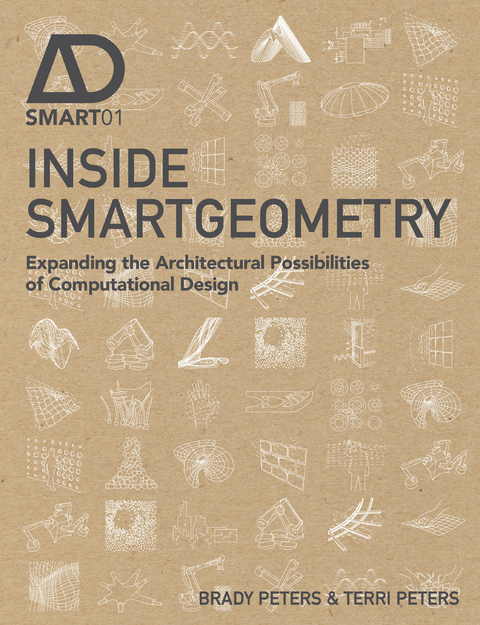
Inside Smartgeometry (eBook)
John Wiley & Sons (Verlag)
978-1-118-78666-6 (ISBN)
Smartgeometry (SG) is a key influence on the architectural community who explore creative computational methods for the design of buildings. An informal international network of practitioners and researchers, the group meets annually to experiment with new technologies and collaborate to develop digital design techniques.
When SG was founded in 2001 by London-based architects and friends Hugh Whitehead (Foster + Partners), J Parrish (AECOM) and Lars Hesselgren (PLP), there was little in the way of parametric tools for architecture. SG was founded to encourage the development, discussion and experimentation of digital design techniques driven by design intent rather than on construction specifications. SG calls for a re-consideration of the design process, where the creation of computational mechanisms become an integral part of designing – not a task done prior to or separate from the process. In the early years of the workshops this need for new ways of design thinking led to the development of Bentley´s GenerativeComponents software. In recent years, the ecology of these design environments has diversified to include multiple software platforms, as well as innovative fabrication techniques and interactive environments. SG has grown accordingly from a handful of experts to an international network of designers who are defining the future of design. Founded by digital pioneers, it creates the algorithmic designers of the future.
Inside Smartgeometry can be seen as a retroactive manifesto for SG, examining and contextualising the work of the SG community: the digital spaces, prototypes and buildings designed using bespoke tools created in response to architectural ideas. From interactive crowd-sourcing tools to responsive agent-based systems to complex digitally fabricated structures, it explores more than a decade of advances that have been influential for architecture. Through 23 original texts including reflections by the founders, and key contributors such as Robert Aish, Martin Bechthold, Mark Burry, Chris Williams and Robert Woodbury, the book offers a critical state of the art of computational design for architecture. Many international design and engineering firms have participated in SG and the book includes chapters by practitioners from offices such as CASE, Design2Production, Foster + Partners, Grimshaw, Populous and SOM.
Smartgeometry (SG) is a key influence on the architectural community who explore creative computational methods for the design of buildings. An informal international network of practitioners and researchers, the group meets annually to experiment with new technologies and collaborate to develop digital design techniques. When SG was founded in 2001 by London-based architects and friends Hugh Whitehead (Foster + Partners), J Parrish (AECOM) and Lars Hesselgren (PLP), there was little in the way of parametric tools for architecture. SG was founded to encourage the development, discussion and experimentation of digital design techniques driven by design intent rather than on construction specifications. SG calls for a re-consideration of the design process, where the creation of computational mechanisms become an integral part of designing not a task done prior to or separate from the process. In the early years of the workshops this need for new ways of design thinking led to the development of Bentley s GenerativeComponents software. In recent years, the ecology of these design environments has diversified to include multiple software platforms, as well as innovative fabrication techniques and interactive environments. SG has grown accordingly from a handful of experts to an international network of designers who are defining the future of design. Founded by digital pioneers, it creates the algorithmic designers of the future. Inside Smartgeometry can be seen as a retroactive manifesto for SG, examining and contextualising the work of the SG community: the digital spaces, prototypes and buildings designed using bespoke tools created in response to architectural ideas. From interactive crowd-sourcing tools to responsive agent-based systems to complex digitally fabricated structures, it explores more than a decade of advances that have been influential for architecture. Through 23 original texts including reflections by the founders, and key contributors such as Robert Aish, Martin Bechthold, Mark Burry, Chris Williams and Robert Woodbury, the book offers a critical state of the art of computational design for architecture. Many international design and engineering firms have participated in SG and the book includes chapters by practitioners from offices such as CASE, Design2Production, Foster + Partners, Grimshaw, Populous and SOM.
Brady Peters is an architect. A PhD fellow at the Centre for Information Technology and Architecture (CITA) in Denmark he was previously an Associate Partner at Foster + Partners and a key member of the Specialist Modelling Group. He has taught at the Royal Danish Academy of Fine Arts, the University of Ghent, the University of Nottingham, and has been a tutor at all Smartgeometry conferences since 2005. He is the co-editor with Xavier De Kestelier of Computation Works: The Building of Algorithmic Thought, Architectural Design (AD) (March/April 2013). Terri Peters is an architect, and writer. A PhD Fellow at the Aarhus School of Architecture in Denmark she researches architectural approaches to sustainable building transformation. Since 2003, she has written more than 200 published articles spanning architecture, sustainability, art, urbanism, technology and culture. She lectures internationally and sits on the jury of various design award panels and competitions. She is the editor of Experimental Green Strategies: Redefining Ecological Design Research, Architectural Design (AD) (November/December 2011).
Foreword 6-7
by Brett Steele
Introduction 8-19
by Brady Peters and Terri Peters
The Origins of Smartgeometry 20-35
by Hugh Whitehead, Lars Hesselgren and J Parrish
First Build Your Tools 36-49
by Robert Aish
Parametric Evolution 50-59
by Branko Kolarevic
Matrix Architecture 60-71
by Jenny E Sabin
Metrics of Human Experience 72-79
by Roly Hudson and Michael Westlake
Interacting with the Model 80-91
by Neil Katz, with Bess Krietemeyer and Tobias Schwinn
Responsive Design: Towards an Ecology of Objects and People
92-101
by Andre Chaszar, Anton Savov, Peter Liebsch and Sascha
Bohnenberger
Design Flow and Tool Flux 102-111
by Robert Woodbury
The Sound of Smartgeometry 112-121
by Brady Peters
Design Exploration and Steering of Design 122-129
by Axel Kilian
Geometry: How Smart Do You Have To Be? 130-141
by Chris Williams
GenerativeComponents and Smartgeometry: Situated Software
Development 142-153
by Volker Mueller and Makai Smith
From Descriptive Geometry to Smartgeometry: First Steps towards
Digital Architecture 154-165
by Mark Burry
EXPLORING Human-Computer Interaction IN DESIGN PROCESS
166-175
by Flora Salim and Przemek Jaworski
Designing Intelligence: DIY Robotics for Responsive Environments
176-185
by Nick Puckett
Encoding Design 186-195
by Fabian Scheurer
Working Prototypes, Creating Knowledge 196-205
by Shane Burger and Xavier De Kestelier
Mind the Gap: Stories of Exchange 206-217
by CASE
Designing Robotic Assemblies 218-231
by Tobias Bonwetsch
The Practice of Smartgeometry 232-241
by Hugh Whitehead
Digital Crafting: Performative Thinking for Material Design
242-253
by Mette Ramsgard Thomsen and Martin Tamke
Design Robotics: New Strategies for Material System Research
254-267
by Martin Bechthold
Contributor Biographies 268-272
INTRODUCTION
BRADY PETERS TERRI PETERS
Smartgeometry (SG) was founded in 2001 as an informal network of designers interested in harnessing the powers of computation for architectural design. Friends and former colleagues Hugh Whitehead, Lars Hesselgren and J Parrish felt frustrated by the lack of resources and network surrounding computation and architecture and sought to redefine ways that architects could use digital tools. At first, the trio of architects drew on their network of friends and collaborators such as computer scientist Robert Aish, academics Robert Woodbury and Axel Kilian, and experimental practitioners architect Mark Burry and engineer Chris Williams to put together a few modest conferences and workshops. These began with a lecture and workshop in 2003 in Cambridge, UK, then in 2004 at the University of Waterloo, Ontario, Canada, where the focus was on software development, new tools for architects and engaging with ideas outside the boundaries of ‘architecture’. These early workshops provided inspiration and a testing ground for the creation of new parametric software GenerativeComponents (GC) that was introduced to the group by Robert Aish and Bentley Systems. Rather than being concerned solely with software or form-making, SG focuses on the creation and application of digital tools and technologies, and in cross-disciplinary fertilisation of emerging ideas in practice. In workshop groups, designers are able to work on projects ‘off the books’, away from their offices or university settings, creating pure explorations of technique beyond the confines of the design project. SG embodied new ideas and new ways of thinking. The event now spans six days, with a four-day curated workshop and two-day public conference, and attracts more than 300 international participants and attendees each year.
1 Design explorations at SG 2006,
Cambridge, UK.
Conceptual geometric design explorations using GenerativeComponents.
WHY GEOMETRY?
Architectural design software at the time SG was founded was created by software developers using object-oriented programming that almost literally translated software ‘objects’ as building ‘objects’. SG co-founder Lars Hesselgren has written that they wanted to build new design tools and founded SG as a rejection of these conservative influences that promoted computer-aided design (CAD) solely as the organisation of building components.1 In order to be free of these predefined tools and have a higher-level discussion of building form in terms of first principles, this led to a discussion of geometry and mathematics. As this is a more generic approach, thinking of architecture and form in this way allowed them to share computational tools between disciplines. It allowed architects to design conceptually and create their own custom ‘objects’ rather than use the specified objects provided by their CAD software.
As Robert Aish explains in his chapter, SG explores the ideas of design computation, with the notion that there is a distinction between the generative description of the building, and the resulting generated model of the building. Therefore SG is more about the exploration of design intent and how this is inscribed in the design tools and the design environment, rather than specific technology for the integrated delivery of building projects. It is about designing a system, rather than working on a more detailed 3D model.
2 ‘Responsive Acoustic Surfaces’ workshop cluster at SG 2011, Copenhagen, Denmark.
Participants engage in a design discussion.
Digital models from the ‘Responsive Acoustic Surfaces’ workshop cluster at SG 2011, Copenhagen, Denmark.
Participants work on digital models of hyperboloid geometry using a variety of software.
‘Use the Force’ workshop cluster at SG 2011, Copenhagen, Denmark.
Participants discuss design and computation.
SG is an agile network. It is purposely structured to be able to react to and reflect ideas in contemporary practice; there is no overriding goal or charter. The idea is to engage with current issues and debates in a collaborative and non-competitive environment. Digital design leads logically to digital fabrication. Over several years, but culminating in 2010 where it was a central feature, the event embraced digital fabrication, interaction and simulation with ‘workshops’ that more equally split experimentation in digital and physical realms. As Xavier De Kestelier and Shane Burger explain in their chapter, the evolving workshop structure is due to shifts in participants and leadership. The earlier events attracted lower numbers of workshop participants and leaders and these were almost exclusively from professional practice. Recent SG events have had multi-day programs with larger audiences and an increased focus on academic and research questions. This shift is discussed in the chapter by CASE, where they identify the move away from the pragmatics of designing for construction of buildings, towards workshops based not only on research and experimentation, which does not necessarily rule out the practical building issues, but also on creative explorations using these same methods. The five current SG Directors are all from architectural practice, but each year attendees and workshop leaders come increasingly from research and academia.
TALKING ABOUT COMPUTATION
‘The most profound technologies are those that disappear. They weave themselves into the fabric of everyday life until they are indistinguishable from them.’2 This statement from computational pioneer Mark Weiser in 1991 is relevant to architectural practice today. Computation is everywhere; should it really be the medium and not the message? Architects desperately need to talk about computation, and over the past decade SG has provided the only experimental workshop-based discussion forum on this topic. It is not enough to say computation is ubiquitous in our field; it is not ‘just’ a tool – there can be no doubt that it is fundamentally changing architecture. Computation is not what architecture is, but if architecture can be understood as a practice, concerned with technique, then computation is a technique intricately connected to designing for meaning and experience in architecture. Even architecture as edifice, separated from any discussion of technique, reveals the tool of the maker. While meaning in architecture can come from symbols and symbolism in the building itself, it also comes from the experience of that building.3 Therefore the better we can simulate the experience of architecture, the better we can design for it. The technologies explored and discussed at SG are still quite visible. However, one hopes they will be customised, tested and engaged with by architects even as they continue to be woven into the fabric of the design environment.
3 Prototypes and analysis from the ‘Responsive Acoustic Surfaces’ workshop cluster at SG 2011, Copenhagen, Denmark.
1:10 scale prototypes were tested for their acoustic performance and this data was used to inform the design of the full-scale prototype wall.
4 Workshops at SG 2011, Copenhagen, Denmark.
View of participants and workshop clusters.
Of course, the mere fact of using a particular computational technique does not guarantee good architecture, the same way that using the same pen as Norman Foster will not guarantee a great building. But why shouldn’t architects share techniques and tools? It would be pretty silly if architects each had to invent our own pens, drafting boards and drawing conventions. So while it is the building that matters most, rather than focusing on the process of design and making, in the context of design it is critical to acknowledge that design processes are changing, and SG is at the forefront of this change.
CREATING KNOWLEDGE AND TECHNIQUE
The ways that computation and architectural design are explored at SG are unique. The idea is to nourish a collaborative environment where participants feel as though anything can happen. The theme of the event is set in advance and then workshop leaders apply to lead a cluster based on their own research: for example, in 2012, 40 detailed applications were submitted for 10 positions. Participants also apply to join workshops, submitting portfolios and statements of interest, with only 100 selected. Carefully curated by the SG community and directors, the selected workshop themes are developed and in the four days, focused questions of design, digital technique and physical making can be explored. In contrast to many other design workshops with traditional student–teacher dynamics, workshop leaders do not bring work they have done earlier to get ‘students’ to build, participants do not come to learn something they know nothing about, and experts do not arrive with ‘answers’ to disseminate. Research and knowledge is created during the workshops. The challenge is not to construct a research question that can be ‘answered’ in four days but rather to construct a line of thinking that can be investigated intelligently and discussed through experimentation. The SG environment is part research and part professionally focused, which seems to inspire productivity, as participants work long into the night to actually do something as a group within the given time, to produce some results to share with the wider group by the end of the workshop, and to work together. In Robert...
| Erscheint lt. Verlag | 12.8.2013 |
|---|---|
| Reihe/Serie | AD Smart |
| AD Smart | AD Smart |
| Sprache | englisch |
| Themenwelt | Informatik ► Weitere Themen ► CAD-Programme |
| Technik ► Architektur | |
| Schlagworte | Annually • Architectural • Architecture • Architektur • Bauentwurf • Building Design • buildings • Community • Computational • Design • design techniques • Experiment • explore creative • Foster • Group • Influence • Informal • international • Key • londonbased • Methods • Network • New • Partners • SG • smartgeometry |
| ISBN-10 | 1-118-78666-1 / 1118786661 |
| ISBN-13 | 978-1-118-78666-6 / 9781118786666 |
| Informationen gemäß Produktsicherheitsverordnung (GPSR) | |
| Haben Sie eine Frage zum Produkt? |
 EPUB (Adobe DRM)
Kopierschutz: Adobe-DRM
Adobe-DRM ist ein Kopierschutz, der das eBook vor Mißbrauch schützen soll. Dabei wird das eBook bereits beim Download auf Ihre persönliche Adobe-ID autorisiert. Lesen können Sie das eBook dann nur auf den Geräten, welche ebenfalls auf Ihre Adobe-ID registriert sind.
Details zum Adobe-DRM
Dateiformat: EPUB (Electronic Publication)
EPUB ist ein offener Standard für eBooks und eignet sich besonders zur Darstellung von Belletristik und Sachbüchern. Der Fließtext wird dynamisch an die Display- und Schriftgröße angepasst. Auch für mobile Lesegeräte ist EPUB daher gut geeignet.
Systemvoraussetzungen:
PC/Mac: Mit einem PC oder Mac können Sie dieses eBook lesen. Sie benötigen eine
eReader: Dieses eBook kann mit (fast) allen eBook-Readern gelesen werden. Mit dem amazon-Kindle ist es aber nicht kompatibel.
Smartphone/Tablet: Egal ob Apple oder Android, dieses eBook können Sie lesen. Sie benötigen eine
Geräteliste und zusätzliche Hinweise
Buying eBooks from abroad
For tax law reasons we can sell eBooks just within Germany and Switzerland. Regrettably we cannot fulfill eBook-orders from other countries.
aus dem Bereich