PHP Objects, Patterns, and Practice (eBook)
XXII, 488 Seiten
Apress (Verlag)
978-1-4302-6032-5 (ISBN)
The next section is devoted to design patterns. These describe common problems and their solutions. The section describes the design principles that make patterns powerful. It covers many of the classic design patterns and includes chapters on enterprise and database patterns.
The last segment of the book covers the tools and practices that can help turn great code into a successful project. The section shows how to manage multiple developers and releases with git, how to build and install using Phing and PEAR. It also explores strategies for automated testing and build.
In addition to discussing the latest developments in build, test, and continuous integration, this section keeps pace with best practice in version control by focusing on Git, increasingly the developer's system of choice.
Taken together these three elements: object fundamentals, design principles, and best practice will help the reader develop elegant and rock solid systems.
PHP Objects and Patterns:
- Describes and demonstrates PHP's built-in object-oriented features
- Breaks down the principles of object-oriented design, explaining key design patterns using practical examples.
- Discusses the tools and practices necessary for developing, testing and deploying exemplary applications.
Matt Zandstra has worked as a web programmer, consultant, and writer for nearly two decades. He is the author of SAMS Teach Yourself PHP in 24 Hours (three editions) and a contributor to DHTML Unleashed. He has written articles for Linux Magazine, Zend.com, IBM DeveloperWorks, and php|architect Magazine, among others. Matt works as a consultant advising companies on their architectures and system management, and also develops systems primarily with PHP, and Java. Matt also writes fiction.
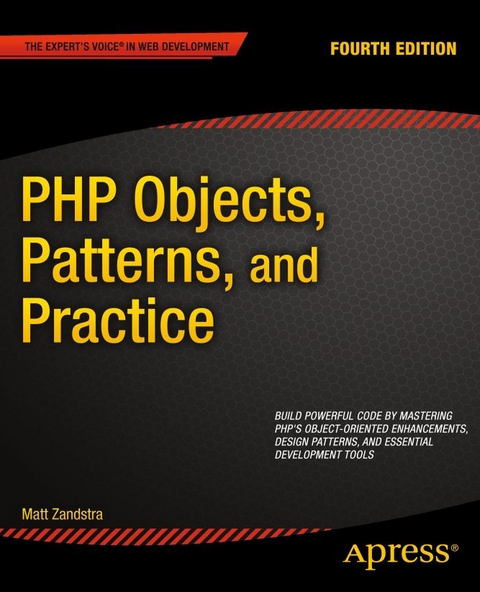
PHP Objects Patterns and Practice, Fourth Edition is revised and updated throughout. The book begins by covering PHP's object-oriented features. It introduces key topics including class declaration, inheritance, reflection and much more. These provide the fundamentals of the PHP's support for objects. It also introduces some principles of design. This edition introduces new object relevant features such as traits, reflection extension additions, callable type hinting, improvements to exception handling, and many smaller language enhancements. The next section is devoted to design patterns. These describe common problems and their solutions. The section describes the design principles that make patterns powerful. It covers many of the classic design patterns and includes chapters on enterprise and database patterns. The last segment of the book covers the tools and practices that can help turn great code into a successful project. The section shows how to manage multiple developers and releases with git, how to build and install using Phing and PEAR. It also explores strategies for automated testing and build. In addition to discussing the latest developments in build, test, and continuous integration, this section keeps pace with best practice in version control by focusing on Git, increasingly the developer's system of choice. Taken together these three elements: object fundamentals, design principles, and best practice will help the reader develop elegant and rock solid systems. PHP Objects and Patterns: Describes and demonstrates PHP's built-in object-oriented features Breaks down the principles of object-oriented design, explaining key design patterns using practical examples. Discusses the tools and practices necessary for developing, testing and deploying exemplary applications.
Matt Zandstra has worked as a web programmer, consultant, and writer for nearly two decades. He is the author of SAMS Teach Yourself PHP in 24 Hours (three editions) and a contributor to DHTML Unleashed. He has written articles for Linux Magazine, Zend.com, IBM DeveloperWorks, and php|architect Magazine, among others. Matt works as a consultant advising companies on their architectures and system management, and also develops systems primarily with PHP, and Java. Matt also writes fiction.
PHP: Design and Management PHP and Objects Object Basics Advanced Features Object Tools Objects and Design What Are Design Patterns? Why Use Them? Some Pattern Principles Generating Objects Patterns for Flexible Object Programming Performing and Representing Tasks Enterprise Patterns Database Patterns Good (and Bad) Practice An Introduction to PEAR and Pyrus Generating Documentation with phpDocumentor Version Control Testing with PHPUnit Automated Build with Phing Continuous Integration Objects, Patterns, and Practice App A: Bibliography App B: A Simple Parser
| Erscheint lt. Verlag | 21.1.2014 |
|---|---|
| Zusatzinfo | XXII, 488 p. 106 illus. |
| Verlagsort | Berkeley |
| Sprache | englisch |
| Themenwelt | Mathematik / Informatik ► Informatik ► Web / Internet |
| ISBN-10 | 1-4302-6032-7 / 1430260327 |
| ISBN-13 | 978-1-4302-6032-5 / 9781430260325 |
| Informationen gemäß Produktsicherheitsverordnung (GPSR) | |
| Haben Sie eine Frage zum Produkt? |
 PDF (Wasserzeichen)
DRM: Digitales Wasserzeichen
Dieses eBook enthält ein digitales Wasserzeichen und ist damit für Sie personalisiert. Bei einer missbräuchlichen Weitergabe des eBooks an Dritte ist eine Rückverfolgung an die Quelle möglich.
Dateiformat: PDF (Portable Document Format)
Mit einem festen Seitenlayout eignet sich die PDF besonders für Fachbücher mit Spalten, Tabellen und Abbildungen. Eine PDF kann auf fast allen Geräten angezeigt werden, ist aber für kleine Displays (Smartphone, eReader) nur eingeschränkt geeignet.
Systemvoraussetzungen:
PC/Mac: Mit einem PC oder Mac können Sie dieses eBook lesen. Sie benötigen dafür einen PDF-Viewer - z.B. den Adobe Reader oder Adobe Digital Editions.
eReader: Dieses eBook kann mit (fast) allen eBook-Readern gelesen werden. Mit dem amazon-Kindle ist es aber nicht kompatibel.
Smartphone/Tablet: Egal ob Apple oder Android, dieses eBook können Sie lesen. Sie benötigen dafür einen PDF-Viewer - z.B. die kostenlose Adobe Digital Editions-App.
Buying eBooks from abroad
For tax law reasons we can sell eBooks just within Germany and Switzerland. Regrettably we cannot fulfill eBook-orders from other countries.
aus dem Bereich