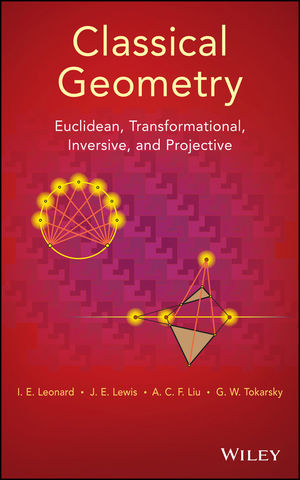
Classical Geometry (eBook)
John Wiley & Sons (Verlag)
978-1-118-67914-2 (ISBN)
Features the classical themes of geometry with plentiful applications in mathematics, education, engineering, and science
Accessible and reader-friendly, Classical Geometry: Euclidean, Transformational, Inversive, and Projective introduces readers to a valuable discipline that is crucial to understanding bothspatial relationships and logical reasoning. Focusing on the development of geometric intuitionwhile avoiding the axiomatic method, a problem solving approach is encouraged throughout.
The book is strategically divided into three sections: Part One focuses on Euclidean geometry, which provides the foundation for the rest of the material covered throughout; Part Two discusses Euclidean transformations of the plane, as well as groups and their use in studying transformations; and Part Three covers inversive and projective geometry as natural extensions of Euclidean geometry. In addition to featuring real-world applications throughout, Classical Geometry: Euclidean, Transformational, Inversive, and Projective includes:
- Multiple entertaining and elegant geometry problems at the end of each section for every level of study
- Fully worked examples with exercises to facilitate comprehension and retention
- Unique topical coverage, such as the theorems of Ceva and Menalaus and their applications
- An approach that prepares readers for the art of logical reasoning, modeling, and proofs
The book is an excellent textbook for courses in introductory geometry, elementary geometry, modern geometry, and history of mathematics at the undergraduate level for mathematics majors, as well as for engineering and secondary education majors. The book is also ideal for anyone who would like to learn the various applications of elementary geometry.
I. E. LEONARD, PHD, is Lecturer in the Department of Mathematical and Statistical Sciences at the University of Alberta, Canada. The author of over fifteen journal articles, his areas of research interest include real analysis and discrete mathematics.
J. E. LEWIS, PHD, is Professor Emeritus in the Department of Mathematical Sciences at the University of Alberta, Canada. He was the recipient of the Faculty of Science Award for Excellence in Teaching in 2004.
A. C. F. LIU, PHD, is Professor in the Department of Mathematical and Statistical Sciences at the University of Alberta, Canada. He has authored over thirty journal articles.
G. W. TOKARSKY, MSC, is Faculty Lecturer in the Department of Mathematical and Statistical Sciences at the University of Alberta, Canada. His areas of research interest include polygonal billiards and symbolic logic.
Features the classical themes of geometry with plentiful applications in mathematics, education, engineering, and science Accessible and reader-friendly, Classical Geometry: Euclidean, Transformational, Inversive, and Projective introduces readers to a valuable discipline that is crucial to understanding bothspatial relationships and logical reasoning. Focusing on the development of geometric intuitionwhile avoiding the axiomatic method, a problem solving approach is encouraged throughout. The book is strategically divided into three sections: Part One focuses on Euclidean geometry, which provides the foundation for the rest of the material covered throughout; Part Two discusses Euclidean transformations of the plane, as well as groups and their use in studying transformations; and Part Three covers inversive and projective geometry as natural extensions of Euclidean geometry. In addition to featuring real-world applications throughout, Classical Geometry: Euclidean, Transformational, Inversive, and Projective includes: Multiple entertaining and elegant geometry problems at the end of each section for every level of study Fully worked examples with exercises to facilitate comprehension and retention Unique topical coverage, such as the theorems of Ceva and Menalaus and their applications An approach that prepares readers for the art of logical reasoning, modeling, and proofs The book is an excellent textbook for courses in introductory geometry, elementary geometry, modern geometry, and history of mathematics at the undergraduate level for mathematics majors, as well as for engineering and secondary education majors. The book is also ideal for anyone who would like to learn the various applications of elementary geometry.
I. E. LEONARD, PHD, is Lecturer in the Department of Mathematical and Statistical Sciences at the University of Alberta, Canada. The author of over fifteen journal articles, his areas of research interest include real analysis and discrete mathematics. J. E. LEWIS, PHD, is Professor Emeritus in the Department of Mathematical Sciences at the University of Alberta, Canada. He was the recipient of the Faculty of Science Award for Excellence in Teaching in 2004. A. C. F. LIU, PHD, is Professor in the Department of Mathematical and Statistical Sciences at the University of Alberta, Canada. He has authored over thirty journal articles. G. W. TOKARSKY, MSC, is Faculty Lecturer in the Department of Mathematical and Statistical Sciences at the University of Alberta, Canada. His areas of research interest include polygonal billiards and symbolic logic.
Preface v
Part I Euclidean Geometry
1 Congruency 3
2 Concurrency 41
3 Similarity 59
4 Theorems of Ceva and Menelaus 95
5 Area 133
6 Miscellaneous Topics 159
Part II Transformational Geometry
7 The Euclidean Transformations or Isometries 207
8 The Algebra of Isometries 235
9 The Product of Direct Isometries 255
10 Symmetry and Groups 271
11 Homotheties 289
12 Tessellations 313
Part III Inversive And Projective Geometries
13 Introduction to Inversive Geometry 339
14 Reciprocation and the Extended Plane 375
15 Cross Ratios 411
16 Introduction to Projective Geometry 435
Bibliography 466
Index 471
"The book is an extremely valuable compendium of
elementary constructions of Euclidean geometry. The text,
especially the proofs, is clearly structured and move forward in
simple steps, and thus are at the one hand very suitable for a
beginner in geometry and at the other hand exemplary for a teacher
of geometry." (Zentralblatt MATH, 1 October
2014)
CHAPTER 1
CONGRUENCY
1.1 Introduction
Assumed Knowledge
This text assumes a bit of knowledge on the part of the reader. For example, it assumes that you know that the sum of the angles of a triangle in the plane is 180° (x + y + z = 180° in the figure below), and that in a right triangle with hypotenuse c and sides a and b, the Pythagorean relation holds: c2 = a2 + b2.
We use the word line to mean straight line, and we assume that you know that two lines either do not intersect, intersect at exactly one point, or completely coincide. Two lines that do not intersect are said to be parallel.
We also assume certain knowledge about parallel lines, namely, that you have seen some form of the parallel axiom:
Given a line l and a point P in the plane, there is exactly one line through P parallel to l.
The preceding version of the parallel axiom is often called Playfair’s Axiom. You may even know something equivalent to it that is close to the original version of the parallel postulate:
Given two lines l and m, and a third line t cutting both l and m and forming angles ϕ and θ on the same side of t, if ϕ + θ < 180°, then l and m meet at a point on the same side oft as the angles.
The subject of this part of the text is Euclidean geometry, and the above-mentioned parallel postulate characterizes Euclidean geometry. Although the postulate may seem to be obvious, there are perfectly good geometries in which it does not hold.
We also assume that you know certain facts about areas. A parallelogram is a quadrilateral (figure with four sides) such that the opposite sides are parallel.
The area of a parallelogram with base b and height h is b · h, and the area of a triangle with base b and height h is b · h/2.
Notation and Terminology
Throughout this text, we use uppercase Latin letters to denote points and lowercase Latin letters to denote lines and rays. Given two points A and B, there is one and only one line through A and B. A ray is a half-line, and the notation denotes the ray starting at A and passing through B. It consists of the points A and B, all points between A and B, and all points X on the line such that B is between A and X.
Given rays and , we denote by ∠BAC the angle formed by the two rays (the shaded region in the following figure). When no confusion can arise, we sometimes use ∠A instead of ∠BAC. We also use lowercase letters, either Greek or Latin, to denote angles.
When two rays form an angle other than 180°, there are actually two angles to talk about: the smaller angle (sometimes called the interior angle) and the larger angle (called the reflex angle). When we refer to ∠BAC, we always mean the nonreflex angle.
Note. The angles that we are talking about here are undirected angles; that is, they do not have negative values, and so can range in magnitude from 0° to 360°. Some people prefer to use m(∠A) for the measure of the angle A; however, we will use the same notation for both the angle and the measure of the angle.
When we refer to a quadrilateral as ABCD we mean one whose edges are AB, BC, CD, and DA, Thus, the quadrilateral ABCD and the quadrilateral ABDC are quite different.
There are three classifications of quadrilaterals: convex, simple, and nonsimple, as shown in the following diagram.
1.2 Congruent Figures
Two figures that have exactly the same shape and exactly the same size are said to be congruent. More explicitly:
Theorem 1.2.1. Vertically opposite angles are congruent.
Proof. We want to show that a = b. We have
and it follows from this that a = b.
Notation. The symbol ≡ denotes congruence. We use the notation ΔABC to denote a triangle with vertices A, B, and C, and we use C(P, r) to denote a circle with center P and radius r.
Thus, C(P, r) ≡ C(Q, s) if and only if r = s.
We will be mostly concerned with the notion of congruent triangles, and we mention that in the definition, ΔABC ≡ ΔDEF if and only if the following six conditions hold:
Note that the two statements ΔABC ≡ ΔDEF and ΔABC ≡ ΔEFD are not the same!
The Basic Congruency Conditions
According to the definition of congruency, two triangles are congruent if and only if six different parts of one are congruent to the six corresponding parts of the other. Do we really need to check all six items? The answer is no.
If you give three straight sticks to one person and three identical sticks to another and ask both to constuct a triangle with the sticks as the sides, you would expect the two triangles to be exactly the same. In other words, you would expect that it is possible to verify congruency by checking that the three corresponding sides are congruent. Indeed this is the case, and, in fact, there are several ways to verify congruency without checking all six conditions.
The three congruency conditions that are used most often are the Side-Angle-Side (SAS) condition, the Side-Side-Side (SSS) condition, and the Angle-Side-Angle (ASA) condition.
Axiom 1.2.2. (SAS Congruency)
Two triangles are congruent if two sides and the included angle of one are congruent to two sides and the included angle of the other.
Theorem 1.2.3. (SSS Congruency)
Two triangles are congruent if the three sides of one are congruent to the corresponding three sides of the other.
Theorem 1.2.4. (ASA Congruency)
Two triangles are congruent if two angles and the included side of one are congruent to two angles and the included side of the other.
You will note that the SAS condition is an axiom, and the other two are stated as theorems. We will not prove the theorems but will freely use all three conditions.
Any one of the three conditions could be used as an axiom with the other two then derived as theorems. In case you are wondering why the SAS condition is preferred as the basic axiom rather than the SSS condition, it is because it is always possible to construct a triangle given two sides and the included angle, whereas it is not always possible to construct a triangle given three sides (consider sides of length 3, 1, and 1).
Axiom 1.2.5. (The Triangle Inequality)
The sum of the lengths of two sides of a triangle is always greater than the length of the remaining side.
The congruency conditions are useful because they allow us to conclude that certain parts of two triangles are congruent by determining that certain other parts are congruent.
Here is how congruency may be used to prove two well-known theorems about isosceles triangles. (An isosceles triangle is one that has two equal sides.)
Theorem 1.2.6. (The Isosceles Triangle Theorem)
In an isosceles triangle, the angles opposite the equal sides are equal.
Proof. Let us suppose that the triangle is ABC with AB = AC.
In ΔABC and ΔACB we have
so ΔABC ≡ ΔACB by SAS.
Since the triangles are congruent, it follows that all corresponding parts are congruent, so ∠B of ΔABC must be congruent to ∠C of ΔACB.
Theorem 1.2.7. (Converse of the Isosceles Triangle Theorem)
If in ΔABC we have ∠B = ∠C, then AB = AC.
Proof. In ΔABC and ΔACB we have
so ΔABC ≡ ΔACB by ASA
Since ΔABC ≡ ΔACB it follows that AB = AC.
Perhaps now is a good time to explain what the converse of a statement is. Many statements in mathematics have the form
where and are assertions of some sort.
For example:
If ABCD is a square, then angles A, B, C, and D are all right angles.
Here, is the assertion “ABCD is a square,” and is the assertion “angles A, B, C, and D are all right...
| Erscheint lt. Verlag | 30.4.2014 |
|---|---|
| Sprache | englisch |
| Themenwelt | Mathematik / Informatik ► Mathematik ► Geometrie / Topologie |
| Technik | |
| Schlagworte | A. C. F. Liu • Applied Mathematics in Science • Bildungswesen • Classical Geometry: Euclidean • Education • Geometrie • Geometrie u. Topologie • Geometry & Topology • G. W. Tokarsky • I. E. Leonard • J. E. Lewis • Lehrpläne / Mathematik • Lehrpläne / Mathematik • Mathematics • Mathematik • Mathematik in den Naturwissenschaften • Transformational, Inversive, and Projective |
| ISBN-10 | 1-118-67914-8 / 1118679148 |
| ISBN-13 | 978-1-118-67914-2 / 9781118679142 |
| Informationen gemäß Produktsicherheitsverordnung (GPSR) | |
| Haben Sie eine Frage zum Produkt? |
 EPUB (Adobe DRM)
Kopierschutz: Adobe-DRM
Adobe-DRM ist ein Kopierschutz, der das eBook vor Mißbrauch schützen soll. Dabei wird das eBook bereits beim Download auf Ihre persönliche Adobe-ID autorisiert. Lesen können Sie das eBook dann nur auf den Geräten, welche ebenfalls auf Ihre Adobe-ID registriert sind.
Details zum Adobe-DRM
Dateiformat: EPUB (Electronic Publication)
EPUB ist ein offener Standard für eBooks und eignet sich besonders zur Darstellung von Belletristik und Sachbüchern. Der Fließtext wird dynamisch an die Display- und Schriftgröße angepasst. Auch für mobile Lesegeräte ist EPUB daher gut geeignet.
Systemvoraussetzungen:
PC/Mac: Mit einem PC oder Mac können Sie dieses eBook lesen. Sie benötigen eine
eReader: Dieses eBook kann mit (fast) allen eBook-Readern gelesen werden. Mit dem amazon-Kindle ist es aber nicht kompatibel.
Smartphone/Tablet: Egal ob Apple oder Android, dieses eBook können Sie lesen. Sie benötigen eine
Geräteliste und zusätzliche Hinweise
Buying eBooks from abroad
For tax law reasons we can sell eBooks just within Germany and Switzerland. Regrettably we cannot fulfill eBook-orders from other countries.
aus dem Bereich