Zum Hauptinhalt springen
Nicht aus der Schweiz? Besuchen Sie lehmanns.de

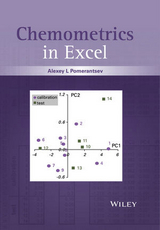
Chemometrics in Excel (eBook)

eBook Download: PDF
2014 | 1. Auflage
333 Seiten
Wiley (Verlag)
9781118873298 (ISBN)

Lese- und Medienproben

Chemometrics in Excel -  Alexey L. Pomerantsev
Systemvoraussetzungen
81,99 inkl. MwSt
(CHF 79,95)
Der eBook-Verkauf erfolgt durch die Lehmanns Media GmbH (Berlin) zum Preis in Euro inkl. MwSt.
  • Download sofort lieferbar
  • Zahlungsarten anzeigen

Providing an easy explanation of the fundamentals, methods, and applications of chemometrics

• Acts as a practical guide to multivariate data analysis techniques
• Explains the methods used in Chemometrics and teaches the reader to perform all relevant calculations
• Presents the basic chemometric methods as worksheet functions in Excel
• Includes Chemometrics Add In for download which uses Microsoft Excel® for chemometrics training
• Online downloads includes workbooks with examples


Alexey L Pomerantsev is a Leading Researcher at The Russian Academy of Science. He is a founding member and Chair of the Russian Chemometrics Society, being instrumental in organizing the annual Winter Symposium on Chemometrics. He is a peer reviewer and member of Editorial Board of the Journal ‘Chemometrics and Intelligent Laboratory Systems.’ Dr. Pomerantsev has over 100 publications, many of them dealing with Chemometric Investigations.
Providing an easy explanation of the fundamentals, methods, and applications of chemometrics Acts as a practical guide to multivariate data analysis techniques Explains the methods used in Chemometrics and teaches the reader to perform all relevant calculations Presents the basic chemometric methods as worksheet functions in Excel Includes Chemometrics Add In for download which uses Microsoft Excel for chemometrics training Online downloads includes workbooks with examples

Alexey L Pomerantsev is a Leading Researcher at The Russian Academy of Science. He is a founding member and Chair of the Russian Chemometrics Society, being instrumental in organizing the annual Winter Symposium on Chemometrics. He is a peer reviewer and member of Editorial Board of the Journal 'Chemometrics and Intelligent Laboratory Systems.' Dr. Pomerantsev has over 100 publications, many of them dealing with Chemometric Investigations.

Cover 1
Title Page 5
Contents 9
Preface 19
Part I Introduction 21
Chapter 1 What is Chemometrics? 23
1.1 Subject of Chemometrics 23
1.2 Historical Digression 25
Chapter 2 What the Book Is About? 28
2.1 Useful Hints 28
2.2 Book Syllabus 29
2.3 Notations 30
Chapter 3 Installation of Chemometrics Add-In 31
3.1 Installation 31
3.2 General Information 34
Chapter 4 Further Reading on Chemometrics 35
4.1 Books 35
4.1.1 The Basics 35
4.1.2 Chemometrics 36
4.1.3 Supplements 36
4.2 The Internet 37
4.2.1 Tutorials 37
4.3 Journals 37
4.3.1 Chemometrics 37
4.3.2 Analytical 38
4.3.3 Mathematical 38
4.4 Software 38
4.4.1 Specialized Packages 38
4.4.2 General Statistic Packages 39
4.4.3 Free Ware 39
Part II The Basics 41
Chapter 5 Matrices and Vectors 43
5.1 The Basics 43
5.1.1 Matrix 43
5.1.2 Simple Matrix Operations 44
5.1.3 Matrices Multiplication 45
5.1.4 Square Matrix 46
5.1.5 Trace and Determinant 47
5.1.6 Vectors 48
5.1.7 Simple Vector Operations 49
5.1.8 Vector Products 49
5.1.9 Vector Norm 50
5.1.10 Angle Between Vectors 50
5.1.11 Vector Representation of a Matrix 50
5.1.12 Linearly Dependent Vectors 51
5.1.13 Matrix Rank 51
5.1.14 Inverse Matrix 51
5.1.15 Pseudoinverse 52
5.1.16 Matrix/endash Vector Product 53
5.2 Advanced Information 53
5.2.1 Systems of Linear Equations 53
5.2.2 Bilinear and Quadratic Forms 54
5.2.3 Positive Definite Matrix 54
5.2.4 Cholesky Decomposition 54
5.2.5 Polar Decomposition 54
5.2.6 Eigenvalues and Eigenvectors 55
5.2.7 Eigenvalues 55
5.2.8 Eigenvectors 55
5.2.9 Equivalence and Similarity 56
5.2.10 Diagonalization 57
5.2.11 Singular Value Decomposition (SVD) 57
5.2.12 Vector Space 58
5.2.13 Space Basis 59
5.2.14 Geometric Interpretation 59
5.2.15 Nonuniqueness of Basis 59
5.2.16 Subspace 60
5.2.17 Projection 60
Chapter 6 Statistics 62
6.1 The Basics 62
6.1.1 Probability 62
6.1.2 Random Value 63
6.1.3 Distribution Function 63
6.1.4 Mathematical Expectation 64
6.1.5 Variance and Standard Deviation 64
6.1.6 Moments 64
6.1.7 Quantiles 65
6.1.8 Multivariate Distributions 65
6.1.9 Covariance and Correlation 65
6.1.10 Function 66
6.1.11 Standardization 66
6.2 Main Distributions 66
6.2.1 Binomial Distribution 66
6.2.2 Uniform Distribution 67
6.2.3 Normal Distribution 68
6.2.4 Chi-Squared Distribution 70
6.2.5 Student's Distribution 72
6.2.6 F-Distribution 73
6.2.7 Multivariate Normal Distribution 74
6.2.8 Pseudorandom Numbers 75
6.3 Parameter Estimation 76
6.3.1 Sample 76
6.3.2 Outliers and Extremes 76
6.3.3 Statistical Population 76
6.3.4 Statistics 77
6.3.5 Sample Mean and Variance 77
6.3.6 Sample Covariance and Correlation 78
6.3.7 Order Statistics 79
6.3.8 Empirical Distribution and Histogram 80
6.3.9 Method of Moments 81
6.3.10 The Maximum Likelihood Method 82
6.4 Properties of the Estimators 82
6.4.1 Consistency 82
6.4.2 Bias 83
6.4.3 Effectiveness 83
6.4.4 Robustness 83
6.4.5 Normal Sample 84
6.5 Confidence Estimation 84
6.5.1 Confidence Region 84
6.5.2 Confidence Interval 85
6.5.3 Example of a Confidence Interval 85
6.5.4 Confidence Intervals for the Normal Distribution 85
6.6 Hypothesis Testing 86
6.6.1 Hypothesis 86
6.6.2 Hypothesis Testing 86
6.6.3 Type I and Type II Errors 87
6.6.4 Example 87
6.6.5 Pearson's Chi-Squared Test 87
6.6.6 F-Test 89
6.7 Regression 90
6.7.1 Simple Regression 90
6.7.2 The Least Squares Method 91
6.7.3 Multiple Regression 92
Conclusion 93
Chapter 7 Matrix Calculations in Excel 94
7.1 Basic Information 94
7.1.1 Region and Language 94
7.1.2 Workbook, Worksheet, and Cell 96
7.1.3 Addressing 97
7.1.4 Range 98
7.1.5 Simple Calculations 98
7.1.6 Functions 98
7.1.7 Important Functions 101
7.1.8 Errors in Formulas 105
7.1.9 Formula Dragging 106
7.1.10 Create a Chart 107
7.2 Matrix Operations 108
7.2.1 Array Formulas 108
7.2.2 Creating and Editing an Array Formula 110
7.2.3 Simplest Matrix Operations 111
7.2.4 Access to the Part of a Matrix 111
7.2.5 Unary Operations 113
7.2.6 Binary Operations 115
7.2.7 Regression 115
7.2.8 Critical Bug in Excel 2003 119
7.2.9 Virtual Array 119
7.3 Extension of Excel Possibilities 120
7.3.1 VBA Programming 120
7.3.2 Example 121
7.3.3 Macro Example 123
7.3.4 User-Defined Function Example 124
7.3.5 Add-Ins 125
7.3.6 Add-In Installation 126
Conclusion 127
Chapter 8 Projection Methods in Excel 128
8.1 Projection Methods 128
8.1.1 Concept and Notation 128
8.1.2 PCA 129
8.1.3 PLS 130
8.1.4 Data Preprocessing 131
8.1.5 Didactic Example 132
8.2 Application of Chemometrics Add-In 133
8.2.1 Installation 133
8.2.2 General 133
8.3 PCA 134
8.3.1 ScoresPCA 134
8.3.2 LoadingsPCA 134
8.4 PLS 136
8.4.1 ScoresPLS 136
8.4.2 UScoresPLS 137
8.4.3 LoadingsPLS 138
8.4.4 WLoadingsPLS 139
8.4.5 QLoadingsPLS 140
8.5 PLS2 141
8.5.1 ScoresPLS2 141
8.5.2 UScoresPLS2 142
8.5.3 LoadingsPLS2 144
8.5.4 WLoadingsPLS2 145
8.5.5 QLoadingsPLS2 146
8.6 Additional Functions 147
8.6.1 MIdent 147
8.6.2 MIdentD2 147
8.6.3 MCutRows 149
8.6.4 MTrace 149
Conclusion 150
Part III Chemometrics 151
Chapter 9 Principal Component Analysis (PCA) 153
9.1 The Basics 153
9.1.1 Data 153
9.1.2 Intuitive Approach 154
9.1.3 Dimensionality Reduction 156
9.2 Principal Component Analysis 156
9.2.1 Formal Specifications 156
9.2.2 Algorithm 157
9.2.3 PCA and SVD 157
9.2.4 Scores 158
9.2.5 Loadings 159
9.2.6 Data of Special Kind 160
9.2.7 Errors 160
9.2.8 Validation 163
9.2.9 Decomposition ``Quality'' 163
9.2.10 Number of Principal Components 164
9.2.11 The Ambiguity of PCA 165
9.2.12 Data Preprocessing 166
9.2.13 Leverage and Deviation 166
9.3 People and Countries 166
9.3.1 Example 166
9.3.2 Data 167
9.3.3 Data Exploration 167
9.3.4 Data Pretreatment 168
9.3.5 Scores and Loadings Calculation 169
9.3.6 Scores Plots 171
9.3.7 Loadings Plot 172
9.3.8 Analysis of Residuals 173
Conclusion 173
Chapter 10 Calibration 176
10.1 The Basics 176
10.1.1 Problem Statement 176
10.1.2 Linear and Nonlinear Calibration 177
10.1.3 Calibration and Validation 178
10.1.4 Calibration ``Quality'' 180
10.1.5 Uncertainty, Precision, and Accuracy 182
10.1.6 Underfitting and Overfitting 183
10.1.7 Multicollinearity 184
10.1.8 Data Preprocessing 186
10.2 Simulated Data 186
10.2.1 The Principle of Linearity 186
10.2.2 ``Pure'' Spectra 186
10.2.3 ``Standard'' Samples 186
10.2.4 X Data Creation 187
10.2.5 Data Centering 188
10.2.6 Data Overview 188
10.3 Classic Calibration 189
10.3.1 Univariate (Single Channel) Calibration 189
10.3.2 The Vierordt Method 192
10.3.3 Indirect Calibration 194
10.4 Inverse Calibration 196
10.4.1 Multiple Linear Calibration 197
10.4.2 Stepwise Calibration 198
10.5 Latent Variables Calibration 200
10.5.1 Projection Methods 200
10.5.2 Latent Variables Regression 204
10.5.3 Implementation of Latent Variable Calibration 205
10.5.4 Principal Component Regression (PCR) 206
10.5.5 Projection on the Latent Structures-1 (PLS1) 208
10.5.6 Projection on the Latent Structures-2 (PLS2) 211
10.6 Methods Comparison 213
Conclusion 217
Chapter 11 Classification 218
11.1 The Basics 218
11.1.1 Problem Statement 218
11.1.2 Types of Classes 219
11.1.3 Hypothesis Testing 219
11.1.4 Errors in Classification 220
11.1.5 One-Class Classification 220
11.1.6 Training and Validation 221
11.1.7 Supervised and Unsupervised Training 221
11.1.8 The Curse of Dimensionality 221
11.1.9 Data Preprocessing 221
11.2 Data 222
11.2.1 Example 222
11.2.2 Data Subsets 223
11.2.3 Workbook Iris.xls 224
11.2.4 Principal Component Analysis 225
11.3 Supervised Classification 225
11.3.1 Linear Discriminant Analysis (LDA) 225
11.3.2 Quadratic Discriminant Analysis (QDA) 230
11.3.3 PLS Discriminant Analysis (PLSDA) 234
11.3.4 SIMCA 237
11.3.5 k-Nearest Neighbors (kNN) 243
11.4 Unsupervised Classification 245
11.4.1 PCA Again (Revisited) 245
11.4.2 Clustering by K-Means 245
Conclusion 249
Chapter 12 Multivariate Curve Resolution 250
12.1 The Basics 250
12.1.1 Problem Statement 250
12.1.2 Solution Ambiguity 252
12.1.3 Solvability Conditions 254
12.1.4 Two Types of Data 255
12.1.5 Known Spectrum or Profile 256
12.1.6 Principal Component Analysis (PCA) 256
12.1.7 PCA and MCR 257
12.2 Simulated Data 257
12.2.1 Example 257
12.2.2 Data 258
12.2.3 PCA 258
12.2.4 The HELP Plot 260
12.3 Factor Analysis 261
12.3.1 Procrustes Analysis 261
12.3.2 Evolving Factor Analysis (EFA) 264
12.3.3 Windows Factor Analysis (WFA) 266
12.4 Iterative Methods 269
12.4.1 Iterative Target Transform Factor Analysis (ITTFA) 269
12.4.2 Alternating Least Squares (ALS) 270
Conclusion 272
Part IV Supplements 275
Chapter 13 Extension Of Chemometrics Add-In 277
13.1 Using Virtual Arrays 277
13.1.1 Simulated Data 277
13.1.2 Virtual Array 279
13.1.3 Data Preprocessing 279
13.1.4 Decomposition 280
13.1.5 Residuals Calculation 280
13.1.6 Eigenvalues Calculation 282
13.1.7 Orthogonal Distances Calculation 283
13.1.8 Leverages Calculation 284
13.2 Using VBA Programming 285
13.2.1 VBA Advantages 285
13.2.2 Virtualization of Real Arrays 285
13.2.3 Data Preprocessing 286
13.2.4 Residuals Calculation 287
13.2.5 Eigenvalues Calculation 288
13.2.6 Orthogonal Distances Calculation 289
13.2.7 Leverages Calculation 290
Conclusion 291
Chapter 14 Kinetic Modeling of Spectral Data 292
14.1 The ``Grey'' Modeling Method 292
14.1.1 Problem Statement 292
14.1.2 Example 294
14.1.3 Data 294
14.1.4 Soft Method of Alternating Least Squares (Soft-ALS) 295
14.1.5 Hard Method of Alternating Least Squares (Hard-ALS) 297
14.1.6 Using Solver Add-In 299
Conclusions 302
Chapter 15 MATLAB® Beginner's Guide 303
15.1 The Basics 303
15.1.1 Workspace 303
15.1.2 Basic Calculations 305
15.1.3 Echo 305
15.1.4 Workspace Saving: MAT-Files 306
15.1.5 Diary 306
15.1.6 Help 307
15.2 Matrices 307
15.2.1 Scalars, Vectors, and Matrices 307
15.2.2 Accessing Matrix Elements 309
15.2.3 Basic Matrix Operations 309
15.2.4 Special Matrices 310
15.2.5 Matrix Calculations 312
15.3 Integrating Excel and MATLAB® 314
15.3.1 Configuring Excel 314
15.3.2 Data Exchange 314
15.4 Programming 315
15.4.1 M-Files 315
15.4.2 Script File 316
15.4.3 Function File 317
15.4.4 Plotting 318
15.4.5 Plot Printing 320
15.5 Sample Programs 321
15.5.1 Centering and Scaling 321
15.5.2 SVD/PCA 321
15.5.3 PCA/NIPALS 322
15.5.4 PLS1 323
15.5.5 PLS2 324
Conclusion 326
The Fourth Paradigm 327
Index 331

"The book is for sure very interesting and very well written, and it covers all the major topics of chemometrics." (Journal of Chemometrics, 14 July 2015)

Erscheint lt. Verlag 23.4.2014
Sprache englisch
Themenwelt Mathematik / Informatik Mathematik Angewandte Mathematik
Naturwissenschaften Chemie Analytische Chemie
Technik
Schlagworte Analytical Chemistry • Analytische Chemie • chemical engineering • Chemie • Chemische Verfahrenstechnik • Chemistry • Chemometrik • Computational & Graphical Statistics • Rechnergestützte u. graphische Statistik • Rechnergestützte u. graphische Statistik • Statistics • Statistik
ISBN-13 9781118873298 / 9781118873298
Informationen gemäß Produktsicherheitsverordnung (GPSR)
Haben Sie eine Frage zum Produkt?
PDFPDF (Adobe DRM)

Kopierschutz: Adobe-DRM
Adobe-DRM ist ein Kopierschutz, der das eBook vor Mißbrauch schützen soll. Dabei wird das eBook bereits beim Download auf Ihre persönliche Adobe-ID autorisiert. Lesen können Sie das eBook dann nur auf den Geräten, welche ebenfalls auf Ihre Adobe-ID registriert sind.
Details zum Adobe-DRM

Dateiformat: PDF (Portable Document Format)
Mit einem festen Seiten­layout eignet sich die PDF besonders für Fach­bücher mit Spalten, Tabellen und Abbild­ungen. Eine PDF kann auf fast allen Geräten ange­zeigt werden, ist aber für kleine Displays (Smart­phone, eReader) nur einge­schränkt geeignet.

Systemvoraussetzungen:
PC/Mac: Mit einem PC oder Mac können Sie dieses eBook lesen. Sie benötigen eine Adobe-ID und die Software Adobe Digital Editions (kostenlos). Von der Benutzung der OverDrive Media Console raten wir Ihnen ab. Erfahrungsgemäß treten hier gehäuft Probleme mit dem Adobe DRM auf.
eReader: Dieses eBook kann mit (fast) allen eBook-Readern gelesen werden. Mit dem amazon-Kindle ist es aber nicht kompatibel.
Smartphone/Tablet: Egal ob Apple oder Android, dieses eBook können Sie lesen. Sie benötigen eine Adobe-ID sowie eine kostenlose App.
Geräteliste und zusätzliche Hinweise

Buying eBooks from abroad
For tax law reasons we can sell eBooks just within Germany and Switzerland. Regrettably we cannot fulfill eBook-orders from other countries.

Mehr entdecken
aus dem Bereich
Trigonometrie, Analytische Geometrie, Algebra, Wahrscheinlichkeit

von Walter Strampp

eBook Download (2024)
De Gruyter (Verlag)
CHF 89,95

von Siegfried Völkel; Horst Bach; Jürgen Schäfer …

eBook Download (2024)
Carl Hanser Verlag GmbH & Co. KG
CHF 34,15