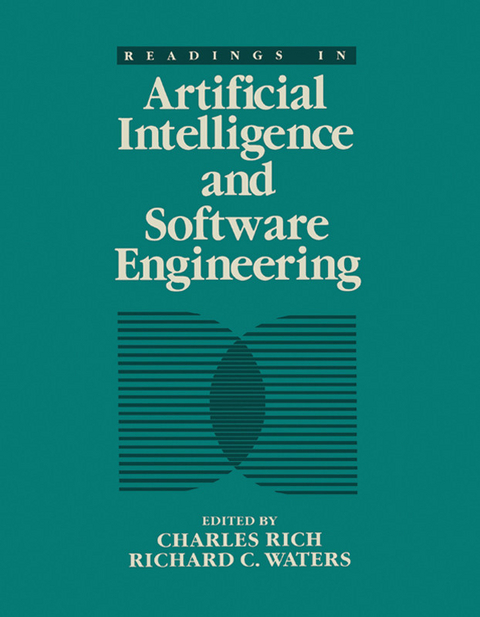
Readings in Artificial Intelligence and Software Engineering (eBook)
624 Seiten
Elsevier Science (Verlag)
978-1-4832-1442-9 (ISBN)
Readings in Artificial Intelligence and Software Engineering covers the main techniques and application of artificial intelligence and software engineering. The ultimate goal of artificial intelligence applied to software engineering is automatic programming. Automatic programming would allow a user to simply say what is wanted and have a program produced completely automatically. This book is organized into 11 parts encompassing 34 chapters that specifically tackle the topics of deductive synthesis, program transformations, program verification, and programming tutors. The opening parts provide an introduction to the key ideas to the deductive approach, namely the correspondence between theorems and specifications and between constructive proofs and programs. These parts also describes automatic theorem provers whose development has be designed for the programming domain. The subsequent parts present generalized program transformation systems, the problems involved in using natural language input, the features of very high level languages, and the advantages of the programming by example system. Other parts explore the intelligent assistant approach and the significance and relation of programming knowledge in other programming system. The concluding parts focus on the features of the domain knowledge system and the artificial intelligence programming. Software engineers and designers and computer programmers, as well as researchers in the field of artificial intelligence will find this book invaluable.
ACKNOWLEDGMENTS
The editors would like to thank Cristina Ciro for her help in preparing the bibliography and index, and Robert Balzer, David R. Barstow, Daniel Bobrow, Martin Feather, Susan Gerhart, Cordell Green, Sol Greenspan, Elaine Kant, Jack Mostow, Beau Sheil, Elliot Soloway, and Richard Waldinger for their comments on chapter selections.
The editors would also like to thank the publishers and authors for permission to reprint copyrighted material in this volume:
Figure 1 (of the introduction) is reprinted from CACM 1(4), 1958, p. 8. Courtesy of the Association for Computing Machinery, Inc.
Zohar Manna and Richard Waldinger, “A Deductive Approach to Program Synthesis,” ACM Trans. on Prog. Lang. and Sys. 2(1), 1980, 90–121. Copyright © 1980, Association for Computing Machinery, Inc. All rights reserved. Reprinted by permission of ACM and the authors.
Douglas R. Smith, “Top-Down Synthesis of Divide-and-Conquer Algorithms,” Artificial Intelligence 27(1), 1985, 43–96. Copyright © 1985, North-Holland Publishing Company. All rights reserved. Reprinted by permission of North-Holland and the author.
Donald I. Good, “Mechanical Proofs About Computer Programs,” Philos. Trans. R. Soc. Lond. 312(1522), 1984, 389–409. Copyright © 1984, Royal Society of London. All rights reserved. Reprinted by permission of the Royal Society of London and the author.
Robert S. Boyer and J Strother Moore, “Proof Checking the RSA Public Key Encryption Algorithm,” The American Mathematical Monthly 91(3), 1984, 181–189. Copyright © 1984, The Mathematical Association of America. Reprinted with the permission of the MAA and authors.
John Darlington, “An Experimental Program Transformation and Synthesis System,” Artificial Intelligence 16, 1981, 1–46. Copyright © 1981, North-Holland Publishing Company. All rights reserved. Reprinted by permission of North-Holland and the authors.
Manfred Broy and Peter Pepper, “Program Development as a Formal Activity,” IEEE Trans. on Software Eng. SE-7(1), 1981, 14–22. Copyright © 1981, IEEE. All rights reserved. Reprinted by permission of IEEE and the authors.
David R. Barstow, “An Experiment in Knowledge-Based Automatic Programming,” Artificial Intelligence 12, 1979, 73–119. Copyright © 1979, North-Holland Publishing Company. All rights reserved. Reprinted by permission of North-Holland and the authors.
Elaine Kant, “On the Efficient Synthesis of Efficient Programs,” Artificial Intelligence 20, 1983, 253–306. Copyright © 1983, North-Holland Publishing Company. All rights reserved. Reprinted by permission of North-Holland and the author.
Thomas E. Cheatham, Jr., “Reusability Through Program Transformations,” IEEE Trans. on Software Eng. SE-10(5), 1984, 589–594. Copyright © 1984, IEEE. All rights reserved. Reprinted by permission of IEEE and the author.
David S. Wile, “Program Developments: Formal Explanations of Implementations,” CACM 26(11), 1983, 902–911. Copyright © 1983, Association for Computing Machinery, Inc. All rights reserved. Reprinted by permission of ACM and the author.
George E. Heidorn, “Automatic Programming Through Natural Language Dialogue: A Survey,” IBM J. Res. Develop. 20(4), 1976, 302–313. Copyright © 1976, International Business Machines Corporation. All rights reserved. Reprinted by permission of IBM and the author.
Gregory R. Ruth, “Protosystem I: An Automatic Programming System Prototype,” AFIPS Conference Proceedings, National Computer Conference, Anaheim, CA, 1978, 675–681. Copyright © 1978, AFIPS. All rights reserved. Reprinted by permission of AFIPS and the author.
Robert M. Balzer, Neil Goldman, and David Wile, “Informality in Program Specifications,” IEEE Trans. on Software Eng. SE-4(2), 1978, 94–103. Copyright © 1978, IEEE. All rights reserved. Reprinted by permission of IEEE and the authors.
Edmund Schonberg, Jacob T. Schwartz, and Micha Sharir, “An Automatic Technique for Selection of Data Representations in SETL Programs,” ACM Trans. on Prog. Lang. and Sys. 3(2), 1981, 126–143. Copyright © 1981, Association for Computing Machinery, Inc. All rights reserved. Reprinted by permission of ACM and the authors.
Lawrence A. Rowe and Fred M. Tonge, “Automating the Selection of Implementation Structures,” IEEE Trans. on Software Eng. SE-4(6), 1978, 494–506. Copyright © 1978, IEEE. All rights reserved. Reprinted by permission of IEEE and the authors.
Cordell Green and Stephen Westfold, “Knowledge-Based Programming Self Applied,” Machine Intelligence 10, Chichester: Ellis Horwood Ltd, Halsted Press, 1982, Copyright © 1982, Ellis Horwood Ltd. All rights reserved. Reprinted by permission of Ellis Horwood and the authors.
Martin S. Feather and Phillip E. London, “Implementing Specification Freedoms,” Science of Computer Programming 2, 91–131, Amsterdam: North-Holland Publishing Company, 1982. Copyright © 1982, North-Holland Publishing Company. All rights reserved. Reprinted by permission of North-Holland and the authors.
Phillip D. Summers, “A Methodology for LISP Program Construction from Examples,” JACM 24(1), 1977, 161–175. Copyright © 1977, Association for Computing Machinery, Inc. All rights reserved. Reprinted by permission of ACM and the author.
Michael A. Bauer, “Programming by Examples,” Artificial Intelligence 12, 1979, 1–21. Copyright © 1979, North-Holland Publishing Company. All rights reserved. Reprinted by permission of North-Holland and the authors.
Robert W. Floyd, “Toward Interactive Design of Correct Programs,” Information Processing 71, 1971, 7–11. Copyright © 1971, North-Holland Publishing Company. All rights reserved. Reprinted by permission of North-Holland and the author.
Mark S. Moriconi, “A Designer/Verifier’s Assistant,” IEEE Trans. on Software Eng. SE-5(4), 1979, 387–401. Copyright © 1979, IEEE. All rights reserved. Reprinted by permission of IEEE and the author.
Richard C. Waters, “The Programmer’s Apprentice: A Session with KBEmacs,” IEEE Trans. on Software Eng. SE-11(11), 1985, 1296–1320. Copyright © 1985, IEEE. All rights reserved. Reprinted by permission of IEEE and the authors.
Cordell Green, David Luckham, Robert Balzer, Thomas Cheatham, and Charles Rich, “Report on a Knowledge-Based Software Assistant,” Rome Air Development Center, Technical Report RADC-TR-83-195, 1983, 1–50. This article is the final report written by Kestrel Institute for the Rome Air Development Center on contract F30602-81-C-0206. Opinions expressed therein, unless otherwise specifically indicated, are those of the authors. They do not purport to express the views of the Rome Air Development Center, the Air Force Systems Command, the Department of the Air Force or any other department or agency of the United States Government. The report is available from the National Technical Information Service under the accession number AD-A134699. Only portions of the report are included here: the title page, table of contents, abstract, pages 1–5 and 7–50, acknowledgments and references. Reprinted by permission of Rome Air Development Center and the authors.
Gregory R. Ruth, “Intelligent Program Analysis,” Artificial Intelligence 7, 1976, 65–85. Copyright © 1976, North-Holland Publishing Company. All rights reserved. Reprinted by permission of North-Holland and the author.
W. Lewis Johnson and Elliot Soloway, “PROUST: Knowledge-Based Program Understanding,” IEEE Trans. on Software Eng. SE-11(3), 1985, 267–275. Copyright © 1985, IEEE. All rights reserved. Reprinted by permission of IEEE and the authors.
Cordell Green and David R. Barstow, “On Program Synthesis Knowledge,” Artificial Intelligence 10, 1978, 241–279. Copyright © 1978, North-Holland Publishing Company. All rights reserved. Reprinted by permission of North-Holland and the authors.
Nachum Dershowitz, “Program Abstraction and Instantiation,” ACM Trans. on Prog. Lang. and Sys. 7(3), 1985, 446–477. Copyright © 1985, Association...
| Erscheint lt. Verlag | 28.6.2014 |
|---|---|
| Sprache | englisch |
| Themenwelt | Mathematik / Informatik ► Informatik |
| Technik ► Bauwesen | |
| ISBN-10 | 1-4832-1442-7 / 1483214427 |
| ISBN-13 | 978-1-4832-1442-9 / 9781483214429 |
| Informationen gemäß Produktsicherheitsverordnung (GPSR) | |
| Haben Sie eine Frage zum Produkt? |
 EPUB (Adobe DRM)
Kopierschutz: Adobe-DRM
Adobe-DRM ist ein Kopierschutz, der das eBook vor Mißbrauch schützen soll. Dabei wird das eBook bereits beim Download auf Ihre persönliche Adobe-ID autorisiert. Lesen können Sie das eBook dann nur auf den Geräten, welche ebenfalls auf Ihre Adobe-ID registriert sind.
Details zum Adobe-DRM
Dateiformat: EPUB (Electronic Publication)
EPUB ist ein offener Standard für eBooks und eignet sich besonders zur Darstellung von Belletristik und Sachbüchern. Der Fließtext wird dynamisch an die Display- und Schriftgröße angepasst. Auch für mobile Lesegeräte ist EPUB daher gut geeignet.
Systemvoraussetzungen:
PC/Mac: Mit einem PC oder Mac können Sie dieses eBook lesen. Sie benötigen eine
eReader: Dieses eBook kann mit (fast) allen eBook-Readern gelesen werden. Mit dem amazon-Kindle ist es aber nicht kompatibel.
Smartphone/Tablet: Egal ob Apple oder Android, dieses eBook können Sie lesen. Sie benötigen eine
Geräteliste und zusätzliche Hinweise
Buying eBooks from abroad
For tax law reasons we can sell eBooks just within Germany and Switzerland. Regrettably we cannot fulfill eBook-orders from other countries.
aus dem Bereich