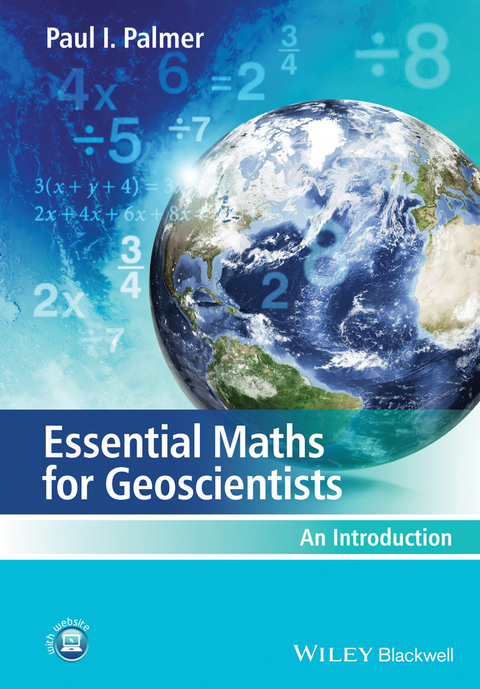
Essential Maths for Geoscientists (eBook)
John Wiley & Sons (Verlag)
978-1-118-52700-9 (ISBN)
Maths for Geoscientists is an accessible, student-friendly introduction to the essential mathematics required by those students taking degree courses within the Geosciences. Clearly structured throughout, this book carefully guides the student step by step through the mathematics they will encounter and will provide numerous applied examples throughout to enhance students understanding and to place each technique into context.
Opening with a chapter explaining the need for studying mathematics within geosciences the book then moves on to cover algebra, equations, solutions, logarithms and exponentials, statistics and probability, trigonometry, vectors and calculus. The final chapter helps to bring it all together and provides the students with sample projects to test their knowledge. Worked applied examples are included in each chapter along with applied problem questions which are a mix of straightforward maths questions, word questions (developing maths to words), and more involved questions that involve the manipulation and interpretation of real and synthetic data.
Essential Maths for Geoscientists An Introduction Essential Maths for Geoscientists: An Introduction is an accessible, student-friendly introduction to the mathematics required by those students taking degree courses within the geosciences. Clearly structured throughout, this book carefully guides students step by step through the first mathematics they will encounter and provides numerous applied examples throughout to enhance students understanding and to place each technique in context. Opening with a chapter explaining the need for studying mathematics within geosciences, this book then moves on to cover algebra, solving equations, logarithms and exponentials, uncertainties, errors and statistics, trigonometry, vectors and basic calculus. The final chapter helps to bring the subject all together and provides detailed applied questions to test students knowledge. Worked applied examples are included in each chapter along with applied problem questions which are a mix of straightforward maths questions, word questions and more involved questions that involve the manipulation and interpretation of real and synthetic data. The emphasis in the book is on the application of relatively rudimentary mathematics to real-life scientific problems within the geosciences, enabling students to make use of current-day research problems and real datasets.
Paul I. Palmer School of Geosciences, University of Edinburgh, UK
Essential Maths for Geoscientists 3
Contents 9
Preface 13
1 How Do You Know that Global Warming Is Not a Hoax? 15
The Earth system: how do we know what we know? 16
2 Preamble 21
2.1 The scientific method: pushing back the frontiers of ignorance 21
2.2 Subscript and superscripts 23
2.3 Scientific number format 24
2.4 Significant figures and rounding numbers 26
2.5 Units and dimensions 27
Unit conversion 28
2.6 Symbols and numbers 28
2.7 Mean, median and variance: commonly encountered statistics 29
2.8 Guesstimation 33
2.9 Exercises 35
3 Algebra 51
3.1 Introduction 51
3.2 Evaluating algebraic equations 51
3.2.1 Preamble: symbols and numbers 51
3.2.2 Powers, roots and bases 52
3.3 Simplifying algebraic equations 53
Removing brackets 57
3.4 Factorization 58
3.4.1 Factorizing quadratic equations 60
3.5 Transposing formulae 60
3.6 Word problems 63
3.7 Exercises 64
4 Solving Equations 67
4.1 Solving linear equations 67
4.1.1 Graphically 68
4.1.2 Analytically 72
4.2 Solving simultaneous equations 72
4.3 Solving quadratic equations 73
4.3.1 Square roots 74
4.3.2 Completing the square 74
4.4 Exercises 76
5 Logarithms and Exponentials 81
5.1 Exponentials 81
5.2 Logarithms 81
5.2.1 Logarithm laws 82
5.2.2 Solving exponential equations 83
5.2.3 Power laws and scaling exponents 83
5.3 Log-normal and log–log plots: when and how to use them 86
5.4 Exercises 88
6 Uncertainties, Errors, and Statistics 91
6.1 Errors 91
6.1.1 Important definitions 92
6.1.2 Measures of error 94
6.2 Combining errors 97
6.2.1 Equations with one variable 97
6.2.2 Equations with two or more variables 98
6.2.3 Linear equations 98
6.2.4 Products 99
6.2.5 Combining results of different experiments 100
6.5 Exercises 107
6.3 Statistics 101
6.3.1 Graphs 101
6.3.2 Descriptive statistics 103
6.4 Correlations 105
6.5 Exercises 107
7 Trigonometry 109
7.1 Some geoscience applications of trigonometry 109
7.2 Anatomy of a triangle 110
7.3 Angles: degrees and radians 113
7.4 Calculating angles given a trigonometric ratio 114
7.5 Cosine and sine rules for non-right-angled triangles 115
7.6 Exercises 115
8 Vectors 119
8.1 What is a vector? 119
8.2 Resolving a vector 119
8.3 Vector algebra 121
8.3.1 Adding and subtracting vectors 121
8.3.2 Multiplying a vector by a scalar 121
8.3.3 The resultant of two perpendicular vectors 121
8.4 Resolving non-perpendicular vectors 122
8.5 Exercises 124
9 Calculus 1: Differentiation 127
9.1 A graphical interpretation of differentiation 128
9.2 A general formula for differentiation 130
9.3 The derivative of some common functions 132
9.4 Differentiation of the sum and difference of functions 132
9.5 Higher derivatives 134
9.6 Maxima and minima 134
9.7 Exercises 136
10 Calculus 2: Integration 139
10.1 Introduction 139
10.2 Definite integrals 141
Area under a curve 141
10.3 Numerical integration 143
10.4 Exercises 144
11 Bringing It All Together 147
A Answers to Problems 157
A.1 Chapter 2: Preamble 157
A.2 Chapter 3: Algebra 162
A.3 Chapter 4: Solving Equations 166
A.4 Chapter 5: Logarithms and Exponentials 172
A.5 Chapter 6: Uncertainties, Errors, and Statistics 176
A.6 Chapter 7: Trigonometry 180
A.7 Chapter 8: Vectors 185
A.8 Chapter 9: Differentiation 188
A.9 Chapter 10: Integration 193
A.10 Chapter 11: Bringing it all together 196
B A Brief Note on Excel 211
C Further Reading 213
Index 215
| Erscheint lt. Verlag | 11.4.2014 |
|---|---|
| Sprache | englisch |
| Themenwelt | Mathematik / Informatik ► Mathematik |
| Naturwissenschaften ► Geowissenschaften ► Geologie | |
| Naturwissenschaften ► Geowissenschaften ► Geophysik | |
| Technik | |
| Schlagworte | Applied Mathematics in Science • earth sciences • Geologie u. Geophysik • Geology & Geophysics • Geowissenschaften • Mathematics • Mathematik • Mathematik in den Naturwissenschaften |
| ISBN-10 | 1-118-52700-3 / 1118527003 |
| ISBN-13 | 978-1-118-52700-9 / 9781118527009 |
| Informationen gemäß Produktsicherheitsverordnung (GPSR) | |
| Haben Sie eine Frage zum Produkt? |
 EPUB (Adobe DRM)
Größe: 5,9 MB
Kopierschutz: Adobe-DRM
Adobe-DRM ist ein Kopierschutz, der das eBook vor Mißbrauch schützen soll. Dabei wird das eBook bereits beim Download auf Ihre persönliche Adobe-ID autorisiert. Lesen können Sie das eBook dann nur auf den Geräten, welche ebenfalls auf Ihre Adobe-ID registriert sind.
Details zum Adobe-DRM
Dateiformat: EPUB (Electronic Publication)
EPUB ist ein offener Standard für eBooks und eignet sich besonders zur Darstellung von Belletristik und Sachbüchern. Der Fließtext wird dynamisch an die Display- und Schriftgröße angepasst. Auch für mobile Lesegeräte ist EPUB daher gut geeignet.
Systemvoraussetzungen:
PC/Mac: Mit einem PC oder Mac können Sie dieses eBook lesen. Sie benötigen eine
eReader: Dieses eBook kann mit (fast) allen eBook-Readern gelesen werden. Mit dem amazon-Kindle ist es aber nicht kompatibel.
Smartphone/Tablet: Egal ob Apple oder Android, dieses eBook können Sie lesen. Sie benötigen eine
Geräteliste und zusätzliche Hinweise
Zusätzliches Feature: Online Lesen
Dieses eBook können Sie zusätzlich zum Download auch online im Webbrowser lesen.
Buying eBooks from abroad
For tax law reasons we can sell eBooks just within Germany and Switzerland. Regrettably we cannot fulfill eBook-orders from other countries.
 PDF (Adobe DRM)
Kopierschutz: Adobe-DRM
Adobe-DRM ist ein Kopierschutz, der das eBook vor Mißbrauch schützen soll. Dabei wird das eBook bereits beim Download auf Ihre persönliche Adobe-ID autorisiert. Lesen können Sie das eBook dann nur auf den Geräten, welche ebenfalls auf Ihre Adobe-ID registriert sind.
Details zum Adobe-DRM
Dateiformat: PDF (Portable Document Format)
Mit einem festen Seitenlayout eignet sich die PDF besonders für Fachbücher mit Spalten, Tabellen und Abbildungen. Eine PDF kann auf fast allen Geräten angezeigt werden, ist aber für kleine Displays (Smartphone, eReader) nur eingeschränkt geeignet.
Systemvoraussetzungen:
PC/Mac: Mit einem PC oder Mac können Sie dieses eBook lesen. Sie benötigen eine
eReader: Dieses eBook kann mit (fast) allen eBook-Readern gelesen werden. Mit dem amazon-Kindle ist es aber nicht kompatibel.
Smartphone/Tablet: Egal ob Apple oder Android, dieses eBook können Sie lesen. Sie benötigen eine
Geräteliste und zusätzliche Hinweise
Buying eBooks from abroad
For tax law reasons we can sell eBooks just within Germany and Switzerland. Regrettably we cannot fulfill eBook-orders from other countries.
aus dem Bereich