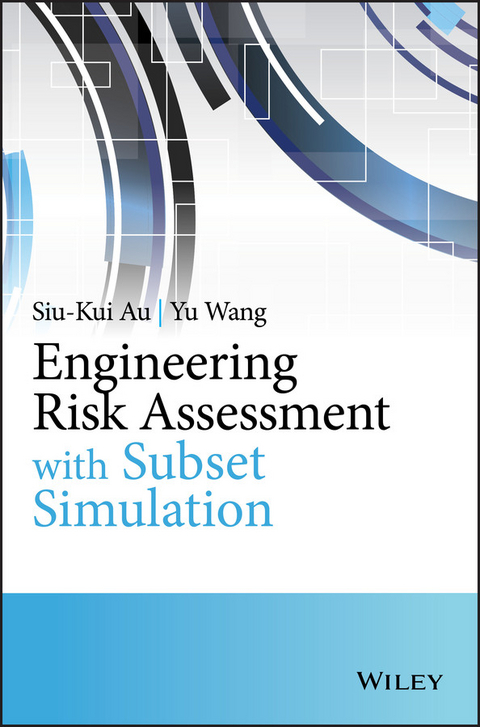
Engineering Risk Assessment with Subset Simulation (eBook)
John Wiley & Sons (Verlag)
978-1-118-39806-7 (ISBN)
This book starts with the basic ideas in uncertainty propagation using Monte Carlo methods and the generation of random variables and stochastic processes for some common distributions encountered in engineering applications. It then introduces a class of powerful simulation techniques called Markov Chain Monte Carlo method (MCMC), an important machinery behind Subset Simulation that allows one to generate samples for investigating rare scenarios in a probabilistically consistent manner. The theory of Subset Simulation is then presented, addressing related practical issues encountered in the actual implementation. The book also introduces the reader to probabilistic failure analysis and reliability-based sensitivity analysis, which are laid out in a context that can be efficiently tackled with Subset Simulation or Monte Carlo simulation in general. The book is supplemented with an Excel VBA code that provides a user-friendly tool for the reader to gain hands-on experience with Monte Carlo simulation.
- Presents a powerful simulation method called Subset Simulation for efficient engineering risk assessment and failure and sensitivity analysis
- Illustrates examples with MS Excel spreadsheets, allowing readers to gain hands-on experience with Monte Carlo simulation
- Covers theoretical fundamentals as well as advanced implementation issues
- A companion website is available to include the developments of the software ideas
Siu-Kui Au, University of Liverpool, UK
Yu Wang, City University of Hong Kong, China
This book starts with the basic ideas in uncertainty propagation using Monte Carlo methods and the generation of random variables and stochastic processes for some common distributions encountered in engineering applications. It then introduces a class of powerful simulation techniques called Markov Chain Monte Carlo method (MCMC), an important machinery behind Subset Simulation that allows one to generate samples for investigating rare scenarios in a probabilistically consistent manner. The theory of Subset Simulation is then presented, addressing related practical issues encountered in the actual implementation. The book also introduces the reader to probabilistic failure analysis and reliability-based sensitivity analysis, which are laid out in a context that can be efficiently tackled with Subset Simulation or Monte Carlo simulation in general. The book is supplemented with an Excel VBA code that provides a user-friendly tool for the reader to gain hands-on experience with Monte Carlo simulation. Presents a powerful simulation method called Subset Simulation for efficient engineering risk assessment and failure and sensitivity analysis Illustrates examples with MS Excel spreadsheets, allowing readers to gain hands-on experience with Monte Carlo simulation Covers theoretical fundamentals as well as advanced implementation issues A companion website is available to include the developments of the software ideas This book is essential reading for graduate students, researchers and engineers interested in applying Monte Carlo methods for risk assessment and reliability based design in various fields such as civil engineering, mechanical engineering, aerospace engineering, electrical engineering and nuclear engineering. Project managers, risk managers and financial engineers dealing with uncertainty effects may also find it useful.
Siu-Kui Au, University of Liverpool, UK Yu Wang, City University of Hong Kong, China
ENGINEERING RISK ASSESSMENT WITH SUBSET SIMULATION 3
Contents 9
About the Authors 15
Preface 17
Acknowledgements 19
Nomenclature 21
1 Introduction 23
1.1 Formulation 24
1.2 Context 27
1.3 Extreme Value Theory 27
1.4 Exclusion 28
1.5 Organization of this Book 29
1.6 Remarks on the Use of Risk Analysis 29
1.7 Conventions 30
References 30
2 A Line of Thought 31
2.1 Numerical Integration 32
2.2 Perturbation 32
2.3 Gaussian Approximation 34
2.3.1 Single Design Point 34
2.3.2 Multiple Design Points 36
2.4 First/Second-Order Reliability Method 36
2.4.1 Context 37
2.4.2 Design Point 38
2.4.3 FORM 39
2.4.4 SORM 40
2.4.5 Connection with Gaussian Approximation 44
2.5 Direct Monte Carlo 46
2.5.1 Unbiasedness 47
2.5.2 Mean-Square Convergence 47
2.5.3 Asymptotic Distribution (Central Limit Theorem) 50
2.5.4 Almost Sure Convergence (Strong Law of Large Numbers) 53
2.5.5 Failure Probability Estimation 54
2.5.6 CCDF Perspective 56
2.5.7 Rare Event Problems 60
2.5.8 Variance Reduction by Conditioning 63
2.6 Importance Sampling 66
2.6.1 Optimal Sampling Density 67
2.6.2 Failure Probability Estimation 67
2.6.3 Shifting Distribution 68
2.6.4 Benefits and Side-Effects 70
2.6.5 Bias 72
2.6.6 Curse of Dimension 75
2.6.7 CCDF Perspective 78
2.7 Subset Simulation 80
2.8 Remarks on Reliability Methods 82
2A.1 Appendix: Laplace Type Integrals 83
References 84
3 Simulation of Standard Random Variable and Process 87
3.1 Pseudo-Random Number 87
3.2 Inversion Principle 88
3.2.1 Continuous Random Variable 89
3.2.2 Discrete Random Variables 89
3.3 Mixing Principle 90
3.4 Rejection Principle 91
3.4.1 Acceptance Probability 93
3.5 Samples of Standard Distribution 94
3.6 Dependent Gaussian Variables 100
3.6.1 Cholesky Factorization 100
3.6.2 Eigenvector Factorization 103
3.7 Dependent Non-Gaussian Variables 105
3.7.1 Nataf Transformation 105
3.7.2 Copula 109
3.8 Correlation through Constraint 111
3.8.1 Uniform in Sphere 111
3.8.2 Gaussian on Hyper-plane 114
3.9 Stationary Gaussian Process 117
3.9.1 Autocorrelation Function and Power Spectral Density 117
3.9.2 Discrete-Time Process 121
3.9.3 Sample Autocorrelation Function and Periodogram 122
3.9.4 Time Domain Representation 123
3.9.5 The ARMA Process 125
3.9.6 Frequency Domain Representation 130
3.9.7 Remarks 137
3A.1 Appendix: Variance of Linear System Driven by White Noise 137
3A.2 Appendix: Verification of Spectral Formula 139
References 140
4 Markov Chain Monte Carlo 141
4.1 Problem Context 141
4.2 Metropolis Algorithm 144
4.2.1 Proposal PDF 145
4.2.2 Statistical Properties 145
4.2.3 Detailed Balance 150
4.2.4 Biased Rejection 154
4.2.5 Reversible Chain 156
4.3 Metropolis–Hastings Algorithm 156
4.3.1 Detailed Balance 157
4.3.2 Independent Proposal and Importance Sampling 157
4.4 Statistical Estimation 159
4.4.1 Properties of Estimator 159
4.4.2 Chain Correlation 161
4.4.3 Ergodicity 165
4.5 Generation of Conditional Samples 170
4.5.1 Curse of Dimension 171
4.5.2 Independent Component MCMC 174
References 177
5 Subset Simulation 179
5.1 Standard Algorithm 179
5.1.1 Simulation Level 0 (Direct Monte Carlo) 180
5.1.2 Simulation Level (MCMC) 181
5.2 Understanding the Algorithm 182
5.2.1 Direct Monte Carlo Indispensible 182
5.2.2 Rare Regime Explored by MCMC 183
5.2.3 Stationary Markov Chain from the Start 183
5.2.4 Multiple Chains 183
5.2.5 Seeds Discarded 184
5.2.6 CCDF Perspective 184
5.2.7 Repeated Samples 184
5.2.8 Uniform Conditional Probabilities 185
5.3 Error Assessment in a Single Run 188
5.3.1 Heuristic Argument 189
5.3.2 Efficiency Over Direct Monte Carlo 191
5.4 Implementation Issues 195
5.4.1 Proposal Distribution 195
5.4.2 Ergodicity 195
5.4.3 Generalizations 196
5.4.4 Level Probability 197
5.5 Analysis of Statistical Properties 201
5.5.1 Random Intervals 202
5.5.2 Random CCDF Values 203
5.5.3 Summary of Results 204
5.5.4 Expectation 205
5.5.5 Variance 207
5.6 Auxiliary Response 212
5.6.1 Statistical Properties 214
5.6.2 Design of Driving Response 216
5.7 Black Swan Events 217
5.7.1 Diagnosis 219
5.8 Applications 221
5.9 Variants 223
References 224
6 Analysis Using Conditional Failure Samples 227
6.1 Probabilistic Failure Analysis 228
6.2 Uncertain Parameter Sensitivity 229
6.3 Conditional Samples from Direct Monte Carlo 230
6.3.1 Conditional Expectation 230
6.3.2 Parameter Sensitivity 232
6.4 Conditional Samples from Subset Simulation 238
6.4.1 Sample Partitioning 239
6.4.2 Conditioning Structure 241
6.4.3 Conditional Expectation 242
6.4.4 Parameter Sensitivity 246
References 253
7 Spreadsheet Implementation 255
7.1 Microsoft Excel and VBA 255
7.1.1 Excel Spreadsheet 256
7.1.2 Illustrative Example – Polynomial Function 258
7.1.3 Visual Basic for Applications (VBA) 264
7.1.4 VBA User-Defined Functions 267
7.1.5 VBA Subroutines 269
7.1.6 Macro Recorder 273
7.2 Software Package UPSS 277
7.2.1 Installation in Excel 2003 277
7.2.2 Installation in Excel 2010 280
7.2.3 Software Context 282
7.2.4 Deterministic System Modeling 283
7.2.5 Uncertainty Modeling 284
7.2.6 Uncertainty Propagation 284
7.2.7 Pre-Processing Tools 287
7.2.8 Post-Processing Tools 290
7.3 Tutorial Example – Polynomial Function 291
7.3.1 Deterministic System Modeling 292
7.3.2 Uncertainty Modeling 292
7.3.3 Uncertainty Propagation 294
7.3.4 Direct Monte Carlo 296
7.3.5 Subset Simulation 297
7.4 Tutorial Example – Slope Stability 300
7.4.1 Problem Context 300
7.4.2 Deterministic System Modeling 301
7.4.3 Uncertainty Modeling 301
7.4.4 Histogram Tool 303
7.4.5 Uncertainty Propagation 304
7.4.6 CCDF of Driving Variable 308
7.4.7 Auxiliary Variable 308
7.5 Tutorial Example – Portal Frame 310
7.5.1 Problem Context 311
7.5.2 Deterministic System Modeling 312
7.5.3 Uncertainty Modeling 313
7.5.4 Uncertainty Propagation 316
7.5.5 Transforming Standard Normal Random Variables 317
7.5.6 Introducing Correlation 321
References 324
Appendix A: Mathematical Tools 325
A.1 Calculus 325
A.1.1 Lagrange Multiplier Method 325
A.1.2 Asymptotics 326
A.2 Linear Algebra 326
A.2.1 Linear Independence, Span, Basis 326
A.2.2 Orthogonality and Norm 327
A.2.3 Gram–Schmidt Procedure 328
A.2.4 Eigenvalue Problem 329
A.2.5 Real Symmetric Matrices 329
A.2.6 Function of Real Symmetric Matrices 330
A.3 Probability Theory 331
A.3.1 Conditional Expectation 331
A.3.2 Conditional Variance Formula 332
A.3.3 Chebyshevs Inequality 332
A.3.4 Jensens Inequality 332
A.3.5 Modes of Stochastic Convergence 333
Index 335
| Erscheint lt. Verlag | 20.3.2014 |
|---|---|
| Sprache | englisch |
| Themenwelt | Mathematik / Informatik ► Mathematik ► Angewandte Mathematik |
| Technik ► Elektrotechnik / Energietechnik | |
| Technik ► Maschinenbau | |
| Schlagworte | BASIC • Book • Carlo • Chain • Class • Computational / Numerical Methods • Electrical & Electronics Engineering • Elektrotechnik u. Elektronik • Engineering statistics • Generation • Ideas • important • investigating rare • Markov • Maschinenbau • MCMC • mechanical engineering • Methods • Monte • One • powerful simulation • probabilistically • propagation • Qualität u. Zuverlässigkeit • Qualität u. Zuverlässigkeit • Quality & Reliability • Random • Rechnergestützte / Numerische Verfahren im Maschinenbau • Rechnergestützte / Numerische Verfahren im Maschinenbau • Samples • Simulation • starts • Statistics • Statistik • Statistik in den Ingenieurwissenschaften • techniques • Uncertainty • Variables |
| ISBN-10 | 1-118-39806-8 / 1118398068 |
| ISBN-13 | 978-1-118-39806-7 / 9781118398067 |
| Informationen gemäß Produktsicherheitsverordnung (GPSR) | |
| Haben Sie eine Frage zum Produkt? |
 PDF (Adobe DRM)
Kopierschutz: Adobe-DRM
Adobe-DRM ist ein Kopierschutz, der das eBook vor Mißbrauch schützen soll. Dabei wird das eBook bereits beim Download auf Ihre persönliche Adobe-ID autorisiert. Lesen können Sie das eBook dann nur auf den Geräten, welche ebenfalls auf Ihre Adobe-ID registriert sind.
Details zum Adobe-DRM
Dateiformat: PDF (Portable Document Format)
Mit einem festen Seitenlayout eignet sich die PDF besonders für Fachbücher mit Spalten, Tabellen und Abbildungen. Eine PDF kann auf fast allen Geräten angezeigt werden, ist aber für kleine Displays (Smartphone, eReader) nur eingeschränkt geeignet.
Systemvoraussetzungen:
PC/Mac: Mit einem PC oder Mac können Sie dieses eBook lesen. Sie benötigen eine
eReader: Dieses eBook kann mit (fast) allen eBook-Readern gelesen werden. Mit dem amazon-Kindle ist es aber nicht kompatibel.
Smartphone/Tablet: Egal ob Apple oder Android, dieses eBook können Sie lesen. Sie benötigen eine
Geräteliste und zusätzliche Hinweise
Buying eBooks from abroad
For tax law reasons we can sell eBooks just within Germany and Switzerland. Regrettably we cannot fulfill eBook-orders from other countries.
aus dem Bereich